
Only 2 Days in Los Angeles? Here's Exactly What to Do | Perfect Itinerary
Only 2 Days in LA? Here's Exactly What to Do
The plane banks left over the Pacific, and suddenly there it is—Los Angeles sprawling beneath you like a circuit board made of light. Freeways curve through the basin in orange ribbons. The Hollywood Hills rise dark against the last glow of sunset. Somewhere down there, eight million stories are unfolding at once, and you have forty-eight hours to find yours.
I've done this math before. Two days in a city this vast feels almost absurd, like trying to drink the ocean through a straw. But here's what I've learned about LA: it rewards intention over ambition. You won't see everything. You shouldn't try. What you can do is choose a thread and follow it honestly, let the city reveal itself in the spaces between famous names.
The taxi from LAX takes the surface streets—my preference, always—and the first thing that strikes me is the light. Even at dusk, even through car windows, Los Angeles light has a quality that explains everything about why people came here to make movies. It's golden and diffuse, forgiving in the way that only certain latitudes can offer. By the time we pass a taqueria glowing neon green, a man walking three identical poodles, a palm tree so tall it seems to bend toward the moon, I remember why this city keeps pulling people back.
Day One: The Morning Nobody Tells You About
Forget the Hollywood sign at dawn. Forget the influencer sunrise spots. The best way to start your first morning in LA is at a farmers market, and I don't mean the Grove.
The Santa Monica Farmers Market on Wednesday and Saturday mornings operates with a seriousness that surprises first-time visitors. This is where actual chefs shop—I watch a woman in kitchen whites examine strawberries with the intensity of a jeweler appraising diamonds. The California growing season produces things that don't exist elsewhere: white peaches so fragrant you smell them from three stalls away, avocados with skin like dark green velvet, tomatoes in colors I didn't know tomatoes came in.
I buy a cardboard tray of something called pluots—a plum-apricot hybrid that tastes like summer distilled into fruit—and eat them on a bench, watching the morning unfold. An older man sets up a keyboard near the flower stalls and begins playing jazz standards to no one in particular. A child runs past clutching a sunflower almost as tall as she is. This is LA before it becomes LA, before the traffic and the industry and the performance of it all kicks in.
From Santa Monica, I walk toward the ocean. The beach at nine in the morning belongs to a different city entirely—joggers, surfers checking conditions, a few tourists already claiming territory with umbrellas. The pier stretches out over water that shifts between gray and green depending on the clouds. I don't ride the ferris wheel or play the arcade games. I just stand at the end, where fishermen cast lines into the Pacific, and let the salt wind rewrite whatever stress I carried here.
The Art of the Mid-Day Transition
Los Angeles requires driving. I know the discourse—the traffic, the sprawl, the environmental implications. All true. But there's also something about driving here that becomes its own meditation, particularly if you embrace it rather than fight it. The city reveals itself through windshields: murals blooming across warehouse walls in the Arts District, mountains appearing suddenly at the end of ordinary streets, neighborhoods shifting from Korean to Ethiopian to Armenian within a few blocks.
I take Venice Boulevard east toward the Los Angeles County Museum of Art, which locals call LACMA with a familiarity that makes it sound like a friend's name. The Urban Light installation—those 202 restored street lamps standing in perfect rows—has become almost too famous, almost too photographed. But I'll tell you something: when you stand among them in person, when the afternoon light filters through and you realize each lamp came from a different decade of LA history, the cliché dissolves. These were actual streetlights that once illuminated actual corners where actual lives happened. Now they stand together like witnesses to a century of nights.
Inside the museum, I skip the blockbuster exhibitions and find myself instead in the Japanese Pavilion, where the light falls through rice paper screens onto Buddhist sculptures from the Kamakura period. A security guard notices me staring at a wooden Amida Buddha for too long and tells me, quietly, that if I come back at four o'clock, the afternoon sun hits the sculpture in a way that makes the gold leaf glow. I file this away. These are the details that make a place yours.
Dinner as Geography Lesson
The evening presents a choice that defines your trip: where do you eat? In Los Angeles, this question carries weight. The city's food scene isn't a scene at all—it's a geography of diaspora, a map of everywhere people came from and what they brought with them.
I drive to Thai Town, a stretch of Hollywood Boulevard that announces itself in purple street signs and storefronts where English takes a back seat. At Jitlada, a restaurant that looks like someone's chaotic living room decorated with Christmas lights year-round, I order the southern Thai tasting menu without fully understanding what I've agreed to. The food arrives in waves—curries stained orange with turmeric, morning glory flash-fried with garlic, a soup so spicy my lips feel sunburned afterward.
The couple at the next table are clearly locals, clearly regulars. They order by pointing at dishes on other tables. The grandmother running the cash register remembers their names. I realize this is what I came for—not the famous, not the photographed, but the genuinely delicious and the genuinely lived-in.
Day Two: The Part Where You Go Higher
The second day begins with elevation. Griffith Observatory sits on a hill that offers something rare: context. From the parking lot alone, you can see downtown's glass towers, the Hollywood sign's white letters against dried chaparral, the Pacific glinting in the distance, and on clear days, the San Gabriel Mountains still wearing snow in April.
Inside, the observatory operates on a beautiful principle: astronomy should be free. The planetarium shows cost almost nothing. The exhibits explain the universe without condescension. I watch a family help their daughter find Saturn through a telescope, and her gasp when she sees the rings makes everyone nearby smile.
But the real reason to come is the trails. Fern Dell winds up through genuine wilderness—coastal sage scrub, live oaks, the occasional coyote trotting across the path like he has somewhere to be. The trail to the Hollywood sign takes longer than tourists expect and rewards anyone who attempts it with burning quadriceps and genuine accomplishment. I take the shorter loop to the observatory's backside, where a bench faces away from the city toward the hills, and I sit there long enough to watch a hawk make three complete circles overhead.
The Neighborhood You Almost Skipped
Everyone tells first-time visitors to see Hollywood Boulevard. I'm going to tell you something else: walk through it quickly, acknowledge its strange mix of glamour and grime, then get out and drive to Los Feliz.
This neighborhood sits in Griffith Park's shadow and operates at a frequency that feels almost European—walkable blocks, independent bookshops, coffee shops where people actually sit with actual newspapers. At Skylight Books, I spend an hour in the travel section, pulling volumes from shelves, reading first paragraphs, putting them back. The staff recommendations actually reflect taste rather than algorithm.
Around the corner, a vintage shop sells furniture from the midcentury period when Los Angeles genuinely believed in the future. I don't buy the $400 lamp shaped like a satellite, but I photograph it. Three doors down, a bakery sells kouign-amann that rivals anything I've had in Paris—an absurd claim I stand behind completely.
This is LA's secret weapon: neighborhoods that feel like small towns tucked inside the urban expanse. Silver Lake bleeds into Echo Park bleeds into Highland Park, each with its own character, its own coffee loyalty, its own arguments about the best tacos.
The Golden Hour Agreement
Los Angeles and photographers have an understanding. Between 5 PM and sunset, the light turns the city into a film set. Everything glows. The buildings downtown become golden towers. The hills turn the color of honey. Even traffic, that eternal antagonist, looks beautiful when the sun hits windshields at the right angle.
I end up at the Getty Center, which requires a tram ride up a hill and rewards you with travertine plazas and gardens designed by Robert Irwin that are artworks in themselves. The museum closes at 5:30, but the grounds stay open for sunset. I find a spot near the cactus garden where I can see the ocean and the mountains simultaneously, and I stay until the sky cycles through pink and purple and finally the deep blue that signals day's end.
A woman next to me is video-calling someone, pointing her phone at the view. "Can you see this?" she keeps asking. "Can you see it?" Her friend says something I can't hear, but the woman shakes her head. "No," she says, "you really have to be here."
Before You Go
Two days works best when you accept Los Angeles for what it is: too big for complete understanding, too varied for simple summary. Visit between September and November for warm days without summer crowds, or February through April for green hills and occasional rain that makes locals act like the sky is falling.
The traffic warnings are real—leave earlier than you think, embrace podcasts as a travel companion, and never, ever try to drive through West Hollywood at 6 PM on a Friday. The neighborhoods I've mentioned reward walking, but you'll need wheels to move between them.
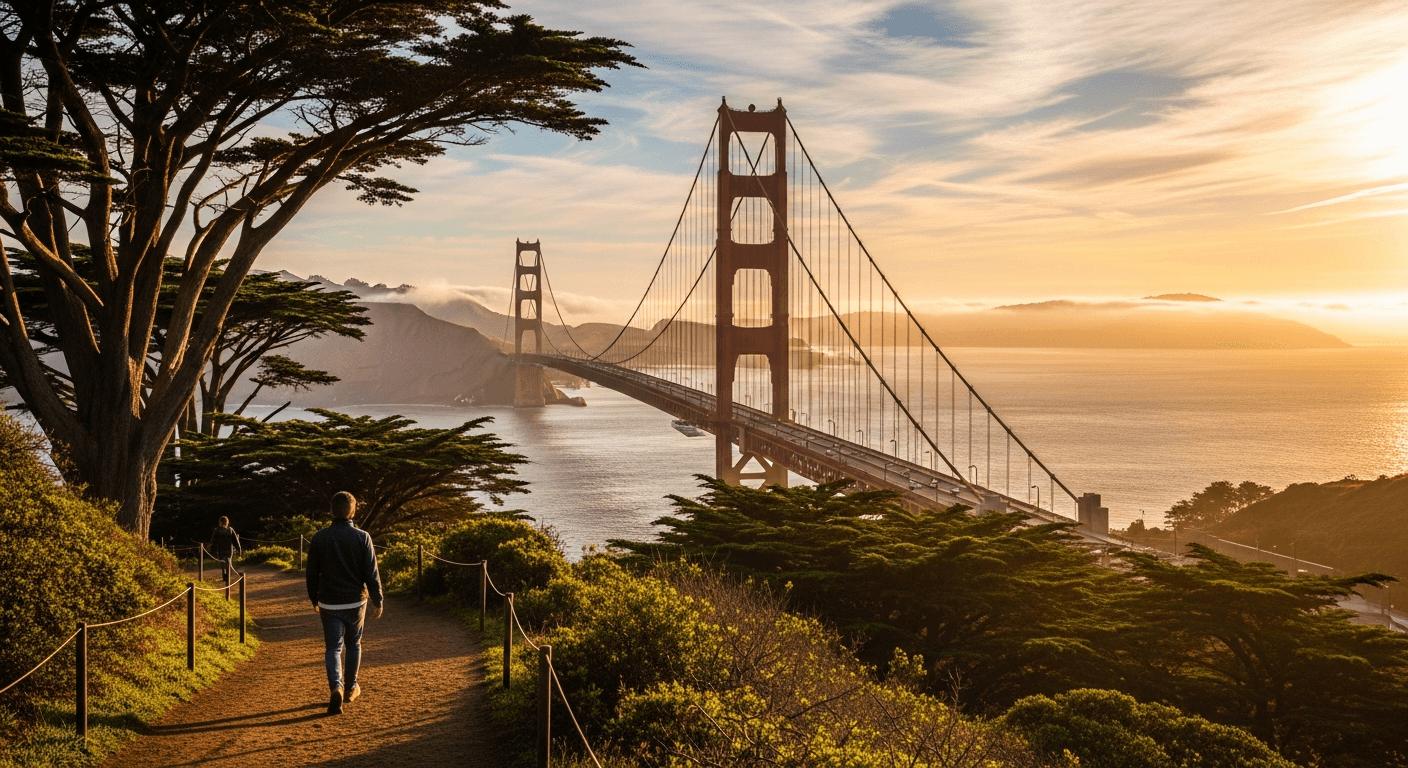
If you have a third day, consider San Francisco—the flight takes barely an hour, and the contrast between these two California cities illuminates both. Where LA sprawls and shimmers, San Francisco climbs and whispers. Where LA performs, San Francisco pontificates. Together, they explain something about the American West that neither can express alone.
Finding Your Own Thread
That first morning at the farmers market, I overheard a conversation between a vendor and a customer who'd clearly been coming for years. They talked about someone's daughter's wedding, about the quality of this year's stone fruit, about nothing particularly important. But watching them, I understood something about Los Angeles that tourism rarely captures: beneath the industry, beneath the image-making, this is a city where people actually live. They buy groceries. They walk their dogs. They fall in love with particular coffee shops and defend them irrationally.
Two days won't give you Los Angeles. But two days, chosen well, can give you a beginning. A handhold. A reason to come back.
On Touratu's interactive maps, I've traced the route I've described here—market to beach to museum to meal to mountain. But the beauty of this platform lies in following other travelers' threads too, watching their video routes unfold through neighborhoods I haven't found yet, discovering the Los Angeles that remains perpetually out of frame.
My flight leaves at eleven. The taxi takes the freeway this time, and the city unfolds in the morning light like a promise or a question. The Hollywood sign catches the sun. The towers of downtown reflect clouds. And already, I'm planning what I'll do differently next time—which neighborhoods I'll wander, which restaurants I'll try, which version of this impossible city I'll discover.
Two days isn't enough. That's exactly why it's enough to start.
Loading activities…
