
20 Places in Uttar Pradesh Travelers Keep Returning To - Have You Been to All of Them?
20 Places in Uttar Pradesh Travelers Keep Returning To — Have You Been to All of Them?
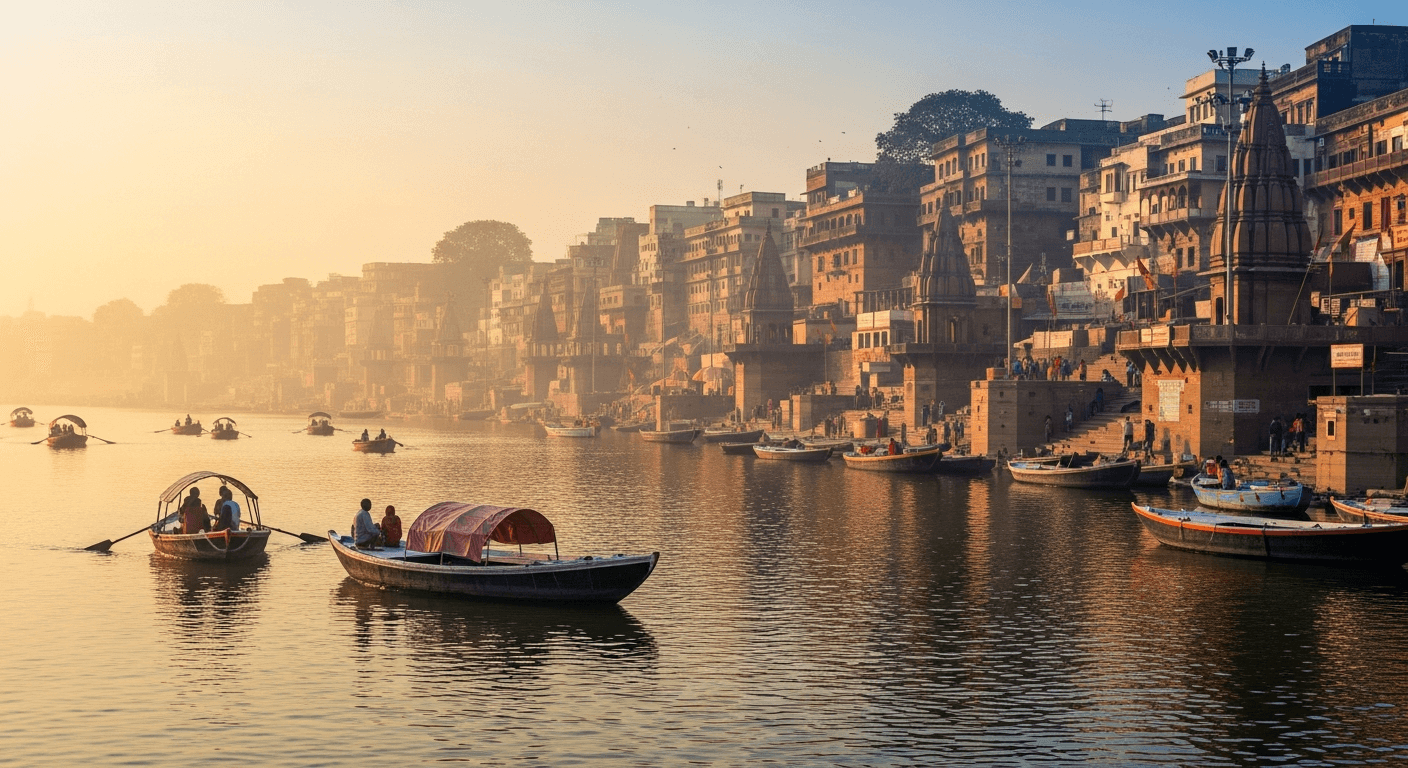
There's a particular quality of light in Uttar Pradesh that stays with you. It's the amber glow filtering through mosque archways at dawn, the way dust motes dance in temple corridors, the golden hour that transforms the Ganges into liquid copper. This is India's spiritual and historical heartland — a state so dense with significance that every corner holds a thousand years of stories waiting to unfold.
Uttar Pradesh doesn't whisper. It announces itself in the call to prayer echoing across Lucknow, in the temple bells cascading down Varanasi's ghats, in the silence that falls when you first glimpse the Taj Mahal. Yet beneath its grandeur lies something more subtle: chai stalls where conversations span generations, narrow lanes where Mughal emperors once walked, riverbanks where pilgrims have sought salvation for millennia.
What keeps travelers returning isn't just the monuments — it's the layers. The way a single city can hold Buddhist enlightenment and Hindu devotion, Mughal sophistication and British colonial ambition, all within walking distance. This list isn't about ticking boxes. It's about understanding why certain places become permanent residents in a traveler's memory.
1. Taj Mahal, Agra
The world's most photographed monument still manages to exceed expectations. That first glimpse through the Great Gate — the way Shah Jahan's tribute to eternal love seems to float rather than stand — remains one of travel's most reliable emotional punches.
What photographs can't capture is the marble's temperature beneath your feet at sunrise, cool and somehow alive. They can't convey how the mausoleum shifts from pale pink at dawn to brilliant white at noon to warm amber at sunset, as if the building itself is breathing through the day.
The pietra dura inlay work rewards patience. Look closely at the floral patterns: carnelians from Baghdad, lapis lazuli from Sri Lanka, turquoise from Tibet — forty-three types of precious stones assembled by craftsmen who understood that love demands extravagance.
Best Time To Visit: Enter at gate opening (sunrise) or arrive two hours before sunset for the golden hour transition. Friday closures mean Thursday and Saturday mornings are crushingly busy.
Insider Observation: The mosque to the left of the main mausoleum offers a less crowded perspective and a moment to absorb the scale without jostling elbows. Most visitors rush past it entirely.
Photography Moment: The reflection pool's still surface creates perfect symmetry only in the early morning before crowds disturb the water with their movement. Position yourself at the far end, frame the minarets, and wait for absolute stillness.
2. Varanasi Ghats
Varanasi doesn't ask permission to transform you. India's oldest continuously inhabited city operates on its own logic — one where death is celebrated, cremation is public theatre, and the boundary between sacred and mundane simply doesn't exist.
The 88 ghats lining the Ganges each carry distinct personalities. Dashashwamedh roars with evening aarti ceremony — fire, bells, incense, and thousands of flickering diyas creating a sensory crescendo that leaves even skeptics momentarily breathless. Manikarnika, the primary cremation ghat, offers something more confronting: the smoke of funeral pyres that burn around the clock, ash-covered Dom community workers, and families finding closure in flame.
Dawn boat rides reveal Varanasi at its most intimate. Pilgrims performing surya namaskar as the sun breaks the horizon, sadhus applying ash and vermillion, women in soaked saris emerging from their morning ablutions — all unfolding in golden light that makes photography feel inadequate.
Best Time To Visit: October to March for bearable temperatures. The ghats never sleep, but 5:30 AM boat rides and 7 PM aarti ceremonies are essential experiences.
Insider Observation: Walk the ghats south to north in the afternoon, against the flow of crowds. The narrowing lanes between Assi and Manikarnika contain chai stalls and music shops that feel untouched by tourism.
Photography Moment: Hire a boat at Assi Ghat and drift northward at sunrise. The golden light hitting the centuries-old buildings creates one of photography's most reliable compositions — but it's the human activity that makes each shot unique.
3. Lucknow's Bara Imambara
The Nawabs of Awadh built monuments that whisper of sophisticated excess. Bara Imambara, commissioned by Nawab Asaf-ud-Daula during the 1784 famine as a massive employment project, remains their greatest architectural statement — and a labyrinth that rewards the curious.
The central hall spans 50 meters without a single pillar, beam, or external support. It's not just impressive engineering; it's the silence that accumulates in such vast space, the way your footsteps echo off walls built to house mourning ceremonies for Imam Hussein.
The Bhool Bhulaiya maze above is Lucknow's great tourist trap — and genuinely worth falling for. The 489 identical doorways were designed to disorient invaders, and they still succeed magnificently. Take a guide unless you genuinely enjoy being lost.
Best Time To Visit: Early morning, before 9 AM, when the complex is quiet enough to appreciate its acoustic peculiarities. The maze becomes chaotic after 11 AM.
Insider Observation: The adjacent Asafi Mosque is often overlooked but architecturally superior. Non-Muslims can view from outside, and the proportions are exceptionally graceful.
Photography Moment: The view from the upper galleries toward Rumi Darwaza captures Lucknow's Nawabi heritage in a single frame — minarets, domes, and the impossibly ornate gate that served as the city's symbol.
4. Sarnath
Eight kilometers from Varanasi's chaos lies the place where Siddhartha Gautama delivered his first sermon after enlightenment. Sarnath's importance to Buddhism is immeasurable — this is where the wheel of dharma was set in motion, where a philosophy that would reshape Asian civilization took its first public breath.
The Dhamek Stupa dominates the manicured park, its 43-meter height and intricate geometric carvings marking the exact spot of Buddha's first teaching. Monks from Sri Lanka, Thailand, Tibet, and Japan circle the structure in clockwise meditation, their robes creating splashes of saffron and maroon against ancient stone.
The archaeological museum holds India's national emblem — the Ashoka Lion Capital, four lions sitting back-to-back atop an abacus decorated with the wheel of law. Seeing the original after passing it on every government document and rupee coin carries unexpected weight.
Best Time To Visit: October through March, ideally at dawn when the park is empty and meditation feels natural rather than performative.
Insider Observation: The Thai, Tibetan, Chinese, and Japanese temples surrounding the main site represent their respective Buddhist traditions with striking architectural contrast. Few tourists visit, and the monks are often happy to talk.
Photography Moment: Late afternoon light hits the Dhamek Stupa from behind, creating a warm glow around the ancient brickwork while throwing the carved geometric patterns into sharp relief.
5. Fatehpur Sikri
Akbar the Great built his dream city on a ridge outside Agra, and thirty years later, abandoned it entirely. Water scarcity forced the departure, but what remains is a perfectly preserved Mughal capital — a ghost city of red sandstone that historians call one of medieval India's greatest urban achievements.
The Buland Darwaza, the "Gate of Magnificence," rises 54 meters and dominates the approach. Climbing its steep steps, you pass inscriptions praising Allah alongside a distinctly irreverent Akbar quote: "The world is a bridge; pass over it, but build no houses upon it." The emperor's spiritual curiosity — he created his own syncretic religion — is written into every architectural choice.
Within the palace complex, look for Panch Mahal, the five-story wind tower where the harem could catch evening breezes while remaining invisible from below. And find the Diwan-i-Khas, where Akbar held court from a central pillar connected to four corners by walkways — a physical manifestation of a ruler who saw himself at the intersection of all faiths and philosophies.
Best Time To Visit: Early morning or late afternoon to avoid midday heat reflecting off the sandstone. Fridays draw large Muslim crowds to the mosque, which can be beautiful or overwhelming depending on your disposition.
Insider Observation: The village below the ridge is genuinely overlooked — stone carvers continue traditions predating the Mughals, and the chai is excellent.
Photography Moment: The view from Buland Darwaza's top step looking back over the courtyard and out to the plains captures the ambition Akbar carried into everything he built.
6. Allahabad (Prayagraj) Sangam
The confluence of the Ganges, Yamuna, and the mythical Saraswati River holds cosmic significance in Hindu cosmology. This is where the world's largest religious gathering — the Kumbh Mela — occurs every twelve years, when tens of millions of pilgrims converge for a single holy dip.
Outside Kumbh years, the Sangam maintains a different energy: quieter, more contemplative. Boats ferry pilgrims to the exact confluence point, where they bathe where three rivers become one. The water shifts from the Ganges' grey-green to the Yamuna's blue, and somewhere beneath, believers insist, flows the invisible Saraswati.
The surrounding ghats lack Varanasi's density but offer their own pleasures. Priests perform rituals on the banks, families scatter ashes, and the late afternoon light transforms the water into shifting gold.
Best Time To Visit: During Magh Mela (January–February) for spiritual intensity without Kumbh's impossible crowds. Morning visits before 9 AM offer peaceful boat rides.
Insider Observation: Allahabad Fort, on the riverbank, contains an ancient Akshayavat tree (believed to be the undying banyan mentioned in Hindu scriptures) and a surprisingly moving small temple. Military restrictions mean only portions are accessible.
Photography Moment: Sunset boat rides capture the confluence with the fort silhouetted behind — but the human element (pilgrims bathing, priests performing rituals) elevates the composition.
7. Mathura and Vrindavan
The birthplace of Lord Krishna and the forests where he spent his youth lie along the Yamuna, just 60 kilometers from Agra. For devotees, this is one of the most sacred pilgrimages in Hinduism. For travelers, it's an immersion in living faith that operates at remarkable intensity.
Vrindavan holds over 5,000 temples, from ISKCON's towering modernist complex to tiny neighborhood shrines where priests have served for generations. The Banke Bihari Temple draws crowds that border on frightening — but the experience of being swept along in a sea of devotees, all straining for a glimpse of the deity, is genuinely unforgettable.
During Holi, this region becomes the center of the world's most chaotic festival. Colors fly, strangers embrace, and the boundary between celebration and spiritual ecstasy dissolves entirely. It's not for everyone, but those who experience it rarely forget.
Best Time To Visit: March for Holi (arrive several days early to see the building celebrations). Otherwise, October through February offers comfortable temperatures and active temple life.
Insider Observation: The Rangaji Temple blends South Indian Dravidian architecture with North Indian religious practice — a fascinating hybrid that most tourists miss entirely. Its gopuram (tower) is stunning.
Photography Moment: Evening aarti at Keshi Ghat in Vrindavan is intimate and photogenic — floating diyas on the Yamuna, devotional songs, and far fewer crowds than Varanasi.
8. Kushinagar
Where Buddha chose to die carries a melancholy that Sarnath and Bodh Gaya lack. Kushinagar, the site of the Mahaparinirvana (Buddha's final passing), feels quieter, more reflective — a place for pilgrims who've already visited the celebratory sites and are ready for something more contemplative.
The Mahaparinirvana Temple houses a 6-meter reclining Buddha statue, carved from a single block of red sandstone, depicting the moment of passing. The statue's expression — serene, almost smiling — has comforted pilgrims for over 1,500 years.
The surrounding stupa and monastery ruins date to the 5th century CE, when Chinese pilgrims Fa-Hien and Xuanzang visited and left detailed accounts. Walking the same paths they documented creates a connection across fifteen centuries of Buddhist pilgrimage.
Best Time To Visit: November to February for pleasant weather. The site is rarely crowded, but early morning meditation before 8 AM offers near-solitude.
Insider Observation: The Japanese, Thai, and Chinese temples built by their respective Buddhist communities near the main site offer fascinating architectural contrasts — and monks happy to share tea and conversation.
Photography Moment: The reclining Buddha through the temple doorway, framed by the threshold and lit by the day's first light, creates a contemplative composition that rewards patience.
9. Agra Fort
The Taj Mahal casts such a long shadow that Agra Fort often receives rushed visits. This is a mistake. The red sandstone fortress that served as the primary Mughal residence for generations contains architectural evolution, political drama, and a tragic postscript that deepens the Taj experience enormously.
Shah Jahan spent his final years imprisoned here by his son Aurangzeb, gazing at his wife's mausoleum from a small marble balcony. Finding that balcony — the octagonal Musamman Burj with its pietra dura inlay — and looking toward the distant white dome transforms the Taj from architectural wonder to devastating love story.
The fort's interiors shift from Akbar's masculine sandstone strength to Shah Jahan's delicate white marble refinement. This evolution across three generations of Mughal emperors is visible in every courtyard, every audience hall, every private chamber.
Best Time To Visit: Late afternoon, when tour groups depart and golden light illuminates the red sandstone. The Taj view from Shah Jahan's prison chamber is best at this hour.
Insider Observation: Most visitors skip the Sheesh Mahal (mirror palace) in the harem section. If you can convince a guard to illuminate it with flashlights, the effect of thousands of mirrors reflecting light is genuinely magical.
Photography Moment: The Khas Mahal pavilions frame the Yamuna and distant Taj perfectly — a composition that captures both architectural achievement and the romantic tragedy of an imprisoned emperor.
10. Chitrakoot
Where gods walked and saints meditated, Chitrakoot occupies the Vindhya Range border between Uttar Pradesh and Madhya Pradesh. This is where Rama, Sita, and Lakshmana spent eleven years of their exile — and where the sage Atri and his wife Anasuya performed austerities so powerful they're still commemorated.
The pilgrimage here feels different from Varanasi or Mathura — slower, older, more connected to forest and river than temple and ceremony. The Mandakini River, with its gentle ghats and evening aarti, offers spiritual practice without overwhelming crowds.
Kamadgiri, the sacred hill that pilgrims circumambulate (a 5-kilometer parikrama), is believed to contain Rama himself. The path passes shrines, sadhus, and remarkably intact forest — a walking meditation that predates organized Hinduism.
Best Time To Visit: October to March for comfortable walking weather. The parikrama is best begun at dawn, completed before the midday heat.
Insider Observation: Gupt Godavari, a cave containing two streams (one accessible, one hidden), is both geologically fascinating and spiritually significant. The boat ride into the cave's darkness is genuinely atmospheric.
Photography Moment: Sunset over the Mandakini from Ram Ghat creates the classic Chitrakoot image — pilgrims performing evening rituals, temple bells, and that extraordinary light that makes every North Indian river photograph sing.
11. Jhansi Fort
The fortress where Rani Lakshmibai made her last stand against the British holds complicated resonance — military history, colonial rebellion, and a woman warrior who became a symbol of Indian resistance. The massive granite walls, rebuilt by every dynasty from the Chandelas to the Marathas, now house a museum and some of India's most dramatic historical views.
Standing on the ramparts, looking out over the city that the Rani defended and ultimately fled, the 1857 uprising becomes viscerally real. British cannonballs still embedded in the walls, the spot where the queen reportedly jumped with her adopted son strapped to her back — these aren't sanitized monuments but active wounds in the landscape.
The sound and light show is admittedly cheesy, but the fort at dusk, when day visitors have departed and the light goes purple over the Bundela plains, offers something more honest.
Best Time To Visit: Early morning or late afternoon for pleasant temperatures and better light. Avoid midday entirely from April through September.
Insider Observation: The Jhansi Government Museum, near the fort, contains an excellent collection of Bundela-period sculptures that most visitors skip. The 9th–12th century pieces rival anything in Delhi's National Museum.
Photography Moment: The fort's southern walls at golden hour, with the city spreading below, capture Jhansi's layered history — Chandela foundations, Maratha additions, British artillery damage, and contemporary life continuing beneath.
12. Dudhwa National Park
Uttar Pradesh's only national park exists in a landscape most visitors to the state never imagine: sal forests, swamplands, and grasslands along the Nepal border that harbor tigers, rhinos, and some of India's most important wetland ecosystems.
Dudhwa's tiger population is smaller than Ranthambore's or Corbett's, but the park's remoteness means encounters feel less performative. The rhinoceros population, introduced from Assam in the 1980s, has established successfully — seeing these prehistoric-looking creatures in North Indian grassland rather than Kaziranga's famous terrain adds unexpected novelty.
The birdlife is exceptional. Swamp francolin, Bengal florican, and the critically endangered Bengal bustard all occur here, making Dudhwa a serious birding destination that happens to also have megafauna.
Best Time To Visit: November through May (the park closes during monsoon). February and March offer the best tiger and rhino sightings as vegetation thins.
Insider Observation: The Forest Rest Houses inside the park offer basic but atmospheric accommodation — falling asleep to distant alarm calls beats any hotel experience.
Photography Moment: The grasslands at dawn, with mist rising and deer moving through, create safari images distinct from any other Indian park. The light here is unusually soft.
13. Ayodhya
The birthplace of Lord Rama has always been significant; the completion of the Ram Mandir in 2024 has transformed it into one of Hinduism's most important active pilgrimage destinations. Visiting now means witnessing religious history in real-time — the construction of a faith center that will draw millions for centuries to come.
The temple complex's scale is staggering: three floors, 392 pillars, and a statue of Ram Lalla (infant Rama) that draws devotees into spontaneous tears. Whether or not you share the faith, the emotional intensity of believers finally seeing their temple realized after decades of controversy is genuinely moving.
Beyond the main temple, Ayodhya's ghats along the Saryu River offer quieter spiritual experience. The evening aarti here, while less famous than Varanasi's, carries its own devotional power.
Best Time To Visit: October to March for weather; expect massive crowds on religious holidays. Weekday mornings offer the best chance of actually seeing the temple without hours of queuing.
Insider Observation: The Hanuman Garhi temple, predating the current controversies by centuries, sits on a hill overlooking the city and offers excellent views. The 76 steps are a pilgrimage in themselves.
Photography Moment: The Ram Mandir at golden hour, when the pink sandstone glows amber, is currently one of India's most sought-after images. Early morning or late afternoon are the only times photography works without crushing crowds.
14. Shravasti
Where Buddha spent 24 monsoon seasons, more than anywhere else, Shravasti holds a significance in Buddhism that casual visitors often underestimate. This was the Buddha's primary residence during his teaching years — the place where he performed miracles, delivered discourses, and established the patterns of monastic life still followed today.
The ruins of Jetavana Monastery, purchased for the Buddha by the wealthy merchant Anathapindika (who legendarily covered the land with gold coins to meet the seller's price), contain some of the best-preserved Buddhist foundations in India. Walking the same paths that Buddha walked for a quarter of his teaching career creates an intimacy that other Buddhist sites can't match.
The twin miracle tree site, where Buddha reportedly manifested multiple images of himself to confound rival teachers, draws particular veneration from Sri Lankan and Thai pilgrims. The tree itself is a descendant planting, but the devotion is authentic.
Best Time To Visit: October to March for comfortable weather. The site is rarely crowded; early morning offers near-solitude for meditation.
Insider Observation: The South Korean temple complex near the ruins is architecturally impressive and extremely peaceful — monks often invite visitors for tea.
Photography Moment: The ancient bodhi tree at Jetavana, with monks meditating beneath, creates compositions that could have been captured any time in the last 2,500 years.
15. Chunar Fort
Perched on a rocky outcrop above the Ganges, Chunar Fort's location mattered to everyone who sought to control North India — from ancient Hindu kings through Afghan warlords, Mughals, and finally the British. The result is an architectural palimpsest that rewards careful exploration.
The views alone justify the visit. The Ganges curves below, Varanasi lies upstream, and on clear days the Vindhya Range is visible to the south. Strategic value becomes immediately apparent: whoever held this rock controlled river traffic through the heartland.
The fort's current incarnation includes Mughal tombs, British-era prison cells, and a functioning Hindu temple — all within walls that incorporate stonework from at least five different centuries.
Best Time To Visit: October to February for pleasant weather. Late afternoon light makes the sandstone glow and improves the river photography.
Insider Observation: The tomb of Shah Qasim Suleimani, a medieval saint, draws local devotion that predates any tourist interest. The qawwali performances on his anniversary (dates vary) are exceptional.
Photography Moment: The Ganges from the fort's highest point, with boats moving along the river and sunset light coloring the water, captures strategic India in a single frame.
16. Meerut
India's first war of independence began here in May 1857, when sepoys refused to use cartridges rumored to be greased with cow and pig fat. The events that followed — mutiny, massacre, and the eventual collapse of Mughal rule — are written into Meerut's landscape for those who know where to look.
The Augarnath Temple, where the first shots were fired, maintains the original well where executed sepoys were thrown. The Shaheed Smarak (Martyrs' Memorial) commemorates the uprising's fallen with a dignity that colonial-era sites rarely receive.
Beyond history, Meerut's production of sports equipment (it supplies much of India's cricket gear) and its musical instrument workshops offer glimpses of living industries rarely included in tourist itineraries.
Best Time To Visit: October to March for pleasant weather. Avoid the intense summer heat entirely.
Insider Observation: The musical instrument workshops in the old city produce harmoniums and tablas for musicians across India. Watching craftsmen tune and test their work is a rare privilege.
Photography Moment: The Shaheed Smarak at sunset, when the memorial's clean lines catch the dying light, creates a contemplative frame for India's independence struggle.
17. Deogarh
The Dashavatara Temple here represents the finest surviving example of Gupta architecture — the 6th-century "golden age" style that influenced every subsequent Hindu temple tradition. For architecture enthusiasts, this is a pilgrimage site.
The temple's carved panels depict Vishnu's various incarnations with a fluidity and emotion that later periods rarely matched. The famous Gajendra Moksha panel — showing Vishnu rescuing an elephant from a crocodile — is considered among the greatest masterpieces of Indian sculpture.
Deogarh lies in the Bundelkhand region's dramatic landscape: rocky outcrops, deep ravines, and the sort of isolated beauty that makes certain places feel timeless.
Best Time To Visit: October to March, ideally in the late afternoon when the light brings out the carved panels' details.
Insider Observation: The temple is rarely visited; you may have it entirely to yourself. The local ASI caretaker offers informal guided tours of the sculptural program that rival any professional guide's knowledge.
Photography Moment: The Gajendra Moksha panel in raking afternoon light — the shadows reveal carving details invisible at other times.
18. Jaunpur
The "Shiraz of India" (named by Persian-influenced Sharqi sultans who ruled here in the 15th century) holds some of North India's most distinctive mosque architecture. The Sharqi style — characterized by massive propylons (entrance gates) that tower over the prayer halls — exists almost nowhere else.
The Atala Mosque, built over a demolished Hindu temple, incorporates carved temple elements into its Islamic structure in ways that feel surprisingly harmonious. The scale is impressive; the architectural fusion is fascinating.
The Jaunpur Bridge, built by Mughal governor Munim Khan in the 16th century, still carries traffic across the Gomti River — a functioning piece of medieval infrastructure that makes Mughal engineering tangibly real.
Best Time To Visit: October to February for pleasant weather. Friday mosque prayers are authentic but crowded; other days offer quieter exploration.
Insider Observation: The Sharqi tombs outside the city center are rarely visited but architecturally significant — the Sharqi rulers' graves carry the same distinctive propylon style as their mosques.
Photography Moment: The Atala Mosque's propylon at midday, when the light is directly overhead and shadows define the geometric patterns, demonstrates why this architectural style is called "emphatic."
19. Ballia
At Uttar Pradesh's eastern edge, where the state meets Bihar, Ballia's connection to the independence movement runs deep. The region briefly established independent rule during the 1942 Quit India movement — one of the few places where British authority was genuinely overthrown, if only temporarily.
The Bhrigu Temple, associated with the Vedic sage who legendarily cursed Lord Vishnu to take human birth repeatedly, draws devoted pilgrims and offers riverside spirituality without tourist infrastructure.
Ballia's real appeal is its remoteness: this is Uttar Pradesh without pretense, where travelers are rare and local life continues unchanged.
Best Time To Visit: October to February. The monsoon floods much of the region; avoid July through September.
Insider Observation: The local specialty, sattu paratha (stuffed with roasted gram flour), is exceptionally good here. Street stalls near the main market serve it fresh.
Photography Moment: The Ganges at Ballia is broad and slow; fishermen casting nets at dawn create compositions that feel unchanged across centuries.
20. Vindhyachal
The Vindhyavasini Devi temple attracts millions of Shakti devotees annually — this is one of the 51 Shakti Peethas, the sites where Sati's body parts fell after her self-immolation. The goddess here is fierce, and the worship reflects it: animal sacrifice (now largely symbolic), intense devotion, and a crowd energy that can feel overwhelming.
During Navratri, the temple becomes one of India's most concentrated devotional experiences. The nine nights of the goddess draw pilgrims whose faith is viscerally apparent — this isn't spiritual tourism but genuine religious intensity.
The surrounding Vindhya Range offers trekking and nature that most Uttar Pradesh itineraries miss entirely. The contrast between temple chaos and forest silence creates a memorable juxtaposition.
Best Time To Visit: Navratri (September–October) for full intensity, or November to February for calmer exploration. The temple operates 24 hours during festivals.
Insider Observation: The Ashtabhuja temple, a few kilometers away, is far less crowded but spiritually connected — many devoted pilgrims visit both.
Photography Moment: The temple crowds during evening aarti, with oil lamps, incense smoke, and devotees in various states of religious ecstasy, offer images of living faith impossible to capture elsewhere.
Moving Through Uttar Pradesh
The state's infrastructure has improved dramatically, but travel here still requires flexibility. The Lucknow-Agra Expressway makes western Uttar Pradesh accessible; the eastern regions remain slower going.
Trains connect the major pilgrimage and tourist centers efficiently. The Varanasi-Lucknow-Agra triangle is easily navigable by rail, and the stations themselves — particularly Lucknow's Charbagh — are architectural experiences in their own right.
For the smaller sites — Deogarh, Chunar, Shravasti — hired cars offer the only practical access. Negotiate rates before departing; expect to pay premium prices for air conditioning, which you will need from March through October.
Accommodation ranges from palace hotels in Lucknow and Agra to basic dharamshalas at pilgrimage sites. The holy cities' budget options can be spectacularly grim; invest in mid-range hotels unless you're genuinely prepared for Indian pilgrimage infrastructure.
Cultural navigation matters here more than in many Indian states. Dress conservatively at religious sites (shoulders and knees covered); remove shoes before entering temples and many mosques; and understand that photography restrictions at active worship sites are genuine, not negotiable.
The food alone justifies multiple visits. Lucknow's kebabs and biryanis represent Mughal cuisine at its peak; Varanasi's street food (kachori, jalebi, thandai) offers morning sustenance between temple visits; and the mithai (sweets) across the state — from Agra's petha to Mathura's peda — are pilgrimage destinations in their own right.
Discover More With Touratu
Uttar Pradesh's 20 destinations represent only the most essential experiences in India's most historically dense state. Touratu's interactive traveler map offers routes through these locations with visual reels, local tips, and discoveries from travelers who've navigated the same paths. Browse itineraries connecting Varanasi's ghats to Sarnath's stupas, find hidden food spots between Agra's monuments, or trace Buddhist pilgrimage routes from Shravasti to Kushinagar — all through the experiences of real travelers who've documented their journeys.
Uttar Pradesh doesn't offer easy travel. It demands patience, flexibility, and a willingness to be transformed. But the payoff — standing where Buddha taught, where the Mughals built empires, where the Ganges has flowed since before history began — rewards those demands completely. This is India at its most concentrated, most contradictory, and most essentially itself. The 20 places here are entry points, not endpoints. The state reveals more each time you return, layers peeling back to expose new depths beneath. Eventually, like the millions of pilgrims who've traced these routes before you, you stop counting visits and simply accept that you'll be back. The light on the Ganges demands it. The marble of the Taj insists. And somewhere in a Lucknow lane, a cup of chai waits for your return.
FAQ_JSON_START [ {"question": "What is the best time to visit Uttar Pradesh for sightseeing?", "answer": "October to March offers the most comfortable weather across Uttar Pradesh, with pleasant temperatures ideal for exploring monuments, religious sites, and national parks. Avoid April through June when temperatures regularly exceed 40°C, and July through September when monsoon rains can disrupt travel.", "sortOrder": 1}, {"question": "How many days are needed to explore the major tourist destinations in Uttar Pradesh?", "answer": "A comprehensive trip covering Varanasi, Agra, Lucknow, and key Buddhist sites requires 10–14 days. A focused visit to the golden triangle extension (Delhi-Agra-Varanasi) takes 5–7 days. Individual cities like Varanasi deserve at least 3 full days for meaningful exploration.", "sortOrder": 2}, {"question": "Is Uttar Pradesh safe for solo travelers and women travelers?", "answer": "Major tourist destinations like Agra, Varanasi, and Lucknow are generally safe with standard precautions. Women travelers should dress conservatively, especially at religious sites, and avoid isolated areas after dark. Smaller towns and rural areas require more cultural awareness but are typically hospitable to respectful visitors.", "sortOrder": 3}, {"question": "What are the must-try foods when traveling in Uttar Pradesh?", "answer": "Lucknow's galouti kebabs and Awadhi biryani represent North Indian cuisine at its peak. Varanasi offers exceptional street food including kachori, jalebi, and thandai. Agra's petha (sweet gourd candy) and Mathura's peda (milk-based sweet) are regional specialties worth seeking out.", "sortOrder": 4}, {"question": "Can Buddhist pilgrimage sites in Uttar Pradesh be visited in a single trip?", "answer": "Yes, the Buddhist circuit connecting Sarnath,
Loading activities…
