
Australia Travel Guide: Map, Videos & Activities
Australia: What Actually Happens When You Stop Chasing Instagram Shots and Start Living Here
The moment the wheels touched down in Sydney, I understood why people never quite come back the same from Australia. It wasn't the Opera House—that building is stunning but famously photographed. It was the smell: salt and eucalyptus mixing with something indefinably ancient. The light felt different. Not brighter, but somehow more honest, like the sun didn't have marketing obligations here.
I've spent months moving through Australia's interior, coasts, and cities. Long enough to understand that visiting Australia properly means abandoning the idea that you'll see it all, or even most of it. This country is functionally enormous—larger than the continental United States—and radically varied. The question isn't "What should I do in Australia?" but rather "Which slice of Australia am I actually equipped to understand in the time I have?"
What Makes Australia Different (Beyond the Animals)
Yes, there are deadly spiders and snakes. Yes, the animals are strange. But that's not what makes Australia feel genuinely different to travel through. It's the sense of isolation embedded in the landscape itself.
Australians live on the edges of their continent. They cluster in cities along the coast, which means the moment you move inland, you're in a landscape that contains very few people and stretches, sometimes, for days. There's something psychologically distinct about traveling through a country where wilderness doesn't mean "a nice forest" but means actual emptiness.
I realized this while driving the Nullarbor Plain—a 1,200-kilometer stretch of essentially nothing between South Australia and Western Australia. The road is straight. Genuinely, mathematically straight. You pass the longest stretch of straight road in the world. You stop at a roadhouse where the owner has lived alone for twenty years. The conversations get strange because you're one of maybe five cars that passed that day.
But that's not the whole story. In Sydney, Melbourne, and Brisbane, you're in genuinely sophisticated cities with serious food cultures, design movements, and arts scenes. The duality is the actual experience: extreme civilization and extreme wilderness, sometimes a few hours apart by car.
What to Actually Expect
In the cities, you get what you'd expect from major Australian hubs: waterfront walks, excellent coffee (seriously, Australian café culture is not a cliché—they've genuinely mastered it), museums, galleries, and neighborhoods that feel properly lived-in rather than curated for tourism. Sydney's Bondi Beach is crowded but the surrounding beaches—Tamarama, Clovelly, Cooee—are where locals actually swim. Melbourne's laneways are worth wandering because they have actual businesses, not just Instagram props.
On the coasts, Australia delivers the obvious: excellent beaches, reef snorkeling, surfing that justifies the hype. But the real experience is understanding that Australians are genuinely comfortable in water. I watched teenagers casually surf in conditions that would terrify most people. The beach isn't a destination—it's infrastructure.
In the interior, prepare yourself for scale. The Outback doesn't deliver what Hollywood suggests. It's not Mars-like and dramatic in every direction. It's often quiet and subtle—red earth, sparse vegetation, enormous sky. The real spectacle is Uluru, which is legitimately awe-inducing, but also genuinely remote. You'll spend most of your time driving to get there.
The wildlife angle requires calibration. You won't casually encounter crocodiles or deadly spiders unless you're specifically looking for them or being reckless. Australia doesn't feel dangerous in daily life. But it feels less domesticated than other developed countries—there's a genuine sense that nature isn't here for your comfort.
Planning Your Time: The Honest Version
Best time to visit: Australia's size means climate varies. Southern Australia (Sydney, Melbourne) is pleasant September to May. The Outback is bearable April to October (winters are mild). North Australia (Darwin, Cairns) gets cyclones November to April. Counterintuitively, summer (December-February) is brutally hot and humid in the north, despite being school holidays. If you're visiting once, aim for April to October.
How long: This depends on ambition.
- For cities only: 10-14 days covering two major cities reasonably well
- For coast and city: 2-3 weeks minimum if you want to actually sleep somewhere beyond a car
- For the full experience (interior + coast + city): plan 3-4 weeks, and you'll still miss things
The mistake most people make is trying to do the drive to Uluru as a side trip from Sydney. It's not. It's a separate journey that requires different equipment, mindset, and time.
Transport: Flying is essential between regions—driving Melbourne to Sydney (9 hours) or Sydney to Brisbane (10 hours) is doable but genuinely tiring. Domestic flights are inexpensive by developed-world standards. For road trips, rentals are reasonable. The real cost is time.
Crowds: Unlike Europe, Australia's tourism is surprisingly uneven. The Twelve Apostles, Bondi Beach, and Uluru get crowded. Everything else is relatively quiet. This means you can often find quieter alternatives with a bit of research. Driving from Sydney to Melbourne via the Great Ocean Road is exceptional; driving via the inland highway feels pointless.
Worthwhile Nearby Experiences (It's Worth Understanding Them)
Blue Mountains (two hours from Sydney): Dramatic cliff formations, eucalyptus-filled valleys, and excellent walking tracks. The Echo Point viewpoint is crowded but legitimately impressive. The actual experience is hiking between vantage points rather than standing at the viewpoint taking photos.
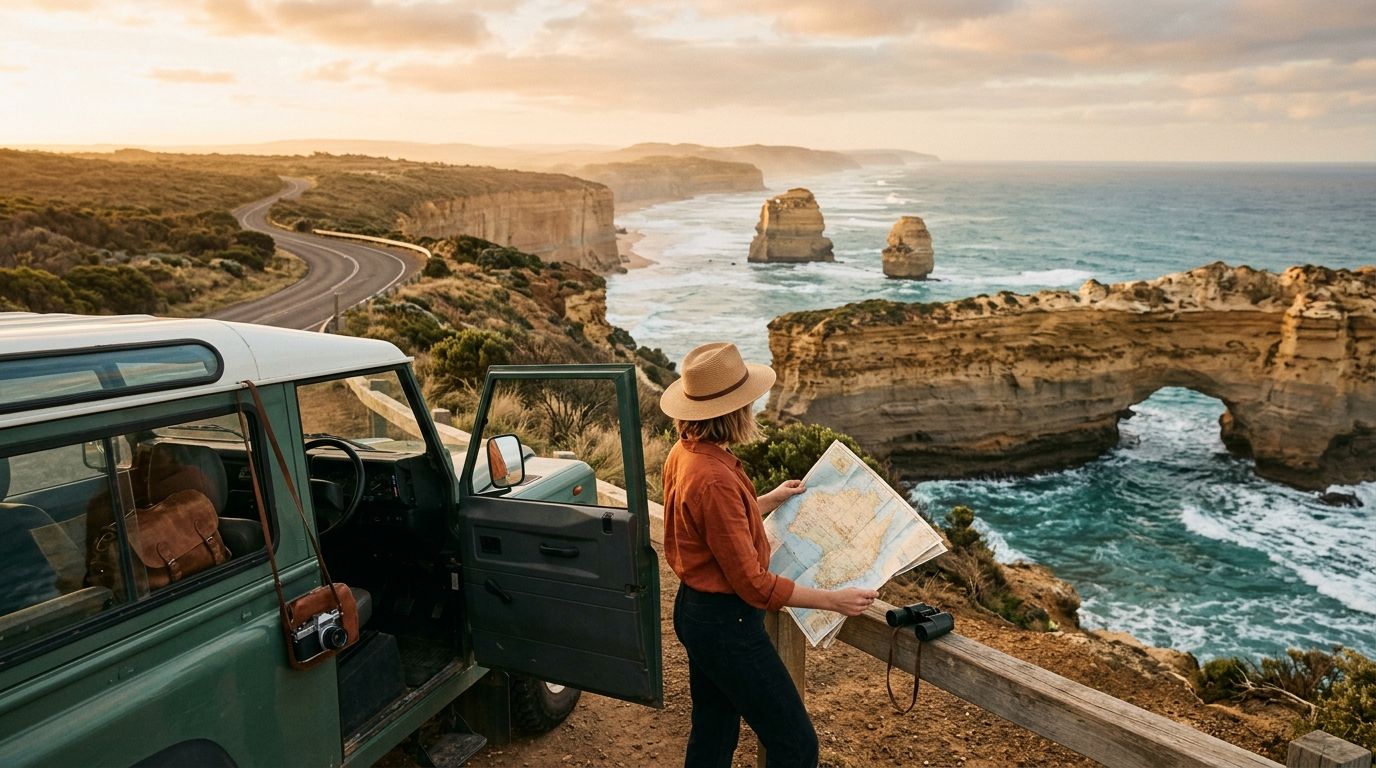
Great Ocean Road (Victoria): A coastal drive with legitimate geological drama—the Twelve Apostles are actually worth the effort, though arrive early or late to avoid crowds. The drive itself (6-7 hours) is the point as much as the destination.
Daintree Rainforest (near Cairns): If you're going northeast, this is genuinely ancient rainforest and worth the detour. It feels like Australia's opposite—dense, humid, complicated rather than sparse and open.
Is It Worth Your Time? The Actual Answer
Yes, but with qualifications. Australia rewards people who:
- Have time (it's not a quick trip)
- Are comfortable driving long distances
- Want to experience different types of landscape and city culture in one trip
- Aren't dependent on dramatic Instagram moments (the beauty is often subtle)
Australia doesn't feel exotic to Western visitors in the way Southeast Asia or Central America might. It's familiar—coffee shops, English-speaking people, developed infrastructure. What it offers instead is genuine emptiness and scale. If that appeals to you, you'll have an exceptional time. If you're hoping for dramatic cultural immersion, Southeast Asia delivers more of that in less time.
The honest thing: Australia is expensive, the flights are long, and much of the interior is actually, genuinely boring if you're not in the right headspace for emptiness. But the cities are intelligent, the coasts are excellent, and the experience of scale is something you don't get in most developed countries.
Quick Facts
- Best entry point: Sydney
- Currency: Australian Dollar (AUD)
- Language: English (with distinct Australian accent and vocabulary)
- Visa: Most Western visitors need an eVisa (Australia ETA)
- Driving: Left-hand side (like UK)
- Size: 7.7 million square kilometers (larger than contiguous US)
- Cost: Expensive by global standards, moderate by developed-country standards
- Main cities: Sydney, Melbourne, Brisbane, Perth, Adelaide
The Final Word
Australia works because it doesn't try to be something it isn't. It's not offering mystical enlightenment or untouched wilderness in the Instagram sense. It's offering genuine scale, functioning cities with actual culture, and the particular experience of traveling through a very large, lightly populated developed country. You learn things here—about yourself, about distance, about what it means to live at the edge of a continent.
The light will still smell like eucalyptus when you leave. You'll probably come back.
Explore Australia's routes, regions, and experiences on Touratu's interactive map, where you can see travel videos, plan your journey, and discover bookable activities across the country.
Loading activities…
