
20 Best Places to Visit in Uttar Pradesh - An Insider Travel Guide
20 Places in Uttar Pradesh Travelers Keep Returning To — Have You Been to All of Them?
There's a particular quality to morning light in Uttar Pradesh — the way it filters through marble lattice screens in Agra, catches the brass bells of Varanasi's temples, or settles like gold dust over the Buddhist stupas of Sarnath. This is India's spiritual and historical heartland, a state where every city seems to hold centuries in its palm, where the Ganges carries prayers and the Yamuna reflects monuments that have witnessed empires rise and crumble.
Uttar Pradesh doesn't reveal itself easily. The first-time visitor might see only the chaos — the honking rickshaws, the crowded ghats, the relentless energy of streets that never seem to sleep. But return visitors know something different. They've learned to read the rhythms, to find the quiet corners behind the noise, to understand why pilgrims and poets and emperors all found themselves drawn to these plains. This is a place that demands patience and rewards curiosity.
What follows isn't a checklist. It's an explorer's companion — twenty places across this vast state where travelers find themselves returning, pulled back by something they can't quite name. Perhaps it's the way a certain courtyard holds the afternoon light, or how a particular ghat sounds at dawn. Perhaps it's simply that Uttar Pradesh, for all its intensity, has a way of becoming familiar. Of feeling, eventually, like a kind of home.
Taj Mahal, Agra
The Taj Mahal needs no introduction, yet it manages to surprise even those who've seen a thousand photographs. What images cannot capture is the scale — how the mausoleum seems to float above its reflecting pools, how the marble shifts from warm cream at sunrise to cool blue at twilight, how the inlaid precious stones in the walls catch light in ways that feel almost alive.
Stand at the main gateway at first light, before the tour groups arrive, and watch the Taj emerge from morning mist like a half-remembered dream. The symmetry is deliberate, obsessive — Shah Jahan's grief made geometric, his love for Mumtaz Mahal translated into mathematics and marble.
Best Time to Visit: Sunrise on weekdays, ideally in October through March when the air is clearer. Friday is closed to casual visitors.
Insider Observation: The mosque to the left of the Taj is often empty when the main platform is crowded. Sit there for a few minutes. The acoustics make even whispered conversations carry, and the view is nearly as good as the famous front-facing shot.
Visual Moment: The reflection pool offers the classic composition, but walk to the raised marble platform on the right side for a three-quarter angle that shows the monument's depth and the intricate calligraphy bordering the archways.
Varanasi Ghats
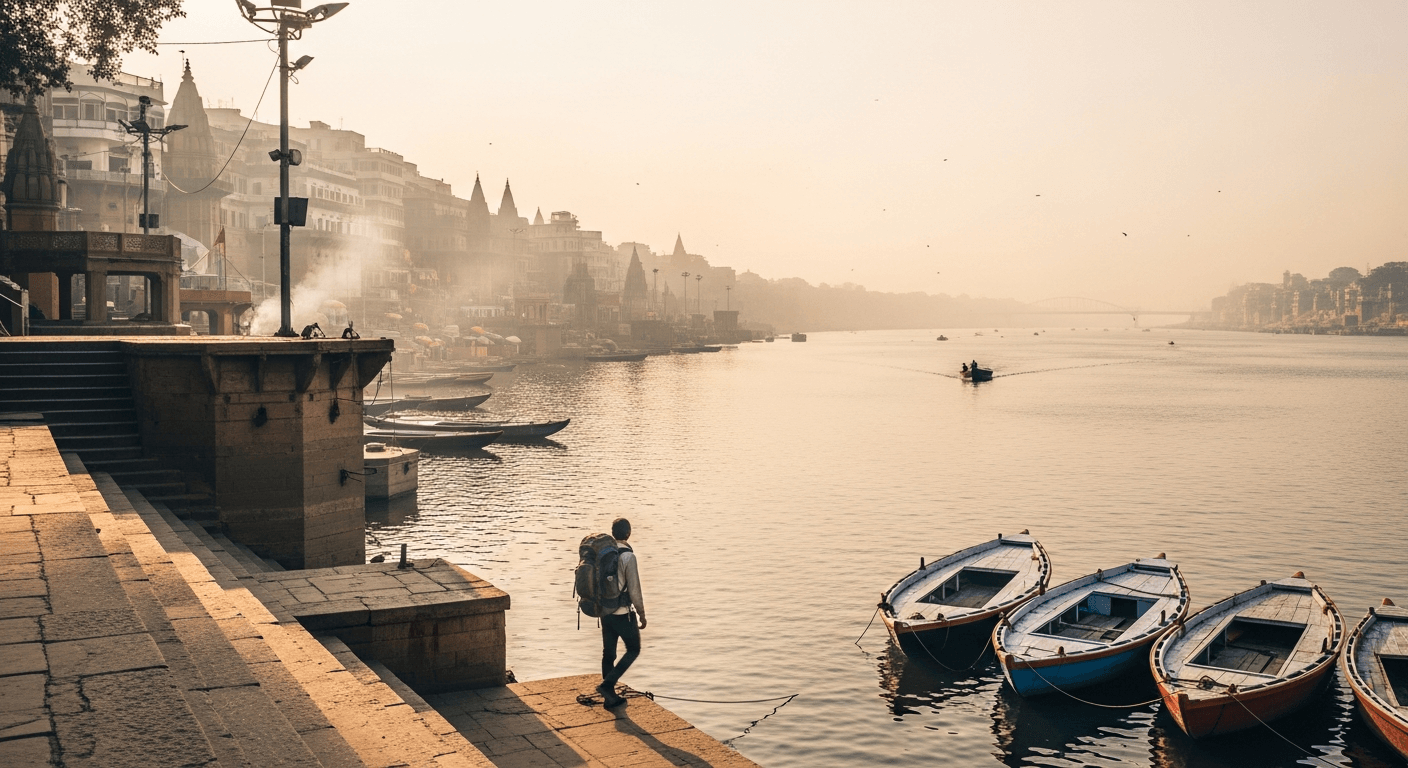
Varanasi operates on its own logic. The city is simultaneously ancient and immediate — rituals performed here for three thousand years happening right now, this morning, as you read this. The ghats descend to the Ganges in stone steps worn smooth by centuries of bare feet, and every one of them holds a different character.
Dashashwamedh Ghat erupts each evening in the Ganga Aarti ceremony — priests wielding flaming brass lamps, chanting that reverberates off the old buildings, crowds that include pilgrims, tourists, and locals who've seen this spectacle a thousand times and still show up. But walk north to Manikarnika, the cremation ghat, and the atmosphere shifts entirely. Here, death is public and constant, bodies burning day and night. It sounds morbid until you witness it. Then it simply feels honest.
Best Time to Visit: Dawn for the quietest experience. Take a boat ride as the sun rises and the city wakes.
Insider Observation: The narrow lanes behind the ghats — known locally as galis — contain some of Varanasi's best chai stalls and oldest shops. Getting lost here is part of the experience.
Visual Moment: The golden hour light hitting the ghats from the water, shot from a slowly moving boat, captures the city's layered chaos better than any street-level photograph.
Fatehpur Sikri
Akbar built his dream city here in the 1570s, then abandoned it barely fifteen years later — some say because the water ran out, others because his beloved saint died. Whatever the reason, Fatehpur Sikri remains frozen in time, a Mughal capital without the wear of continuous habitation, its red sandstone still sharp-edged and startling.
The Buland Darwaza, the massive victory gate, announces the scale of Akbar's ambition. Climb its steps and turn back to look at the sprawling complex below — mosques, palaces, courtyards, gardens, all arranged with a precision that suggests both power and philosophy. Akbar was obsessed with religious harmony; you can see it in how the architecture blends Hindu, Islamic, and Jain elements into something distinctly his own.
Best Time to Visit: Late afternoon, when the crowds thin and the sandstone turns copper in the lowering sun.
Insider Observation: The Panch Mahal, the five-storied pavilion, was likely for the royal women to catch evening breezes. Stand on its upper levels and imagine the view when this was a living city, not a monument.
Visual Moment: Frame the Buland Darwaza from inside the courtyard, looking up — the scale becomes genuinely humbling.
Sarnath
Eight kilometers from Varanasi's chaos, Sarnath exists in deliberate stillness. This is where the Buddha delivered his first sermon after enlightenment, where he set the wheel of dharma in motion. The contrast with Varanasi could not be more complete.
The Dhamek Stupa rises like a gentle giant from manicured lawns — built in the 5th century, it marks the precise spot where the Buddha taught his first five disciples. Walk slowly around it, as pilgrims do, and notice how the silence here feels cultivated rather than accidental. Monks in maroon robes sit in meditation. The archaeological museum nearby holds the Lion Capital of Ashoka, now India's national emblem, carved over two thousand years ago and still impossibly elegant.
Best Time to Visit: Early morning or late afternoon, especially during the cooler months. Buddhist pilgrims arrive year-round, but the site feels most contemplative outside peak hours.
Insider Observation: The Thai, Japanese, Chinese, and Tibetan temples nearby each interpret Buddhism through their own cultural lens — visiting all of them takes half a day but offers a fascinating study in religious architecture.
Visual Moment: The Dhamek Stupa photographed from the surrounding gardens, with monks walking in the foreground, captures the site's meditative atmosphere.
Lucknow's Old Quarter
Lucknow moves differently than other Indian cities. There's a deliberateness to its manners, a formality inherited from the Nawabs who made this their capital. The old quarter around Chowk still holds that atmosphere — crumbling havelis with elaborate stucco work, narrow lanes where artisans hammer silver into intricate chikan embroidery, and food stalls that have been perfecting the same recipes for generations.
The Bara Imambara is the centrepiece — a vast congregation hall built without a single pillar, its roof held up by an engineering mystery that still impresses structural experts. Attached to it is the Bhul Bhulaiya, a maze of narrow passages designed to confuse invaders, now a tourist attraction where guides charge a few rupees to ensure you don't emerge on the wrong rooftop.
Best Time to Visit: October through February for comfortable weather. Visit the food stalls in Chowk after sunset when the kebab vendors fire up their grills.
Insider Observation: Lucknow's famous tunday kababi — minced meat kebabs supposedly so tender they were invented for a toothless Nawab — has multiple locations. The original in Chowk remains the most atmospheric, though the Aminabad branch often has shorter queues.
Visual Moment: The Bara Imambara's central hall, with its massive chandeliers and intricate lime stucco, photographs best in late morning when soft light enters through the high windows.
Chitrakoot
Where the forests meet the Mandakini River, Chitrakoot sits quietly at the intersection of mythology and geography. This is where Ram, Sita, and Lakshman spent eleven of their fourteen years in exile — or so the Ramayana tells us. Whether you approach it as history, faith, or simply landscape, the beauty is undeniable.
The ghats here lack Varanasi's intensity but hold their own kind of devotion. Pilgrims bathe at dawn, temple bells echo across the water, and the forested hills behind the town feel genuinely wild. Kamadgiri, the sacred hill, is circumambulated by devotees who believe the walk grants wishes. The five-kilometer path takes about two hours and passes through forest thick with monkeys and birdsong.
Best Time to Visit: The Ramlila during Dussehra draws enormous crowds but offers an immersive cultural experience. For quieter visits, October through March provides pleasant weather without major festival crowds.
Insider Observation: The boat ride across the Mandakini to Janaki Kund — where Sita is said to have bathed — costs almost nothing and offers views of the ghats that most tourists miss.
Visual Moment: Sunset over the Mandakini from Ram Ghat, with the temple spires silhouetted against the fading light.
Allahabad (Prayagraj) — The Sangam
Three rivers meet at Prayagraj — the Ganges, the Yamuna, and the mythical Saraswati, invisible but believed to flow underground. This confluence, the Sangam, is among Hinduism's holiest sites, and bathing here during the Kumbh Mela draws tens of millions in the largest human gatherings on Earth.
But even outside festival periods, the Sangam possesses a quiet power. Boats row pilgrims out to where the rivers visibly merge — the milky Ganges meeting the darker Yamuna in swirling patterns that look almost painted. Priests perform rituals on the temporary platforms. The scale of faith here, even on ordinary days, feels humbling.
Best Time to Visit: The Magh Mela in January–February offers a glimpse of Kumbh intensity without the overwhelming crowds. Otherwise, October through March for comfortable boating weather.
Insider Observation: The Allahabad Fort, built by Akbar, sits at the Sangam's edge but is largely closed to civilians. The Patalpuri Temple inside, however, is accessible and contains an ancient underground chamber worth visiting.
Visual Moment: The confluence itself, photographed from a boat at sunrise when the water's colour difference is most visible and the morning light softens the industrial backdrop.
Mathura and Vrindavan
Krishna's birthplace and childhood playground sit just fifteen kilometers apart, connected by a road and separated by atmosphere. Mathura is a proper city — dusty, commercial, centred on the Shri Krishna Janmabhoomi temple complex where an active mosque shares a controversial wall with the deity's supposed birth cell. Vrindavan is smaller, stranger, more devoted — a town where widows come to spend their final years chanting, where hundreds of temples compete for attention, where monkeys rule the streets with genuine authority.
The Banke Bihari Temple in Vrindavan offers one of India's most intense darshans. The curtain before the deity opens and closes every few minutes — supposedly because the idol's eyes are so powerful that continuous exposure would be overwhelming. The crowd surges with each opening, creating a rhythm of devotion that feels almost hypnotic.
Best Time to Visit: Holi in Vrindavan is legendary but genuinely overwhelming — colour-soaked chaos that requires commitment. For calmer visits, October through February. Evening aartis at ISKCON's elaborate temple offer a more accessible introduction.
Insider Observation: The Seva Kunj gardens, where Krishna is believed to have danced with Radha, close at sunset and remain empty all night. Nobody stays after dark — locals say the divine couple still meets there.
Visual Moment: The evening light on the Yamuna at Kesi Ghat in Vrindavan, where small lamps float downstream and temple bells create an overlapping soundscape.
Dudhwa National Park
Far from the temple circuit, Uttar Pradesh's terai region holds wilderness that rivals any in India. Dudhwa spreads across the Nepal border in sal forests and grasslands that shelter tigers, rhinos, elephants, and swamp deer in genuinely wild densities.
The park lacks Ranthambore's tourist infrastructure, which is precisely its appeal. Jeep safaris often have sections of forest to themselves. The silence between birdsongs feels deeper. The Barasingha deer here — their antlers can carry up to fourteen points — exist nowhere else in such numbers.
Best Time to Visit: November through May, with February through April offering the best wildlife sightings as vegetation thins. The park closes during monsoon.
Insider Observation: The Tharu tribal villages bordering the park offer homestay experiences that combine wildlife access with cultural immersion — significantly more atmospheric than the government rest houses.
Visual Moment: Dawn over the grasslands, when mist rises and herds of deer emerge like brushstrokes on a scroll painting.
Jhansi Fort
The fort where Rani Lakshmibai held out against British forces in 1857 rises from Jhansi's modern sprawl like a granite rebuke to colonial history. The queen's story — her refusal to surrender, her death in battle with her infant son strapped to her back — has become legend, but the fort itself needs no mythology to impress.
Built in the 17th century by the Bundela Rajputs, later claimed by the Marathas, finally besieged by the British, the fort's walls hold layers of history in their stone. The views from the ramparts sweep across the city and surrounding countryside. The Rani Mahal museum nearby contains her personal effects and the sword she wielded into battle.
Best Time to Visit: October through March for comfortable climbing weather. Avoid midday heat — the fort has minimal shade.
Insider Observation: The sound-and-light show in the evenings dramatizes the 1857 rebellion with predictable bombast but genuine emotion. Worth attending at least once.
Visual Moment: The fort's silhouette against sunset, photographed from the busy streets below where modern life continues beneath ancient walls.
Ayodhya
Few places in India carry as much contemporary weight as Ayodhya. The city where Ram was born — or where, at least, millions believe he was born — became the site of modern India's most divisive religious conflict. The demolished Babri Masjid, the Supreme Court verdict, the newly constructed Ram Mandir — these are recent history, still being written.
But Ayodhya exists beyond its politics too. The Saryu River ghats at dawn hold a gentleness that surprises visitors expecting only intensity. The narrow lanes contain temples centuries old, sweetshops serving prasad to pilgrims, and an atmosphere that feels more like a large village than a city. The completed Ram Mandir now draws enormous crowds, its architecture consciously drawing from ancient temple traditions while using thoroughly modern engineering.
Best Time to Visit: Ram Navami (March–April) sees the largest celebrations but overwhelming crowds. November through February offers pleasant weather without major festival intensity.
Insider Observation: The Hanuman Garhi temple, approached via 76 steep steps, offers views across the city and the Saryu. The resident monkeys are fed by devotees and consequently well-behaved.
Visual Moment: The Saryu ghats at sunset, when oil lamps float downstream and the new temple's silhouette rises in the background.
Kushinagar
The Buddha died here — or, in Buddhist terminology, achieved Mahaparinirvana. Kushinagar holds the intimacy of an ending rather than the triumph of a beginning. The Parinirvana Temple contains a reclining Buddha statue, over six meters long, depicting him in his final moments. Pilgrims sit in silence before it.
The Ramabhar Stupa marks the cremation site. Unlike Sarnath's manicured grounds or Bodh Gaya's busy devotion, Kushinagar feels almost neglected — which somehow makes it more moving. This is where the teacher finally rested. The quiet feels earned.
Best Time to Visit: November through February for pleasant weather. The Buddha Purnima celebrations in May draw more visitors but intensify the contemplative atmosphere.
Insider Observation: The archaeological museum here, tiny and underfunded, contains artifacts recovered from the surrounding area that rival anything in larger institutions. Take time for it.
Visual Moment: Morning light entering the Parinirvana Temple, illuminating the Buddha's serene face.
Agra Fort
Overshadowed by its more famous neighbour, Agra Fort deserves its own attention. This is where Shah Jahan spent his final years imprisoned, gazing across the Yamuna at the tomb he built for his wife — a poetic cruelty engineered by his own son, Aurangzeb.
The fort sprawls across 94 acres of red sandstone and white marble, a palimpsest of Mughal rulers who each added their own structures. Akbar built the walls and gates; Jahangir added the gardens; Shah Jahan contributed the delicate marble pavilions that now frame views of the distant Taj. Walking through feels less like visiting a monument than reading a dynasty's diary.
Best Time to Visit: Late afternoon light on the marble structures creates genuinely magical effects. Winter months offer the clearest air.
Insider Observation: The Musamman Burj, the octagonal tower where Shah Jahan was imprisoned, contains the window from which he watched the Taj. Stand there at sunset and the view suddenly explains everything.
Visual Moment: The Taj Mahal framed through the Musamman Burj's carved marble window — possibly the most emotionally resonant view in India.
Vindhyachal
Where the Vindhya mountains meet the Ganges plain, the goddess temples of Vindhyachal have drawn pilgrims for millennia. The Vindhyavasini Devi temple sits at the centre of a triangle of shrines — Vindhyavasini, Ashtabhuja, and Kali Khoh — that devotees visit in a single circuit believed to grant wishes.
The atmosphere here differs from the Vaishnavite temples of Mathura or the Buddhist sites. Shakti worship has its own intensity — the goddess in her fierce forms, the tantric traditions that still operate quietly alongside mainstream Hinduism. The covered market leading to the main temple sells offerings of coconuts, red cloth, and turmeric.
Best Time to Visit: Navaratri (September–October) sees the most intense devotion but also the densest crowds. For calmer visits, October through February.
Insider Observation: The boat ride from Vindhyachal to the Ganges is used primarily by pilgrims but offers unexpected river views that most tourists miss entirely.
Visual Moment: The temple at night during aarti, when oil lamps flicker against ancient stone and chanting fills the air.
Bithoor
Few tourists reach Bithoor, which is precisely why those who do remember it. This small town on the Ganges, thirty kilometers from Kanpur, holds disproportionate significance — it's where Valmiki is said to have written the Ramayana, where Sita raised Ram's sons, where Nana Sahib plotted rebellion against the British.
The ghats here feel village-intimate rather than city-grand. The Brahmavart Ghat marks the supposed creation point of the universe — claims don't get larger than that. The Valmiki Ashram sits peacefully overlooking the river. The Dhruv Teela marks where the child Dhruva meditated until he became the pole star.
Best Time to Visit: October through March, preferably on weekday mornings when the ghats are quietest.
Insider Observation: The crumbling remains of Nana Sahib's palace, now mostly reclaimed by vegetation, are worth seeking out for their atmospheric decay and historical resonance.
Visual Moment: The Ganges from Brahmavart Ghat at sunrise, when the water holds the only sound and the temple bells begin.
Shravasti
The Buddha spent 24 monsoon retreats at Shravasti — more than anywhere else. The ruins here are extensive but require imagination; what remains are foundations, brick stumps, the archaeological traces of a city that was already ancient when the Buddha arrived.
The Sahet-Mahet complex divides into a monastery area and a city area, spread across several kilometers. The Anandabodhi tree, grown from a cutting of the original Bodhi tree at Bodh Gaya, still provides shade. The Japanese, Thai, Chinese, Korean, and Sri Lankan temples nearby each interpret the site through their own cultural lenses.
Best Time to Visit: October through March for comfortable exploring weather. The Buddha Purnima celebrations bring pilgrims but not overwhelming crowds.
Insider Observation: The light-and-sound show here, unlike many in India, maintains a genuinely contemplative tone. Worth staying for.
Visual Moment: The Gandha Kuti ruins at sunset, when the ancient bricks glow warm and the scale of what once stood here becomes imaginable.
Chunar Fort
The fort at Chunar guards a strategic bend in the Ganges with an authority that explains why everyone from the Mauryas to the Mughals to the British wanted to control it. The views from its ramparts sweep across river, plain, and the distant profiles of Varanasi's ghats.
Unlike better-known forts, Chunar receives relatively few visitors, lending its corridors and bastions an exploratory atmosphere. The British-era barracks mix incongruously with Mughal gateways. The old cannon still point at phantom enemies. The sense of layered occupation — dynasty after dynasty claiming the same strategic ground — feels palpable.
Best Time to Visit: October through March, ideally in late afternoon when the river catches the sunset.
Insider Observation: The Durga Kund within the fort is believed to be bottomless and connected to the Ganges. The claims are obviously mythological, but the spring-fed pool's color is genuinely unusual.
Visual Moment: The Ganges from the highest rampart, bending around the fort's position in a curve that immediately explains centuries of military history.
Kanpur's Colonial Heritage
Kanpur doesn't appear on most tourist itineraries, which means its colonial-era architecture remains relatively unrestored and authentic. The All Souls Memorial Church, built to commemorate British victims of the 1857 rebellion, stands in gothic red brick amid the city's industrial sprawl. The Kanpur Memorial Garden marks the site of the Bibighar massacre — difficult history, presented with the complexity it deserves.
The city's leather and textile industries give it a working-class energy different from tourist-oriented destinations. The Allen Forest Zoo, one of India's oldest, sprawls across genuinely wild-feeling terrain. The ghats along the Ganges lack Varanasi's religious intensity but offer their own quieter rhythms.
Best Time to Visit: November through February for comfortable weather. Avoid the summer industrial heat.
Insider Observation: The Nana Rao Park, site of a British massacre and now a memorial to Indian martyrs, offers a lens into how the 1857 rebellion is remembered from different perspectives.
Visual Moment: The All Souls Church interior, where memorial plaques to fallen British soldiers line the walls — somber, complicated, historically fascinating.
Gorakhpur
Gateway to the Buddhist circuit and birthplace of the Gorakhnath sect, Gorakhpur holds religious significance that most travelers pass through too quickly to notice. The Gorakhnath Temple, heart of the Nath tradition, sprawls across 52 acres with the kind of living devotion that sterile heritage sites lack.
The city's chaotic surface — rickshaws, trucks, the endless motion of a major junction town — conceals quieter corners. The Imambara Bade Peer Sahab draws both Hindu and Muslim devotees in a syncretic tradition that feels increasingly rare. The Ramgarh Tal lake offers unexpected green space and evening breezes.
Best Time to Visit: October through March for comfortable weather. The Makar Sankranti fair in January draws enormous crowds.
Insider Observation: Gorakhpur's literary connection — writer Premchand was born nearby — is marked by the Premchand Smarak Sansthan, a small museum that literature lovers find moving.
Visual Moment: The Gorakhnath Temple's main gate at sunset, when devotees stream in for evening prayers and the temple bells create overlapping rhythms.
Sankisa
The site where the Buddha descended from heaven after teaching his mother — Sankisa draws Buddhist pilgrims who know its significance even as it remains almost unknown to casual tourists. The Ashoka elephant pillar marks the spot. The temple is modest. The village around it moves to agricultural rhythms unchanged for centuries.
Coming here feels like discovery rather than tourism. The archaeological remains are being actively excavated. The modern temple, built by Sri Lankan Buddhists, houses a Thai statue. The faithful few who visit represent a half-dozen countries but share a quiet reverence.
Best Time to Visit: October through March for pleasant weather. Buddha Purnima sees increased activity but not crowds.
Insider Observation: The local caretakers know the site's history better than any guidebook and are genuinely happy to share it with interested visitors.
Visual Moment: The Ashoka pillar at sunset, when its ancient stone glows warm and the village falls quiet.
Navigating Uttar Pradesh
Travel in Uttar Pradesh rewards patience and planning. The state's sheer size — India's most populous, stretching from the Himalayan foothills to the Vindhya ranges — means distances are real. Lucknow and Varanasi have the best-connected airports. The train network is comprehensive if occasionally overwhelming; book reserved seats on the better classes where possible.
Auto-rickshaws dominate local transport in most cities. Negotiating fares before starting is essential — meters are largely fictional. In Varanasi and Mathura-Vrindavan, e-rickshaws and cycle rickshaws navigate the narrow lanes better than any car. Hiring a car and driver for multi-city trips offers comfort and flexibility, though prices vary dramatically; fix them in advance.
The heat matters. April through June can be genuinely dangerous, with temperatures regularly exceeding 45°C. The monsoon (July–September) brings relief but also flooding, disrupted transport, and humidity that makes sightseeing exhausting. October through March offers the sweet spot — cool mornings, warm afternoons, clear skies for the monuments.
Vegetarian food dominates most temple towns, though Lucknow's kebabs and Agra's Mughlai cuisine offer carnivorous pleasures. Street food is generally safe in busy areas with high turnover; the chai is uniformly excellent. Temple protocols vary — Varanasi's major temples are now heavily regulated; Mathura and Vrindavan allow more spontaneous access. Dress modestly for all religious sites. Shoes come off at temples; sometimes cameras do too.
Discover More on Touratu
Uttar Pradesh reveals itself in layers — the famous monuments give way to quieter towns, the tourist circuits open onto pilgrim paths, the main roads lead to riverside ghats where the light at dawn makes everything feel possible. Touratu's interactive map brings these discoveries together, tracing the routes travelers have actually walked and the reels that capture moments beyond the guidebook. Browse the visual itineraries, find the hidden corners, plan your own path through this ancient, complicated, endlessly surprising state.
Some places you visit. Others you return to, pulled back by something you can't quite explain — a quality of light, a particular silence, the memory of how a city smelled at sunrise. Uttar Pradesh holds many such places. They wait along the Ganges, behind crumbling fort walls, in temple courtyards where the same prayers have echoed for centuries. They wait for you to notice them, and then to miss them, and then to return.
Loading activities…
