
Best Street Food in Varanasi: Local Flavours
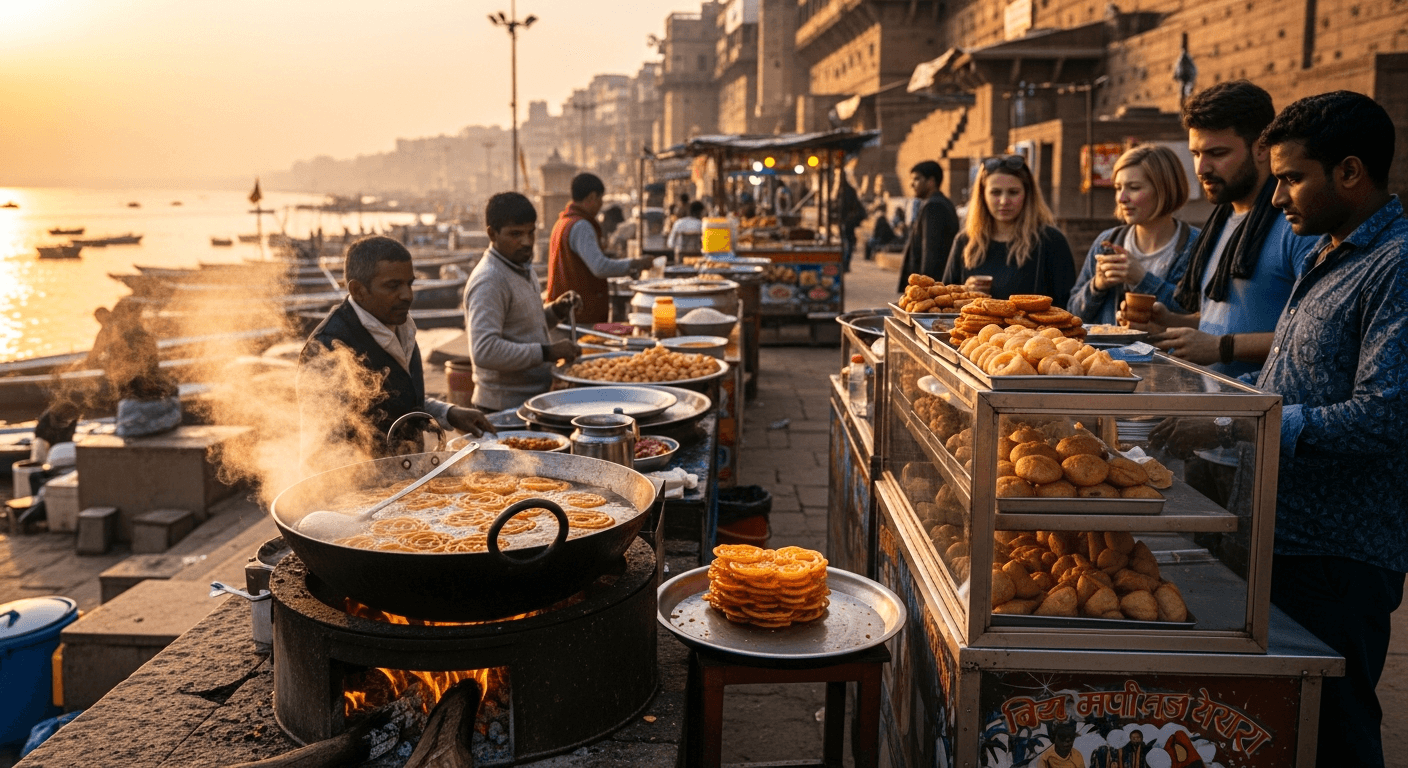
Best Street Food in Varanasi: The Flavours Locals Eat That Tourists Always Miss
The sun hasn't yet touched the Ganges when the city's real appetite wakes. Varanasi at dawn is a different animal altogether—not the postcards of pilgrims and pyres, but something more intimate. The street food vendors are already arranging their small worlds: brass pots catching the early light, pyramids of fresh produce glistening with dew, charcoal braziers coming alive with that particular smell of anticipation. This is when locals move through the narrow lanes with purpose, stopping at familiar carts like the rest of us stop for coffee. They know something the guides don't tell you.
Most visitors to this ancient city arrive with preconceived notions of what they should eat, following the same well-worn paths to the same restaurants with the same English menus. They miss the texture of real hunger in Varanasi—the kind that sends a grandmother to the same chaat vendor for forty years, that makes a businessman deviate from his route for fresh jalebi still warm enough to glow. Street food here isn't convenient; it's devotional. It's the rhythm of the city made edible.
The real Varanasi tastes nothing like the Varanasi of travel blogs. It tastes of things that require knowing where to stand, when to arrive, and who to ask.
1. Kachori at Lakshmi Chaat (Near Godaulia Crossing)
There's a particular kind of violence in how locals bite into a fresh kachori—no hesitation, no caution, just immediate engagement with the hot, crispy shell. This isn't delicate eating. The kachori here (not the sweet kind, but the savoury, potato and moong dal-filled version) shatters under teeth, releasing steam and a spiced filling that's been perfected across generations. Lakshmi Chaat's owner still makes the dough by hand each morning, rolling it with the kind of rhythm that suggests muscle memory older than conversation.
What makes this spot transcendent isn't the kachori itself—though it's exemplary—but the chaat topping. The tamarind chutney has fermented for months in terracotta, and the boondi is still warm from last night's preparation. Locals drown theirs in a punchy green chutney that tastes like pure cilantro and heat.
The experience: order two kacharauli (the smaller, crunchier variant) and stand in the shadow of the adjacent temple wall. Watch how the vendor remembers everyone's preference without asking.
Best time: 8–9 AM, when the dough is still relaxed and pliable.
Insider observation: The vendor's wife arrives at 7 AM with fresh curry leaves. When you see her appear, the filling is about to be tempered.
Photography moment: The precise second the hot oil darkens the kachori, just before it's fished out—that bronze-to-mahogany transition.
Practical tip: Bring small change. The transaction here is cash-only and coins appreciated. Order in Hindi if you can manage "do kachori, extra meethi chutney"—it earns you a small smile.
2. Chikhalwali (Street-Side Savoury Cake)
Chikhalwali exists in that strange category of foods that tourists simply walk past. It looks unassuming—essentially a chickpea flour cake with onions, green chilies, and ginger, shallow-fried until the edges crisp. But this is precisely where the magic lives, in the un-photogenic depths of routine.
A vendor near Maidagin prepares these fresh in small batches, her hands moving with absolute efficiency. The cake emerges from the pan studded with caramelized onions on one side, and she cuts it into rough rectangles. It costs almost nothing. It feels like everything.
The experience is less about taste and more about the speed of consumption. Locals buy them in multiples, eating them as they walk, the warm oil still translating through paper. There's something sacred about food this temporary.
Best time: 10–11 AM, or 5–6 PM when it reappears.
Insider observation: The vendor's apprentice, usually around fourteen, can flip the entire cake in the pan with one practiced wrist movement.
Photography moment: The moment the cake lands on the vendor's wooden board and the residual oil catches the light.
Practical tip: Eat it immediately. The texture degrades after ten minutes. Ask for "mirchi zyada"—extra chili—if you prefer your food without subtlety.
3. Dough Fritters (Khasta Kachori from Rana's Cart)
On the corner where Chet Singh Ghat meets the lane toward the temple, an elderly vendor named Rana has been selling khasta kachori since before most travellers were born. These aren't the potato-filled kacharas from earlier; these are pure technique—dough so impossibly light it seems to float. The filling is optional; the magic is in the texture.
Rana makes the dough with ghee and yogurt, kneads it for exactly the time it takes to recite the morning prayer, then rolls and folds it in a way that creates internal layers invisible until you bite into them. When fried, the kachori becomes a golden architecture of crisp shells.
Best time: 6–7 AM. After 7:30, the dough has lost its morning resilience.
Insider observation: Rana tastes every fifth batch. This isn't quality control; it's meditation.
Photography moment: The moment the kachori doubles in size in the oil, that rapid bloom of expansion.
Practical tip: Stand to the side of the cart, not directly in front. You're not ordering; you're witnessing. Ask for "saath ke do"—seven pieces—and pay what feels right.
4. Lassi at the Blue Lassi Shop
Nearly every guidebook mentions this place, yet somehow it still feels like a local secret because tourists arrive with expectations and locals arrive with thirst. The shop itself is barely wider than a single door, painted a fading blue that might have been chosen intentionally or might simply be time. The lassi comes in flavours the menu doesn't list: fruit-based on certain days, spiced with cardamom on others, occasionally spiked with a whisper of rose.
What matters is the temperature—made fresh and served immediately, the yoghurt still grainy, the milk not quite settled. It's the drink of someone who's been walking for hours, not someone scheduling a beverage experience.
Best time: Post-breakfast, around 10 AM. Or late afternoon when the heat demands it.
Insider observation: The owner knows every regular's preference without asking. Newcomers get standard; repeats get personalized.
Photography moment: The froth settling on the surface, the slight unevenness of hand-poured drinks.
Practical tip: Sit on the narrow bench outside if space allows. The shared sitting creates conversation naturally.
5. Aloo Parathas from the Lane Vendor (Near Assi Ghat)
If kachori is the morning shout, paratha is the sustained conversation. The vendor near Assi Ghat makes aloo parathas on a convex griddle, the dough already half-cooked, filled with a potato masala studded with cumin and dried chilies. She flattens it with her palm, fries it in ghee until brown spots appear like freckles, then serves it on a piece of newspaper with a lemon wedge and sliced onions.
The eating of a fresh paratha is an act of caution and commitment. The interior is lava-temperature for the first few minutes; locals know to let it cool slightly, to fold it in half to contain the steam, to eat it in four bites maximum before it stiffens.
Best time: 6–8 AM. After breakfast rush, the dough becomes denser.
Insider observation: The vendor makes a small mark on her griddle that indicates ideal temperature—a mark only she can see.
Photography moment: The moment the paratha puffs and separates slightly under the ghee—that moment of transformation.
Practical tip: Ask for it without the spoon—locals tear it with their hands. The dexterity required is part of the ritual.
6. Tamatar Chaat (Tomato Salad)
This is less a dish and more a principle. A vendor in the market near Godaulia keeps fresh tomatoes, fresh onions, fresh cilantro. She dices them into a steel bowl, adds salt, lime juice, and a particular blend of chaat masala that she grinds herself. That's it. The simplicity is the entire point.
You stand there, watching your specific bowl being assembled in front of you, and suddenly understand that chaat culture isn't about complexity—it's about the acknowledgement of freshness. Every ingredient is a conversation about what was picked this morning.
Best time: 2–4 PM, when the tomatoes have been sitting long enough to release their juice.
Insider observation: The vendor tastes her chaat masala blend every morning at 6 AM. If the proportions are off by even a gram, she knows.
Photography moment: The moment the lime juice hits the diced tomatoes, that immediate wilting and colour shift.
Practical tip: Ask for it in a small bowl ("chhoti wali") and eat standing up. Sitting makes it feel too formal.
7. Jalebi from the Lane (Fresh, Not Stored)
There's jalebi that's been sitting in syrup for days, and there's jalebi that's still dripping. The vendor near Kshitij Bakery makes hers throughout the day, piping the batter directly into hot oil in a geometric spiral, letting it fry to immediate gold, then dunking it into warm sugar syrup that's been simmering since dawn. The jalebi comes out with syrup still running off it, the exterior crisp, the interior somehow still delicate.
Locals buy it by weight, asking for "do sau gram"—two hundred grams—and eating it immediately. The heat keeps the sugar pliable; waiting even five minutes changes the entire texture.
Best time: 3–5 PM. The afternoon is jalebi time in Varanasi.
Insider observation: The vendor's daughter, learning the trade, can identify temperature by the sound of the oil's sizzle alone.
Photography moment: The moment it's lifted from the syrup, that perfect drip of golden liquid suspended mid-air.
Practical tip: Ask for it fresh ("abhi banaa"), and be prepared for teeth-sticking sweetness. This is not refined sugar; this is pure indulgence.
8. Gujhiya from the Seasonal Vendor
This appears only when the season allows, often at a cart that moves locations depending on demand. Gujhiya is a half-moon pastry, fried and filled with khoya (milk solids), nuts, and raisins, finished with a light sugar syrup. It's what grandmothers make at home; the street vendor version is a careful approximation of that memory.
Best time: Holi season and Diwali season primarily. Occasionally in summer.
Photography moment: The moment the pastry shows that perfect brown-gold equilibrium between crisp and tender.
Practical tip: It keeps for a few hours, so buying multiple is reasonable. Share with someone—it's traditionally a festival food meant for gifting.
9. Bhaang Thandai (Seasonal, Cannabis-Infused Milk)
Available during Holi and certain festivals, this spiced, chilled milk preparation contains crushed seeds, nuts, and yes, occasionally cannabis (in small, ceremonial amounts). Locals approach this with respect rather than novelty, viewing it as a sacred drink meant for specific occasions.
Best time: Holi morning, or the day after.
Practical tip: Understand the cultural significance. This isn't a recreational drink; it's a festival offering. Treat it accordingly.
10. Samosa from the Cart Near the Temples
The samosa might be India's most ubiquitous street food, but Varanasi's versions carry local quirks. Here, the filling is spicier, the potato less dominant, the shape slightly flatter. A particular vendor near Kaal Bhairav Temple makes samosas that are almost unpleasantly hot—the kind that makes your eyes water immediately.
Best time: 5–6 PM, when the morning batch is gone and the fresh evening batch is hot.
Practical tip: Order without the chutney first; taste the samosa alone. The flavour is deliberate.
Local Wisdom: Moving Through the City's Food Culture
Varanasi's street food isn't positioned geographically for tourists—it's positioned for people living their lives. This changes everything about how you access it.
Transport yourself via the narrow lanes rather than the main roads. The main ghats and main streets are designed for visitors; the real food economy happens three lanes deep, where the locals actually shop. Walk without a map for an hour, and you'll find twenty carts you didn't know existed. This isn't getting lost; it's navigating by smell and sound instead of coordinates.
The best time to eat is when locals eat: early morning before 8 AM for breakfast items, late afternoon around 4–5 PM for the second shift of snacking. Noon is the dead zone—vendors are closed, tourists are confused, the city is sleeping. Don't fight this rhythm; surrender to it.
Timing matters more than location. A vendor who's been present for thirty years might set up at 6 AM and pack by 10 AM. If you arrive at 10:15, they're gone, and there's no "try tomorrow"—the specific knowledge is already inaccessible. This is why locals develop relationships; they know the vendor will be there because they've already sacrificed convenience for consistency.
About etiquette: approach carts with politeness and cash. Many vendors are still entirely cash-based. Point at what you want rather than trying to order in English. Share table space if there's a bench—it's expected. If a vendor remembers you the next day, acknowledge it. This small recognition is currency more valuable than rupees.
Discover the Routes Locals Take
The beauty of Varanasi's street food culture is that it exists as a living map of neighbourhood rhythms, vendor relationships, and timing-based discoveries. On Touratu's interactive map, you can explore the actual routes travelled by locals who've built their days around these carts—seeing where vendors cluster, when neighbourhoods activate, and which lanes transform at different hours. The visual discoveries from other travellers reveal the unguarded moments: the vendor mid-preparation, the empty lane at 5 AM, the exact corner where light hits differently. Use these routes not as shortcuts, but as permission to move through the city as locals do.
The Deeper Hunger
Varanasi strips away pretence. Food here isn't about Instagrammable moments or culinary tourism; it's about the fundamental human need to nourish yourself in a place that's been nourishing bodies for thousands of years. When you eat kachori at dawn from a cart that's been operating since before you were born, you're not consuming food—you're entering a continuity. You're part of something older than your understanding of it.
The street vendors aren't curating experiences. They're simply doing what their parents did, what their parents' parents did, holding recipes like quiet arguments against time. And when you return—because you will return, the food will demand it—you become part of that argument too. Not as a visitor, but as someone who showed up, who tasted, who understood that Varanasi's greatest monument isn't stone. It's everything made daily, offered without fanfare, and consumed with the kind of hunger that only this city can produce.
