
Dashashwamedh Ghat Varanasi: What to Expect
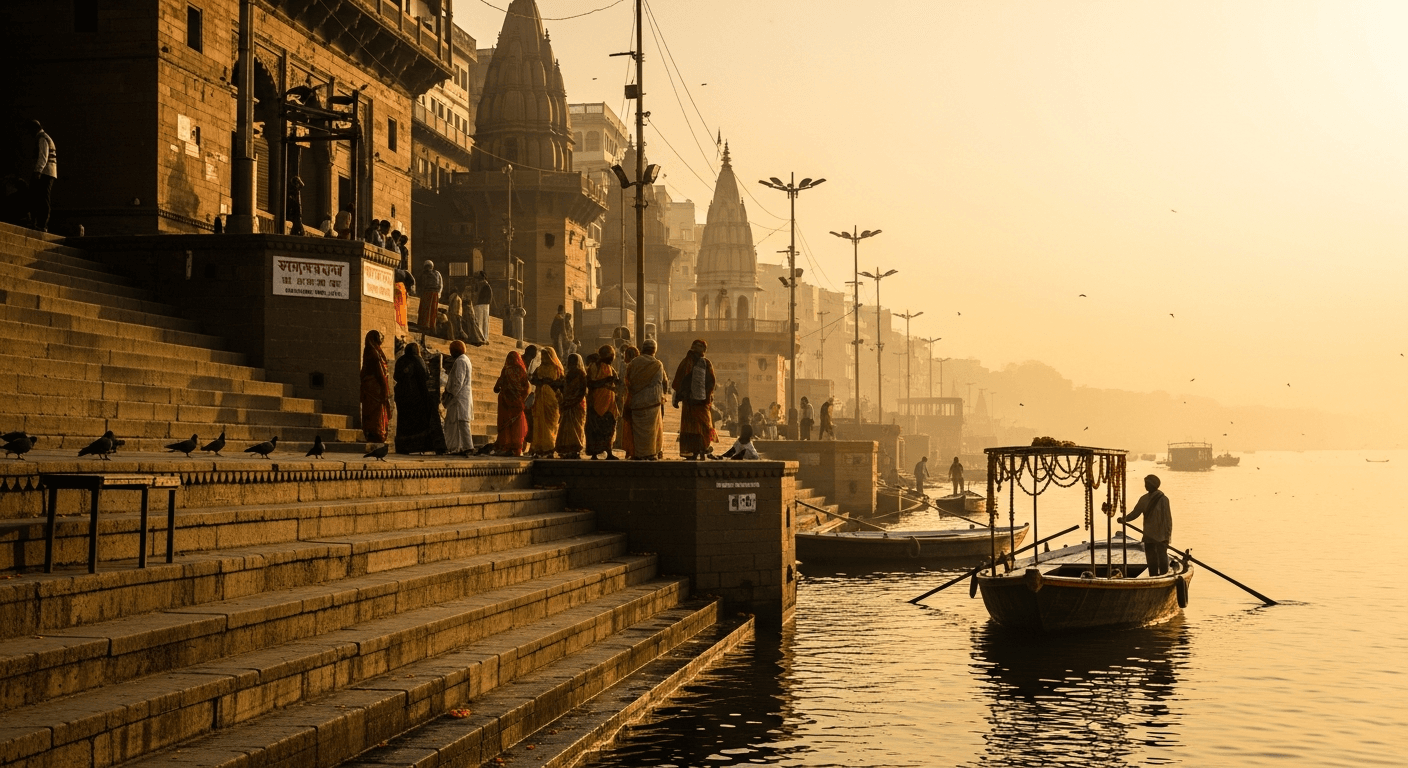
Dashashwamedh Ghat: Where Varanasi Shows You What Faith Actually Looks Like
The first time you see it, you think you've arrived at the wrong place.
There's no grand entrance, no ticket booth, no manicured steps leading somewhere important. There's just a sloped stone platform crowded with people—some sitting cross-legged, others standing with palms pressed together, a few children running between tourists who are trying to photograph everything at once. The Ganges moves past like it always has, indifferent to the centuries of human intention lining its banks.
Then evening falls, and something shifts.
Dashashwamedh Ghat isn't a destination you check off a list. It's a place where you stumble into understanding something about how people actually live with their faith—not in temples hidden away from the world, but right here, in the open, with tea vendors and boat salesmen and pilgrims and confusion all mixed together.
The Historical Weight, Lightly Held
Dashashwamedh is the second ghat downstream from Assi, positioned right at the heart of Varanasi's ghat system. The name itself tells a story: Dasha means ten, ashwa means horse, medh means sacrifice. According to Hindu mythology, this is where the god Brahma performed a ten-horse sacrifice (an ancient Vedic ritual) thousands of years ago. Whether that happened exactly here, or somewhere else entirely, or at all, depends somewhat on which source you're reading. But the point isn't the historical verification—it's that people have believed this for long enough that belief itself has become the real story.
What matters more, practically speaking, is that Dashashwamedh developed into the main ghat for public bathing and ritual washing. It's where most tourists end up, and it's also where most locals come to bathe in the river. This combination—tourist and pilgrim occupying the same stone steps—creates a particular kind of energy that feels neither commercialized nor purely spiritual, but something more honest.
What Makes This Place Stick With You
I've visited Varanasi three times now, and each time I find myself at Dashashwamedh, not because I planned it but because I keep getting pulled back. It's not the architecture (there isn't really any—it's just steps). It's not a single spectacular sight. It's the texture of the place.
In the morning, the ghat is functional. Pilgrims wade into the river, some dunking completely, others just filling their cupped hands and letting the water run over their heads and shoulders. The sun hasn't burned off the mist yet. The water is coldly brown. A man in a white dhoti stands waist-deep, reciting prayers in Sanskrit. An elderly woman sits on a middle step, dangling her feet toward the water but not actually entering. A chai vendor sets up his small metal stall.
By midday, everything has changed and nothing has changed. More tourists appear, holding phones aloft, trying to capture the exact image they've seen in travel magazines. Local boys hustle boat rides with a persistence that's more funny than annoying. The sun turns the stone hot enough to burn your feet if you walk barefoot. The smell of the river—not unpleasant, just distinctive—mixes with incense from the temples above and diesel fumes from the boats below.
Then comes the aarti.
The Evening Aarti: The Real Reason to Come
Dashashwamedh's main draw is the nightly aarti ceremony, performed at this ghat every evening around 6-7 PM (timing shifts seasonally). During aarti, priests in white and saffron robes perform an elaborate ritual of fire worship, waving large brass lamps in synchronized patterns while chanting hymns. Conches sound. Bells ring. Drums beat. The ceremony lasts maybe 30-45 minutes, depending on the day and the priests conducting.
Here's what travel writing usually doesn't tell you: it's crowded. Very crowded. During peak seasons, you'll have shoulder-to-shoulder contact with hundreds of other people, many of them also tourists with cameras. The ghat becomes a human crush. You can watch the aarti, but you won't be able to move, and if you're claustrophobic, this might not be your experience.
But this is also exactly why you should come.
Because what happens in that crowd is genuinely interesting. The aarti isn't performed for tourists—it's performed for the river, for the gods, for the faithful. The fact that you're watching is incidental. You're standing in the middle of an active religious ceremony, not a performance put on for your benefit. The priests aren't making eye contact with the camera operators. The pilgrims aren't performing gratitude for social media. This is what matters to these people, and you're witnessing it.
If you want a clearer view, there are multiple strategies. You can arrive 30-45 minutes early and stake out a spot closer to the platform where the priests stand. You can pay a boatman to take you out into the river—you'll see the ceremony from a better vantage point, though you'll miss the full atmospheric experience of being on the steps. You can come on a weekday rather than weekend, when crowds are marginally thinner. You can come multiple evenings and watch it unfold from different positions.
I've done all of these, and there's no "best" way. Just a series of tradeoffs between comfort, visibility, and immersion.
What the Experience Actually Feels Like
Let me walk you through the steps themselves, because understanding the physical layout helps contextualize what you're seeing.
The ghat is tiered—multiple levels of stone steps descending toward the river. The upper levels (where tourists tend to cluster) offer better views but feel more detached. The middle levels are where the real activity happens: pilgrims bathing, locals washing clothes, children wading. The lowest levels touch the water and are mostly submerged depending on the river's level. During monsoon season, some steps disappear entirely under water.
There are no guard rails. There's no safety infrastructure. If you slip, you go into the Ganges. This is worth knowing before you come, especially if you're wearing sandals on wet stone.
The surrounding buildings are narrow, four or five stories tall, mostly old brick and stone with laundry hanging from windows. Some are religious buildings. Some are hotels. Some are restaurants. The density is remarkable—you can move from the ghat steps directly into a narrow alley, and in 30 seconds you're in a completely different world of shop-lined passageways and quiet courtyards.
In the evening, just before aarti begins, the light changes. The sun hits the west side of the Ganges, turning the water the color of dull gold. The shadows deepen in the alleyways. The air cools just slightly. And then the priests appear, and the ceremony begins, and for the next 45 minutes you're part of something that has been happening in roughly this same form for centuries, in this same location, with largely the same rituals.
Planning Your Visit: The Practical Reality
Best time to visit: October through March. The weather is cool enough to spend hours sitting on stone steps without dying, and the river is lower (making more steps accessible). Avoid July-September monsoon and May-June heat unless you're genuinely committed.
Duration: Plan for 2-3 hours if you're coming specifically for the aarti. This gives you time to explore the ghat, grab food if you want, and position yourself before the ceremony. If you're visiting Varanasi more broadly, you might come here multiple times—once during the day, once for the evening aarti, maybe once more for sunrise.
How to get there: Dashashwamedh Ghat is accessible on foot from most central Varanasi locations. If you're arriving by rickshaw or taxi, ask to be dropped at the main ghat entrance. From there, you'll navigate a narrow market area for 3-5 minutes before reaching the actual steps. There's no parking at the ghat itself.
Crowds: Weekday evenings are noticeably less crowded than weekends. If you come during festivals (like Diwali) or on special religious occasions, expect the crowds to multiply significantly. The aarti still happens, but your personal experience will be more about managing the human density than anything else.
Cost: Accessing the ghat itself is free. Boat rides from the ghat typically cost 300-500 Indian Rupees per person (around $3.50-6 USD) for a 30-45 minute ride. The aarti ceremony doesn't require payment, though some boatmen will suggest you "tip" the priests after the ceremony. You're not obligated.
What to bring: Comfortable walking shoes with good grip (the steps are slippery). A small bag for valuables. Sunscreen if you're going during the day. A sarong or shawl if you want to cover your shoulders respectfully during the aarti. Patience, if large crowds stress you out. A camera or phone if you want to photograph (though put it down sometimes and just observe).
Nearby Places Worth Your Time
Manikarnika Ghat (5-minute walk): Varanasi's main cremation ghat. This is where bodies of deceased Hindus are cremated, sometimes dozens per day. It's not a pleasant place to visit, but it's genuinely important for understanding Varanasi. The smell is strong. The experience is uncomfortable. Go anyway, if you can manage it emotionally. Manikarnika offers something true about death and ritual that most places don't acknowledge.
Assi Ghat (10-minute walk downstream): Quieter, more local, less touristy. Pilgrims bathe here in large numbers, especially in the morning. There's a beautiful Shiva temple at the top. No evening ceremonies, but the atmosphere feels more grounded and less performative. If Dashashwamedh feels too crowded, head here instead.
Gyan Vapi Mosque (15-minute walk): A working mosque built partially over what was once a Hindu temple site (specifically, where the Gyan Vapi well is located). This is an archaeologically and religiously contentious site. It's still an active place of worship, so be respectful—remove your shoes, cover your shoulders, move quietly. It exists in complicated relationship with the city's religious history.
Is It Worth Visiting? The Honest Answer
Yes, but with a caveat.
Dashashwamedh Ghat is genuinely worth experiencing, particularly for the evening aarti. But it's not a miracle worker. It won't transform you spiritually. It won't give you answers. What it will do is show you how millions of people practice their faith in a public, practical, unglamorous way. It's real in a way that travel brochures aren't.
The crowds are real. The smell of the river is real. The religious devotion is real. The tourist bustle is real. The aarti ceremony is real, even if you feel like an outsider watching it.
Go if you're curious about how people actually believe and practice, not just how places photograph. Go if you can sit with discomfort for a while. Don't go if you're looking for spiritual transcendence—that's a different kind of place, and honestly, it's usually quieter and less touristed.
Quick Facts
- Best time: October-March
- Aarti time: Daily 6-7 PM (check locally for exact times)
- Distance from Varanasi city center: 1-2 km
- Accessibility: Accessible by foot; stairs are steep and slippery
- Photography: Generally allowed, though respect the ceremony
- Bathing: Pilgrims swim here daily; tourists sometimes do as well (water quality is a consideration)
- Nearby amenities: Restaurants, guesthouses, and shops in surrounding streets
- Religious significance: Major pilgrimage site; one of Varanasi's oldest ghats
Dashashwamedh Ghat occupies an unusual position in Varanasi tourism—it's a major tourist attraction, but it doesn't feel designed for tourists. It's a working religious space that tourists happen to visit. That tension is exactly what makes it worth going to.
When you're standing on those steps during the evening aarti, surrounded by hundreds of people, watching firelight flicker across the Ganges, you're seeing something unmediated. You're not in a museum. You're not looking at a monument. You're in the middle of a living practice.
Whether that's meaningful or just crowded depends entirely on what you bring to the experience.
For more exploration of Varanasi and route planning through the ghats, check out Touratu's interactive map, where you can trace your path along the river and watch travel videos that show exactly what to expect when you arrive.
Loading activities…
