
Dudhwa to Pilibhit Safari Route: UP's Wildlife Corridor Guide
Forest Safari
Dudhwa to Pilibhit: The Forest Safari Route in UP That Wildlife Lovers Are Rushing to Book
Where the Terai Whispers and Tigers Still Roam
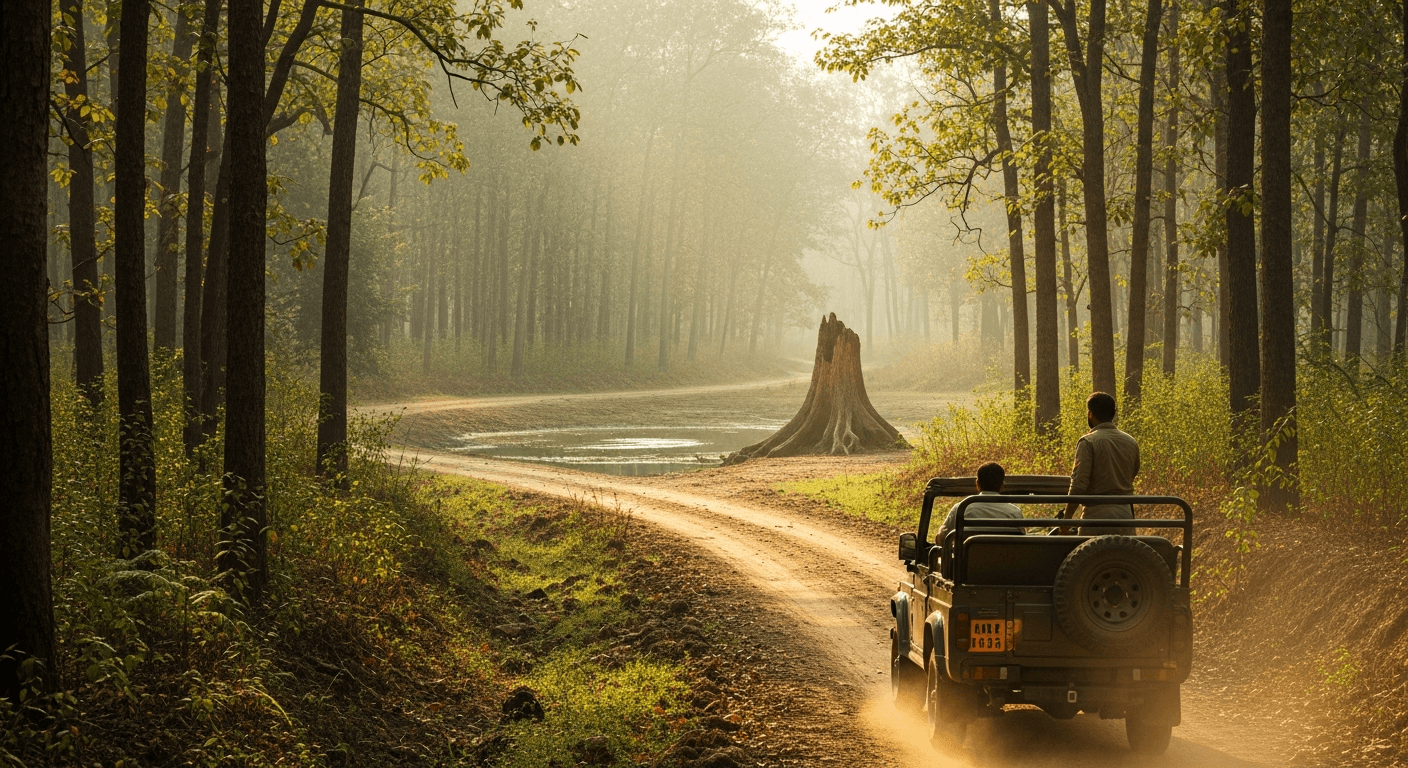
The jeep engine cuts out. In the sudden silence, you hear it — the forest breathing. Not metaphorically, but literally: the creak of sal trees adjusting to morning heat, the distant alarm call of a spotted deer, the rustle of something large moving through elephant grass taller than your vehicle. You're somewhere between Dudhwa and Pilibhit, in a corridor of wilderness that most of India has forgotten exists.
This isn't Corbett. This isn't Ranthambore with its luxury tents and Instagram queues at watering holes. This is Uttar Pradesh's forgotten frontier — a 150-kilometer stretch of terai forest that runs along the Nepal border, where tigers still pad through morning mist and swamp deer gather in herds that can number in the hundreds. Where barasingha antlers catch the first light of dawn like strange, beautiful antennae, and fishing cats hunt in marshlands that most wildlife photographers have never heard of.
The Dudhwa-Pilibhit corridor is experiencing a quiet revolution. Word has spread among serious wildlife enthusiasts — not the tiger-tick-list crowd, but the patient observers, the bird nerds, the photographers willing to wait. They come for what's increasingly rare in India's overrun national parks: genuine wilderness immersion, the chance of unexpected encounters, and mornings where your safari vehicle might be the only one for kilometers. The rush isn't a stampede — not yet — but it's building, and those who understand what's at stake are booking now.
Dudhwa National Park: Where Time Forgot to Modernize
The main gate at Dudhwa opens before dawn, and what strikes you first isn't the forest but the quality of silence. No chai stalls blaring Bollywood. No queue of twenty vehicles jostling for position. Just a chowkidar with a register, the smell of wood smoke from somewhere distant, and a road disappearing into darkness that will, within minutes, become cathedral.
Dudhwa exists in a time warp. The infrastructure is deliberately minimal — basic forest rest houses, no luxury camps, limited vehicle permits. This isn't neglect; it's preservation of something increasingly precious: a park experience that feels like wilderness rather than wildlife theatre. The sal forests here grow so dense in places that mid-morning feels like perpetual twilight. Grasslands stretch to the horizon in others, their tall grasses hiding one of the world's last viable populations of swamp deer.
The Tiger Dynamic: Dudhwa's tigers are different. They've grown accustomed to solitude, not vehicles. Sightings happen, but they happen on the tiger's terms — a flash of orange through grass, a figure drinking at a distant pool, the eerie sensation of being watched from somewhere you can't quite identify. Veteran visitors describe it as "honest wildlife" — you earn your sightings here.
Best Time: Late February through April brings the dry season, when animals concentrate around water sources and visibility through thinning vegetation improves. But November's post-monsoon freshness, when the grasslands glow golden-green, offers a photographer's light that April's harsh sun cannot match.
What Veterans Know: Request Zone 1 or Zone 2 for tiger probability, but don't dismiss Zone 4's wetlands if you care about anything beyond big cats. The Sathiana and Sonaripur ranges hold some of the finest bird concentrations in northern India.
The Dudhwa Barasingha Phenomenon: Antlers at Dawn
Before the tiger obsession consumed Indian wildlife tourism, people came to Dudhwa for one animal: the swamp deer, or barasingha. The name means "twelve-tined" in Hindi, referring to the magnificent antlers carried by mature males — though counts of fourteen or more points aren't unusual here.
The Dudhwa barasingha population is genetically distinct and critically important. The subspecies that roams these grasslands exists nowhere else on Earth in viable numbers. Watching them at dawn, gathered in herds across the Sathiana grasslands, remains one of India's most underrated wildlife spectacles. The males spar during mating season (December through January), their antlers clashing in sounds that carry across the misty plains.
The Visual Moment: Position yourself at Sathiana's grassland edge during golden hour. The deer emerge from tall grass as the mist lifts, their forms dissolving and reforming in light that photographers call "Dudhwa amber." The best shots come when you stop trying to capture everything and focus on a single stag, silhouetted against the rising sun, steam rising from its breath.
Practical Timing: The early morning hours (6:00-8:30 AM) offer the best combination of light and activity. By mid-morning, herds move into deeper grass, becoming invisible until late afternoon.
Kishanpur Wildlife Sanctuary: The Forgotten Buffer
Connected to Dudhwa but operating under its own quieter rhythm, Kishanpur occupies the southeastern edge of the protected area. Most visitors pass through it in transit, seeing only the main road. Those who request dedicated Kishanpur safaris discover something different: a sanctuary where the forest feels genuinely wild because human presence has been genuinely minimal.
The Sharda River runs along Kishanpur's boundary, creating riverine habitat that differs markedly from Dudhwa's sal forests. Here, mugger crocodiles bask on sandbanks. Smooth-coated otters hunt in channels that few tourists ever visit. The birding, particularly for winter migrants, rivals anything in more famous wetlands.
The Insider Move: Ask your naturalist about accessing Kishanpur's western marshes during late winter. The area rarely appears on standard safari routes, but it concentrates waterfowl in densities that birders describe as "embarrassingly productive."
What Makes It Different: Kishanpur lacks Dudhwa's name recognition, which translates directly into fewer vehicles and a heightened sense of discovery. The accommodation options are even more basic — this matters to some visitors, but for others, it's precisely the point.
The Corridor: Understanding the Wildlife Highway
Between Dudhwa and Pilibhit lies something invisible on tourist itineraries but crucial to everything that lives here: the forest corridor. This isn't a single road or trail but a network of protected forests, community lands, and wildlife passages that allow animals to move between the two reserves.
Tigers use it. Elephants definitely use it — sometimes appearing in villages that haven't seen them in years, moving through in search of territory or mates. The corridor's existence explains why both parks remain genetically healthy, their animal populations mixing and dispersing rather than inbreeding into decline.
Driving between the parks, you're not just in transit. You're moving through one of northern India's most important conservation landscapes, a living connection that conservationists fought decades to protect. The villages along the way have their own relationship with the forest — complicated, sometimes difficult, but essential to the corridor's survival.
Timing the Transit: The drive takes roughly 4-5 hours depending on road conditions and stops. Consider breaking it at Mailani or Puranpur, where local dhabas serve surprisingly good dal and the chai comes thick and sweet.
Pilibhit Tiger Reserve: The Rising Star
Pilibhit didn't make tiger tourism news until recently. The reserve gained Tiger Reserve status in 2014, a relative newcomer compared to the establishment Corbetts and Bandhavgarhs of Indian wildlife. But what's happening here has the conservation community quietly excited.
Tiger numbers have climbed. The reserve's mix of sal forest, grasslands, and terai swamps supports a prey base dense enough to sustain a growing predator population. More importantly for visitors, Pilibhit hasn't yet developed the crowds that make some popular reserves feel more like zoos than wilderness.
The park's character differs from Dudhwa. Pilibhit feels younger somehow — the tourism infrastructure still developing, the guides still genuinely enthusiastic rather than routine-hardened, the forest roads still capable of surprise. Sightings here carry an edge of genuine uncertainty that more established parks have lost.
Best Zones: The Mahof and Barahi ranges currently offer the highest probability of tiger encounters, but this shifts seasonally. Local guides know recent patterns — trust their judgment over generic advice.
The Unexpected Highlight: Pilibhit holds one of northern India's best chances for seeing fishing cats in the wild. These elusive wetland specialists hunt in the reserve's numerous streams and marshes, and while sightings remain rare, they happen here with greater frequency than almost anywhere else.
The Swamp Ecosystem: Wildlife Beyond Tigers
Both parks share a landscape feature that makes them ecologically distinct: the terai swamps. These seasonal wetlands — lush after monsoon, contracted but crucial during dry months — support wildlife assemblages found nowhere else in India's more famous reserves.
Gharials still survive here, their populations small but persistent. Marsh crocodiles lounge on mudbanks with an indifference to human presence that suggests they've seen few vehicles. The wetlands attract migrating waterfowl in winter, transforming into temporary homes for species that breed in Siberia and Central Asia.
For wildlife photographers, the swamps offer something Ranthambore's dry deciduous forests cannot: reflection shots. Animals approaching water appear twice — once in reality, once in mirror — and the quality of morning light through rising mist creates an atmosphere that photographers describe as "painterly."
Practical Consideration: Mosquitoes in wetland areas can be aggressive, particularly during dawn safaris in warmer months. Long sleeves, repellent, and strategic positioning downwind make the difference between tolerable and miserable.
Elephant Encounters: The Unpredictable Giants
Unlike southern Indian forests where elephant sightings are near-guaranteed, Dudhwa and Pilibhit's elephant encounters remain genuinely wild. The herds here move between Indian and Nepali territories, their patterns seasonal and difficult to predict. This unpredictability is precisely what makes seeing them meaningful.
When elephants appear, they appear on their own terms. A herd crossing a forest road will cross when it chooses — safari vehicles wait, engines off, as matriarchs assess whether these strange metal boxes pose any threat worth acknowledging. Calves stay close to mothers. Juveniles sometimes approach with curiosity that guides gently discourage.
The Safety Reality: Unlike habituated elephants in some southern parks, terai elephants can be genuinely dangerous. Guides maintain larger distances, and for good reason. This isn't nervousness — it's respect for animals that haven't learned to tolerate human proximity.
The Bird Spectacle: Beyond the Megafauna
Serious birders come to this corridor not despite its tiger reputation but because of its habitat diversity. The combination of sal forest, grassland, wetland, and riverine ecosystem creates niches for species that simply don't overlap elsewhere.
Winter months bring migrants: Dalmatian pelicans in declining numbers, various cranes, waterfowl by the thousands. But resident species alone justify the birding pilgrimage — Bengal floricans displaying in grasslands, great slaty woodpeckers hammering through forest giants, pallas's fish eagles hunting over rivers that feel prehistoric.
The Birding Strategy: Dedicate at least one full morning to a pure birding safari — no tiger focus, no grassland priority, just following wherever the birds lead. The experience differs fundamentally from mammal-watching, requiring slower movement and longer pauses.
Best Season for Diversity: November through February combines winter migrants with comfortable temperatures. April brings summer visitors but also increasingly brutal heat that affects both bird activity and birder endurance.
Accommodation Realities: Managing Expectations
This corridor does not offer luxury wildlife experiences in the conventional sense. Those expecting Pench's elegant lodges or Kaziranga's upscale resorts will find the infrastructure here deliberately minimal.
Forest rest houses — operated by the forest department — provide basic but atmospheric accommodation within or near park boundaries. Rooms are clean rather than comfortable. Hot water arrives in buckets. Electricity follows its own schedule. But waking at 5 AM to forest sounds rather than air conditioning hum carries its own value.
Private options are emerging, particularly around Dudhwa's periphery, but they remain modest by wildlife tourism standards. This is beginning to change — some tour operators now offer organized stays with better amenities — but the corridor has deliberately resisted the luxury overdevelopment that has transformed other reserves.
Booking Reality: Forest rest house accommodation requires advance booking through the forest department, often months ahead for peak season. Private lodges fill faster than their online availability suggests. Plan this trip in advance, not as a spontaneous weekend escape.
Planning the Route: Practical Intelligence
The Ideal Duration: Seven nights allows genuine immersion — three nights Dudhwa, one night transit or Kishanpur, three nights Pilibhit. Shorter trips feel rushed; longer trips allow for weather contingencies and repeat visits to promising zones.
Getting There: Lucknow serves as the nearest major airport. From there, private transfers (5-6 hours to Dudhwa) or train connections to Palia Kalan or Shahjahanpur offer options. Self-driving is possible but the final forest approaches require local knowledge during monsoon.
Season Selection: Mid-November through late March offers the optimal window. February through March provides the best tiger sighting probability as water sources concentrate animals. November through January favors birding and comfortable temperatures.
Permits and Access: Both parks require entry permits, usually arranged through accommodation providers or tour operators. Vehicle limits remain strict — this is a feature, not a bug. Book safaris well in advance; same-day availability is genuinely rare during peak months.
Navigating the Experience Thoughtfully
The Dudhwa-Pilibhit corridor rewards patience over hustle. Visitors who arrive expecting Ranthambore's reliable tiger sightings and Instagram-ready viewpoints will leave disappointed. Those who come understanding that wilderness operates on its own schedule — that a morning without sightings can still be profound, that forest silence is itself an experience — find something increasingly rare in Indian tourism.
Local guides here haven't yet developed the cynicism that years of demanding tourists produce elsewhere. They still get excited about interesting pugmarks. They still stop the vehicle for good bird sightings even when their clients have tiger tunnel-vision. This enthusiasm is worth preserving by being the kind of visitors who appreciate it.
Cultural sensitivity matters in the villages along the corridor. These communities live with wildlife in ways that are sometimes difficult — crops raided by elephants, livestock occasionally lost to predators. Conservation here is a negotiation, not a given. Visitors who understand this complexity contribute to the balance that keeps the corridor functioning.
Discovering Your Own Route
For travelers ready to explore the Dudhwa-Pilibhit corridor, Touratu's interactive maps offer a way to discover what others have found — safari routes mapped by previous visitors, reels from specific zones and seasons, visual stories from the terai that reveal what's possible when you know where to look. Sometimes the best preparation is seeing how other wildlife enthusiasts have navigated the same forest roads.
The Forest That Rewards Those Who Seek It
Standing at a Pilibhit waterhole during that final golden hour of an afternoon safari, watching the light go amber and then orange and then briefly, impossibly pink, you understand why this corridor matters. Not because it promises sightings — no honest wilderness can promise that — but because it offers something that might matter more: the possibility of genuine wildness.
The tiger might appear. The barasingha probably will. The morning mist will definitely rise through sal branches in ways that make you reach for your camera and then put it down, realizing some moments exist for memory rather than documentation. This is what's rushing people to book — not the wildlife alone, but the increasingly rare experience of being somewhere that hasn't yet been optimized, packaged, and tourist-proofed into predictability.
The corridor is quiet now. It won't stay quiet forever. The roads will improve; the lodges will multiply; the vehicle limits will face pressure. But for now, for these years while the balance holds, the terai offers something worth the basic accommodation and the early mornings and the uncertainty of what each safari might hold.
It offers wilderness that still feels like wilderness. In India, in this century, that's worth traveling for.
Loading activities…
