
Ganga Aarti Varanasi: Experience Hindu Fire Ritual
Ganga Aarti in Varanasi: Witnessing Fire and Ritual on the Holiest River
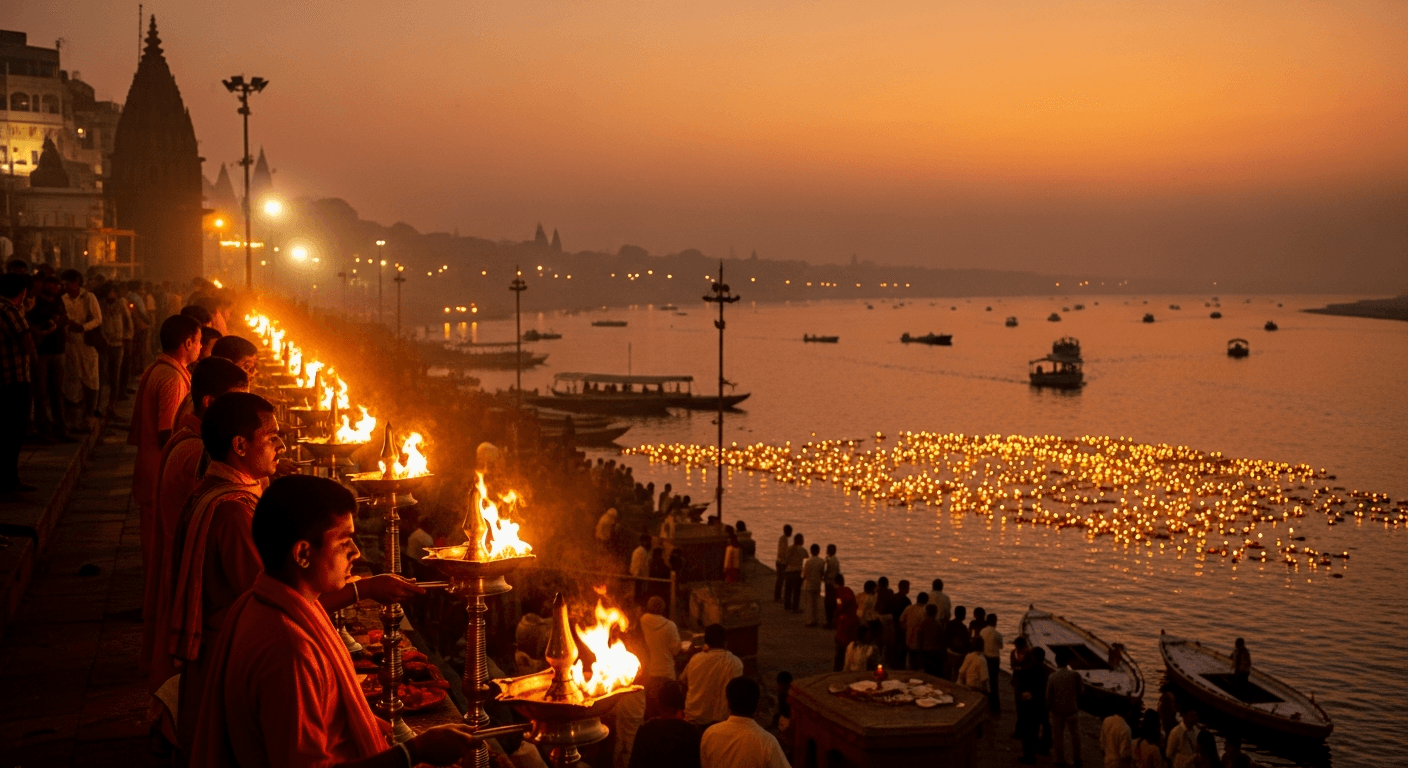
The first time I saw the Ganga Aarti, I was standing shoulder-to-shoulder with a thousand other people on a marble platform at Dashaswamedh Ghat, trying to remember how to breathe. A priest in a saffron dhoti had just lifted a massive candelabra—a structure of flame that seemed to defy both physics and reason—and swung it in a deliberate arc across the darkening sky. The river below caught the reflection, and for a moment, I couldn't tell where the fire ended and the water began.
This is not a serene experience. It's not meditative. It's not particularly comfortable. But it is absolutely real, and that's precisely why people return to Varanasi for it, year after year.
What Makes the Ganga Aarti Actually Worth Your Time
The Aarti (pronounced "ar-ti") is a Hindu ritual of worship performed with fire, and the Ganga Aarti at Dashaswamedh Ghat in Varanasi is the most famous one in India. It happens twice daily—at sunrise and sunset—and draws pilgrims, tourists, and locals who've made this their routine for decades.
But here's what matters: this isn't theatre staged for camera phones. Yes, tourists outnumber pilgrims now. Yes, the ghat has been engineered to accommodate crowds. Yet something genuine persists. The priests are performing a ritual they've seen their fathers perform, and their fathers before them. The prayers are offered to a river that's been sacred for over 2,000 years. The fire is real. The devotion is real.
I've attended Aarti ceremonies in other Indian cities—Haridwar, Rishikesh, even smaller ghats in Varanasi itself. None of them carry the weight of Dashaswamedh. This is the main event. The scale is larger, the choreography more refined, the energy more electric. The five priests move in synchronised patterns they've rehearsed thousands of times. They lift brass lamps—each one heavy enough to require both hands—and swing them with the kind of practiced precision that comes from doing something the same way every single day.
The ritual acknowledges the river as both mother and deity. The fire purifies. The water cleanses. By the end of the ceremony, the priests will have waved flames in specific patterns, rung bells so loud you'll feel them in your chest, and created a moment that's somehow both deeply religious and utterly contemporary—a 2,000-year-old ceremony watched by people from 50 different countries, many of them recording it on their phones.
What to Actually Expect When You Go
Let me start with the practical part: you'll be packed in with a lot of other humans. If you have any claustrophobia, any aversion to crowds, or any need for personal space, this is worth considering. During peak season (October to March), the ghat fills up 30-45 minutes before the ceremony begins. By the time the first priest steps forward, you're unlikely to have more than six inches of space on either side of you.
The smell is layered—marigold garlands, incense, the Ganges itself (which smells like a river where 200 million pilgrims bathe annually), and quite often, people who've been sitting in the sun for an hour. It's not unpleasant; it's just honest.
The sound is orchestral chaos. Bells of different sizes ring at different pitches. A conch shell is blown—a long, low note that seems to vibrate through the marble. Priests chant Sanskrit shlokas. The crowd murmurs prayers. Someone's phone is playing a recorded mantra loudly. It's overwhelming for the first five minutes. Then you stop noticing it as noise and start experiencing it as atmosphere.
The ceremony lasts about 45 minutes to an hour. You'll watch five priests work their way through a precise sequence. They'll purify themselves in the river water. They'll light the main candelabra—a brass structure called a candelabrum that holds five or six levels of oil lamps. They'll swing it in large, controlled arcs. They'll wave handheld lamps with individual flames. They'll ring bells that gradually get louder, faster, more intense, until there's a crescendo of sound that actually does feel transcendent rather than just loud.
The temperature on the ghat can be misleading. Even in winter, standing pressed against dozens of other bodies in the evening sun creates its own micro-climate. Bring water. Wear something you don't mind getting crushed. Leave your bag either in a hotel or in a small locker available on the ghat (they cost 20-30 rupees and are worth it).
The best vantage point isn't always the closest. If you're physically in the front row, you'll see the ceremonies but be constantly jostled. The second or third rows back often offer better angles and less aggravation. If you're genuinely interested in photography, the ghats on either side (Manmandir Ghat or Assi Ghat) offer quieter viewing spots with slightly longer sightlines.
Planning Your Visit: The Practical Essentials
Best time to visit: October to February. The weather is coolest, the crowds are larger (yes, larger), and the visibility is clearest. March to June is hot, September is monsoon season, and July-August has unpredictable river conditions. The January sunset Aarti tends to be the most crowded week of the year.
Duration: If you're only in Varanasi for the Aarti, you need at least an afternoon. Arrive by 3 or 4 PM, explore the ghats, grab food, settle into a ghat position by 5:30 PM for the sunset ceremony. Spending a full day or an overnight in Varanasi lets you attend both the sunrise and sunset ceremonies, which reveals different aspects of the ritual.
Getting there: Varanasi has a domestic airport with connections to Delhi, Mumbai, and other Indian cities. The train station is chaotic but well-connected to the Indian railway network. From the airport, auto-rickshaws or pre-booked cabs take 20-30 minutes to reach the Dashaswamedh Ghat area. Taxis are better than meters or random autos.
Accommodation: The Old City (Varanasi Cantonment) puts you within walking distance of the ghats but can be claustrophobic and extremely noisy early in the mornings. The newer Cantonment area is quieter, 1-2 km away, easily reached by auto-rickshaw for 50-100 rupees. I stayed at both and preferred being slightly further away with a more peaceful morning.
Cost: The Aarti ceremony is free. Entry to Dashaswamedh Ghat is free. If you want a guide (which can be helpful for context), expect to pay 300-500 rupees ($3.50-6 USD) for an hour. Local boat tours of the ghats cost 200-400 rupees per person for a 30-minute sunrise or sunset ride.
Crowds: The sunset ceremony is busier than sunrise. If you go at sunrise (5:30-6:30 AM), you'll encounter maybe 200-400 people instead of 1,500. The ritual is slightly shorter and feels less orchestrated, more intimate. Fewer tourists at sunrise, more local pilgrims.
Nearby Places Worth Your Time
Kashi Vishwanath Temple: The most important Hindu temple in Varanasi, dedicated to Shiva. It's a 10-minute walk uphill from Dashaswamedh Ghat through narrow, winding lanes packed with small shops and priests. The temple itself is small and often crowded, but the energy is different—more chaotic, less orchestrated. It's worth experiencing both the organized Aarti and the spontaneous devotion of the temple.
Assi Ghat: A 20-minute walk south along the river from Dashaswamedh. Assi is where the river Asi (a small tributary) meets the Ganges. The ghat is less crowded, the atmosphere more local. Morning here feels like watching a city actually wake up rather than perform for visitors. Pilgrims bathe, worshippers perform their own small pujas, and you can sit quietly if you've had enough crowds.
Manikarnika Ghat: The cremation ghat. This is where Hindus believe the dead achieve moksha (liberation). It's active 24 hours a day. The experience is sobering—watching funeral pyres while eating samosas feels somehow inappropriate, yet it's happening constantly. Respect is essential here. Don't take photos. Don't be flippant. But witnessing it changes your relationship to the Aarti and to the river itself.
Is It Worth Visiting? The Honest Answer
Yes, with caveats.
The Ganga Aarti is genuinely significant—not because it's been marketed as unmissable, but because it's been significant for centuries and remains so. It's a direct line to thousands of years of Hindu practice. You're not observing a historical reenactment; you're watching a living ritual that hasn't fundamentally changed its form in centuries, even if its audience has.
That said, it's not quiet, serene, or remotely isolated. If you're seeking a peaceful spiritual experience, you might find it more readily at a small temple or a meditation center. The Aarti is spectacle + spirituality + tourism all happening simultaneously.
The real value is in the contradiction. It's authentic and touristy. It's religious and performative. It's chaotic and precise. Those tensions are exactly what make it worth your time. You leave not with a sense of peace but with a sense of having witnessed something that continues to matter to millions of people, regardless of whether you "understood" it or took the right photo.
Quick Facts
- Location: Dashaswamedh Ghat, Varanasi, Uttar Pradesh, India
- Times: Sunset Aarti at 6:15 PM (varies by season). Sunrise Aarti at 4:30-5:00 AM (varies by season)
- Cost: Free
- Duration: 45 minutes to 1 hour
- Best for: Witnessing daily Hindu ritual, photography (if you're prepared for crowds), understanding Varanasi's spiritual significance
- Physical demands: Standing for 45+ minutes in close quarters. Stairs if accessing different ghat levels
- Photography: Permitted, but be aware of your surroundings and consider the experience first, photos second
- Guides: Helpful but optional. Available at the ghat or through hotels
Final Thoughts
The Ganga Aarti won't change your life unless you're looking to be changed. It won't deliver the profound transcendence that Instagram suggests. But it will give you something more valuable: an honest encounter with how millions of people practice faith, how ritual persists in modern life, and how a river can hold that much meaning for that many people.
If you're in Varanasi, go. Go at sunrise if crowds unnerve you. Go at sunset if you want the full spectacle. Go multiple times if you can. The ceremony doesn't reveal everything in one viewing—it's something you experience differently depending on what you bring to it.
To plan your route through Varanasi and explore the surrounding regions, check out Touratu's interactive map where you can trace paths through the Old City, mark the ghats you want to visit, and watch travel videos of other visitors' experiences. It's a practical way to prepare before you arrive.
Book Your Experience
Varanasi Tours
Loading activities...
Location
Data provided by Touratu - India
