
Greece Travel Guide: Top Things to Do
Greece: Why It Demands More Than A Two-Week Itinerary
You're standing in Plaka at dusk—the light turning Athenian stone the color of honey. A scooter whines past. Someone's playing bouzouki three tavernas down. And you realize Greece isn't a single experience you can check off. It's a place that reveals itself in contradictions: ancient temples standing beside laundromats, mountain villages where the internet barely works but the hospitality is genuine, islands that feel abandoned in winter and suffocating in August.
Greece does that. It doesn't perform for you. It exists, and you either move through it thoughtfully or rush through it collecting photos.
I've spent enough time here—scattered across seasons, ferries, and endless cups of coffee—to know that what makes Greece compelling isn't the mythology tourists memorize. It's the reality underneath: a living country that's simultaneously Mediterranean and Balkan, modern and traditional, brutally honest and disarmingly warm.
What Actually Makes Greece Memorable
The real texture of Greece emerges when you stop following the approved script. Yes, the Parthenon is architecturally extraordinary. But what stays with you is different: the barista in a side-street kafeneio in Thessaloniki who, upon learning you're Australian, launches into a story about his uncle who emigrated there in 1962. The fisherman in a village you found by accident who insists you taste his catch before deciding if you want to buy it. The 78-year-old woman in Crete who teaches you how to make horta (boiled greens) and refuses payment.
Greece's actual magic isn't photogenic. It's in the slowness of things. The way meals stretch across three hours because there's no hurrying. The persistence of community in small towns despite economic collapse. The sharp wit and self-deprecating humor that surfaces when you sit long enough anywhere to hear it.
What makes Greece worth traveling for is that it remains fundamentally unmoved by Instagram. That's becoming rare.
The archaeological sites are genuinely significant—the Parthenon, Delphi, Knossos—but you'll absorb them better if you arrive unprepared and let them affect you rather than if you've already written your caption. The islands are beautiful, but the real beauty is swimming at five in the afternoon when beaches empty out and the water turns transparent.
What to Expect: The Actual Experience
Athens is your entry point for most travelers, and it's a city of genuine contradictions. Street art covers walls in the Psyrri district with more creativity than you'll see in purpose-designed galleries elsewhere. The National Archaeological Museum contains artifacts that fundamentally changed how we understand human civilization. But you'll also find yourself stuck in traffic, dodging scooters, navigating a system where payment methods change depending on which neighborhood you're in.
The Acropolis shouldn't be your first stop. Go instead to the Temple of Hephaestus in the Roman Agora—it's technically more intact and almost empty. Then visit the Parthenon when you're ready for crowds and heat.
Delphi sits on a mountainside north of Athens with the kind of geography that made ancient Greeks believe it was the center of the world. The archaeological site spirals up the slope in a way that actually makes sense when you walk it. Bring water. The sun doesn't negotiate.
The Peloponnese—the southern mainland—contains some of the most significant archaeological sites (Mycenae, Sparta, Olympia) but also working villages where you'll see actual life. Drive the coast roads slowly. There's no reason to rush between ruins.
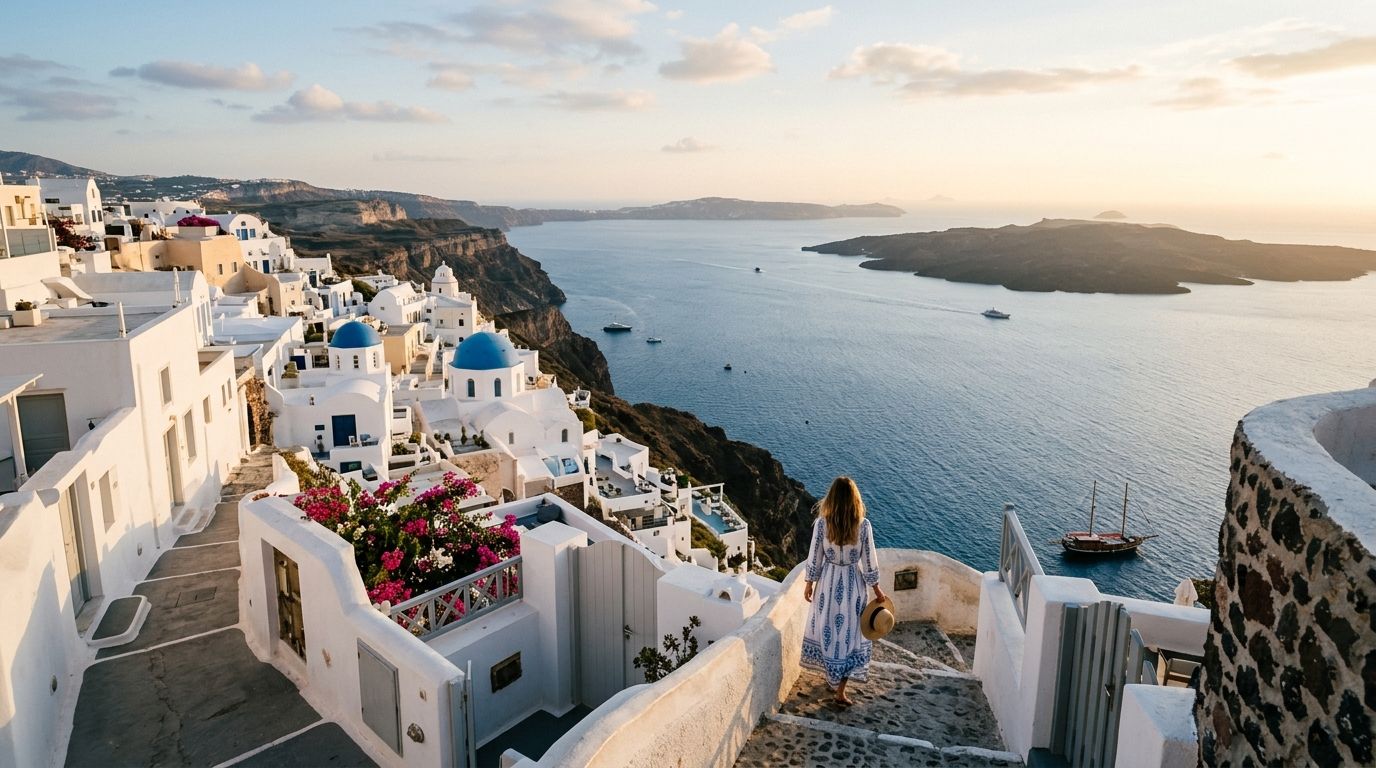
The Islands require different strategies. Santorini and Mykonos are expensive, crowded, and oversold—but they're crowded for a reason; the caldera views are dramatic and the food is genuinely excellent once you know where to look. Crete is larger and feels more like a complete place; you can spend weeks there. Paros, Naxos, and smaller Cycladic islands offer the familiar island experience without some of the commodification. The Ionian Islands (Corfu, Kefalonia) off the west coast have different geology and feel less Aegean, more Alpine-influenced.
The Food: Forget Greek salad as you know it—feta and tomatoes is the tourist reduction. Eat horta with lemon. Eat octopus grilled or in stifado (slow-cooked stew). Eat souvlaki from street stalls at midnight. Eat saganaki (fried cheese) when offered. Drink ouzo properly—diluted with water, in the afternoon, with mezze. The food works because the ingredients are simple and the cooking rarely pretends to be anything it's not.
The Language: Greeks appreciate effort. Kaliméra (good morning) and efharistó (thank you) will open more doors than perfect English. Older people in villages might not speak English. That's fine—it slows you down.
Planning Your Visit: The Practical Reality
Best time: May to early June, or September to mid-October. Everything else is either crowded (July-August), cold (December-February), or rainy (November, March). Spring is unpredictable—beautiful suddenly, then grey. Fall is reliable: warm, clear, less intense than summer.
How long: Two weeks is the minimum to feel like you've breathed the air and not just photographed it. Three weeks allows you to actually linger. A month lets you understand how things work and develop routines.
Getting there: Athens is the main hub. Direct flights from most major cities. Ferry connections to islands are extensive but slow—expect 6-12 hours to reach most islands.
Getting around: Domestic ferries connect islands and mainland. The buses (KTEL) are cheap and reliable, if occasionally run by drivers who seem to believe they're training for Formula 1. Rental cars give freedom but don't improve your experience dramatically—Greeks drive confidently and traffic in Athens is intimidating.
Crowds and seasons: August is genuinely unpleasant everywhere touristy. Ferries require advance booking. Hotels charge premium prices. Beaches become human car parks. Avoid it if you can. Off-season (November-March), much closes—entire villages shut down on islands. Many restaurants only operate in summer. This is a real trade-off, not laziness.
Budget: Greece is no longer cheap, but it's cheaper than Western Europe. A basic meal is €8-15. Hotels range from €30 for clean basic rooms to €200+ for anything with views. You can live on €40-60 per day if careful, €80-120 for comfort.
Nearby Places Worth Your Time
Meteora: Monasteries built impossibly on top of rock pillars in central Greece. The geology is arresting and the walk around the formations beats the interior of any monastery. Three hours from Athens.
The Peloponnese Peninsula: Connected to Athens by car or bus. Contains Olympia (original Olympic site, genuinely moving to stand in), Mycenae (one of the oldest European civilizations), and Sparta (less impressive archaeologically than its mythology suggests). Spend 4-5 days here instead of rushing. The drive south toward the Mani peninsula—limestone cliffs and small villages—is worth the road time.
Turkish Coast: If your timing allows, ferries run from Rhodes or nearby islands to Turkey's Mediterranean coast. A day trip to see how the other side of the sea lives. Practically, not culturally necessary—but geographically interesting.
Is It Worth Visiting? The Honest Answer
Yes, but not for the reasons Instagram suggests. Greece is worth visiting because it teaches you how to sit still, how to value conversation over entertainment, and how to exist in a place where not everything has been optimized for tourists.
It's worth visiting because the food is genuinely excellent and casual. Because swimming in Mediterranean water is a real sensation, not a metaphor. Because the light here actually is remarkable—it's not something photographers invented. Because you'll meet people in their 70s who speak no English but will try anyway, and the effort creates something real.
It's worth visiting because you'll see what happens to places when tourism becomes the primary industry—and you'll understand what we've gained and what we've lost. That's the most valuable education travel offers.
But go with the understanding that you're visiting a real country, not a museum exhibit labeled "Ancient Greece" for your benefit. Go slowly. Go when you can. Go expecting to be disappointed by some things and surprised by others. Go without a complete itinerary.
That's when Greece actually opens up.
Quick Facts
- Capital: Athens (population 3 million metro area)
- Language: Greek. English widely spoken in tourist areas, less elsewhere.
- Currency: Euro (€)
- Electricity: 220V, two round pin sockets
- Visa: EU/US/Australia/Canada citizens get 90 days visa-free
- Official time: EET (UTC+2)
- Population: ~10.7 million
Once you've decided where you want to explore in Greece, use Touratu's interactive map to plot your route, check transport times between locations, and discover videos from each region. You can also browse bookable activities directly—from ferries to guided tours—all organized by location and season. It transforms your itinerary from a Pinterest board into an actually functional plan.
Loading activities…
