
Guided Tours vs Exploring on Your Own: Which Travel Style Creates Better Experiences?
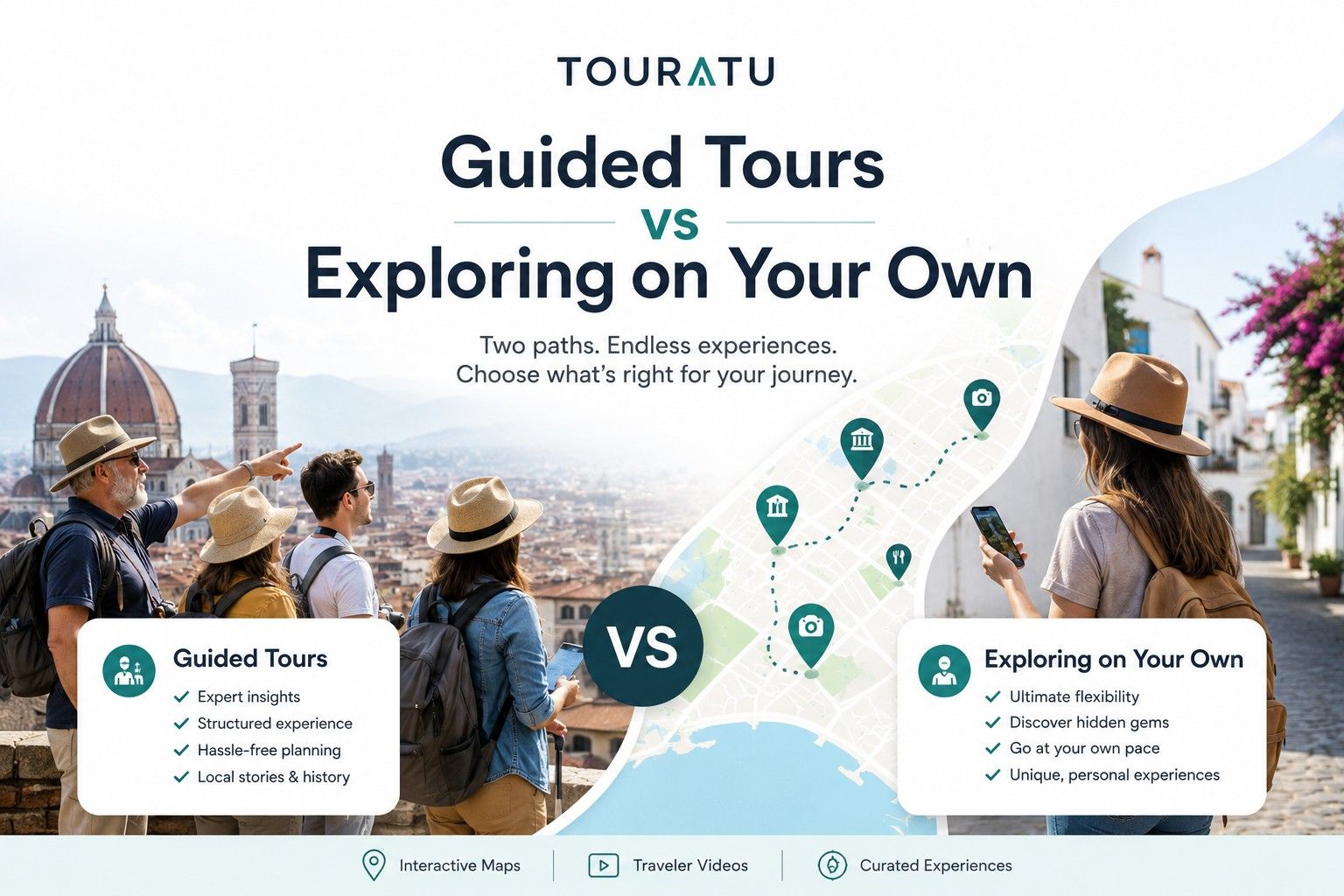
Introduction: There Is No Universal "Best" Way to Travel
One of the most common questions travelers ask before visiting a new destination is whether they should join a guided tour or explore independently.
The answer is rarely straightforward.
A guided walking tour through a historic city can uncover stories that would otherwise remain hidden, while wandering through local neighborhoods without an itinerary can lead to unexpected discoveries that become the highlight of an entire trip.
Modern travelers have more choices than ever before. Alongside traditional guided tours, they can now use interactive maps, traveler-generated videos, digital guidebooks, navigation apps, and local recommendations to design their own experiences.
At the Touratu Research Desk, we believe this is not a question of choosing one approach over the other. Instead, it is about understanding which approach best fits the destination, the attraction, and the traveler's personal goals.
This article compares guided tours and independent exploration, helping travelers understand when each approach delivers the greatest value and how combining both often leads to the most rewarding travel experience.
Why This Decision Matters
Every travel decision involves trade-offs.
Choosing a guided tour may provide convenience, expert knowledge, and time efficiency, but it can also reduce flexibility.
Exploring independently offers freedom and spontaneity, but requires more research and planning.
The wrong choice can lead to:
- Missing important attractions
- Spending unnecessary time navigating
- Overlooking local history
- Visiting overcrowded locations
- Feeling rushed or unprepared
The right choice helps travelers experience destinations with greater confidence and satisfaction.
The Independent Exploration Decision Framework™
Rather than asking,
"Should I book a guided tour?"
travelers should ask five more useful questions.
1. How Familiar Am I with the Destination?
First-time visitors often benefit from guided experiences because they provide context that is difficult to discover independently.
Returning visitors, however, may enjoy exploring beyond the main attractions at their own pace.
Ask yourself:
- Is this my first visit?
- Do I understand local transportation?
- Am I comfortable navigating unfamiliar places?
2. What Is the Purpose of My Trip?
Different travel goals require different approaches.
If your objective is to understand history, architecture, or local culture, a knowledgeable guide may significantly enhance the experience.
If your goal is photography, relaxation, or simply wandering through neighborhoods, independent exploration often provides greater freedom.
Understanding your travel objective should always come before choosing your travel style.
3. How Much Time Do I Have?
Time is one of the most valuable resources during travel.
Guided tours can help travelers cover major attractions efficiently, especially in destinations with complex transportation or large historical sites.
Independent exploration generally requires more time for navigation, decision-making, and spontaneous detours.
Travelers with limited time may benefit from structured experiences, while those with flexible schedules can often enjoy slower exploration.
4. How Comfortable Am I Planning?
Some travelers enjoy researching every attraction, comparing routes, and building detailed itineraries.
Others prefer having logistics arranged for them.
Neither approach is better.
The key is choosing the planning style that allows you to enjoy the destination rather than worrying about the schedule.
5. What Kind of Memories Do I Want to Create?
Some of the most memorable travel moments come from listening to stories shared by local guides.
Others come from unexpectedly discovering a quiet street, a neighborhood café, or a scenic viewpoint without following a schedule.
Your preferred travel memories often reveal which approach is more suitable.
Guided Tours: Strengths and Limitations
Guided tours remain popular for good reason.
Professional guides often provide historical, cultural, and local insights that are difficult to obtain independently.
Advantages include:
- Expert storytelling
- Efficient itineraries
- Simplified logistics
- Local recommendations
- Better understanding of historical sites
- Reduced planning effort
Guided tours are particularly valuable at:
- Archaeological sites
- Museums
- Historic city centers
- Wildlife experiences
- Adventure activities
- Food and cultural experiences
However, guided tours also involve limitations.
Travelers typically follow a fixed schedule and may spend less time at places they personally enjoy.
Group size, pace, and predetermined routes can reduce flexibility.
Independent Exploration: Freedom with Responsibility
Exploring independently offers a very different experience.
Instead of following a predefined route, travelers create their own journey.
This allows greater flexibility to:
- Change plans during the day
- Spend longer at favorite attractions
- Discover quiet neighborhoods
- Visit local cafés
- Explore hidden streets
- Follow personal interests
Independent exploration often produces a stronger sense of discovery because travelers actively shape their own experiences.
The trade-off is that successful independent travel usually requires more preparation.
Research, navigation, attraction timing, and transportation become the traveler's responsibility.
Guided Tours vs Independent Exploration
| Factor | Guided Tour | Independent Exploration |
|---|---|---|
| Flexibility | Limited | High |
| Local Knowledge | Excellent | Depends on preparation |
| Planning Required | Low | High |
| Time Efficiency | High | Moderate |
| Hidden Discoveries | Moderate | High |
| Cultural Context | Excellent | Variable |
| Cost | Usually higher | Often lower |
| Spontaneity | Limited | Excellent |
Neither option consistently outperforms the other.
The better choice depends on the destination and the traveler.
The Best Travel Strategy Is Often a Combination
One observation repeatedly appears across experienced travelers.
The most satisfying trips rarely rely entirely on guided tours or entirely on independent exploration.
Instead, travelers combine both approaches.
For example:
Morning:
Join a guided walking tour to understand the city's history.
Afternoon:
Explore neighborhoods independently using interactive maps.
Evening:
Discover local restaurants recommended by travelers.
This blended approach provides both knowledge and freedom.
How Interactive Maps Support Independent Exploration
Independent exploration has become significantly easier thanks to digital mapping technology.
Instead of relying solely on printed guidebooks, travelers can now visualize destinations before they arrive.
Interactive maps help travelers:
- Understand geographic relationships
- Discover nearby attractions
- Estimate walking distances
- Group attractions efficiently
- Identify hidden gems
Maps reduce one of the biggest challenges of independent travel: uncertainty.
Why Traveler Videos Matter
Reading about an attraction is helpful.
Watching someone experience it provides an entirely different perspective.
Traveler-generated videos help answer practical questions such as:
- What does the attraction actually look like?
- How crowded is it?
- Is the walk difficult?
- What views can I expect?
- How much time should I allow?
Videos reduce uncertainty before visiting.
They help travelers make more confident decisions while setting realistic expectations.
How Touratu Combines Both Travel Styles
Modern travel planning no longer requires choosing between guided experiences and independent exploration.
Touratu is designed to support both.
Travelers can begin by exploring destinations visually through interactive maps, discovering attractions, and watching traveler-generated videos pinned to their exact geographic locations.
Rather than viewing videos in isolation, travelers can immediately understand where they were recorded, what attractions are nearby, and how those locations connect within a destination.
For travelers who prefer independent exploration, this creates a richer planning experience.
They can build personalized itineraries by exploring nearby attractions, hidden gems, markets, restaurants, and scenic viewpoints directly from the map.
For travelers who want additional guidance, Touratu also connects destinations with curated experiences and guided tours from trusted partners. After understanding a destination visually, travelers can compare available experiences and decide whether a guided activity complements their itinerary.
Instead of replacing one travel style with another, Touratu helps travelers combine both according to their interests and travel goals.
When a Guided Tour Makes More Sense
Consider booking a guided tour when:
- Visiting a destination for the first time
- Exploring UNESCO World Heritage Sites
- Learning about history or architecture
- Participating in food experiences
- Joining outdoor adventure activities
- Visiting places with limited transportation
- Traveling with young children or large groups
When Independent Exploration Works Best
Independent exploration is often ideal when:
- Revisiting a familiar destination
- Enjoying photography
- Exploring local neighborhoods
- Visiting parks and beaches
- Shopping in local markets
- Looking for hidden gems
- Following flexible schedules
Final Thoughts
The debate between guided tours and independent exploration is often presented as an either-or decision.
In reality, both approaches offer distinct advantages.
Guided tours provide knowledge, efficiency, and expert insight.
Independent exploration encourages curiosity, flexibility, and personal discovery.
Modern travelers no longer need to rely exclusively on one method. Interactive maps, authentic traveler videos, and location-aware travel platforms have made independent exploration easier than ever, while guided experiences remain valuable for destinations where local expertise adds depth and context.
The most memorable journeys often begin with understanding a destination, continue with discovering it at your own pace, and are enriched by choosing guided experiences where they genuinely add value.
Travel is ultimately not about following someone else's itinerary or proving you can travel independently.
It is about creating experiences that match your interests, your pace, and your curiosity. The best travel style is the one that helps you connect more deeply with the places you visit.
Loading activities…
