
10 Instagram-Worthy Places in Uttar Pradesh
10 Most Instagram-Worthy Places in Uttar Pradesh That Every Traveler Is Secretly Saving
There's a particular kind of light in Uttar Pradesh—one that arrives just before sunrise, turning the Yamuna into molten gold and casting the ancient stones of temples and tombs in shades of amber you didn't know existed. This is the state where empires rose and fell, where devotion collides with commerce, where a seventeenth-century marble inlay catches your eye with such precision that you forget to breathe. But here's the thing about Uttar Pradesh: everyone is scrolling through its most iconic images on their phones, but something essential happens when you're actually standing there, camera in hand, watching how light moves across those surfaces. The frame you capture isn't just a photograph—it's a moment of understanding something deeper about beauty, time, and how civilizations have always reached toward the transcendent.
This isn't a list of the obvious. While the Taj Mahal will always command its throne, there are photographs waiting to be discovered in the quieter corners of this vast state—places where travelers are already marking their digital maps, creating private collections of images that feel like secrets. These are the locations where light, architecture, and human presence combine in ways that feel almost accidental, almost impossible to stage.
The Ten Places
1. Taj Mahal at First Light, Agra
Yes, everyone knows. But nearly no one experiences it correctly. Arrive when the gates open at 6 AM when the marble is still cool and the crowds haven't yet assembled into an Instagram army. The monument reveals itself in layers—first as a silhouette, then in gradations of pink and white and cream. There's a particular quality to the symmetry that doesn't translate through glass or screens. You'll understand why architects became obsessed with proportion.
The Taj transforms throughout the day, but those first ninety minutes belong to something closer to meditation than tourism. Position yourself from the main gateway looking inward—the minarets frame the dome like parentheses around a perfect thought. By 7:30 AM, the light will have shifted enough that you'll have captured three completely different versions of the same structure.
Best visited in October or November when the air is clear and cool. Arrive with a wide-angle lens if you're photographing, but spend at least twenty minutes without your camera, just observing. The gardens in winter hold a particular stillness that summer erases entirely. Wear layers—the marble stays cold longer than the air warms.
2. Fatehpur Sikri's Diwan-i-Khas at Golden Hour
This sixteenth-century city of red sandstone feels like a fever dream that Akbar actually built. Abandon the main courtyard where tour groups cluster, and move toward the Diwan-i-Khas—the private audience hall. The pillared chamber creates a geometry of shadow and stone that shifts every ten minutes as the sun moves. Late afternoon light streams through the central opening, illuminating dust motes like you're photographing an actual golden moment.
The emptiness of these chambers—despite being surrounded by tourists—creates an odd solitude. You can imagine the intrigue, the power plays, the carefully constructed hierarchies played out in this exact space. The red stone deepens to rust and wine-colored tones as evening approaches. This is where light becomes a collaborator rather than just an element.
Visit between 4 PM and sunset. The crowds thin considerably, and the quality of light becomes almost unfair in its beauty. Bring water—there's very little shade, and the stone radiates heat. The palace grounds are extensive enough that you can find genuine quiet if you drift away from the main paths toward the smaller pavilions.
3. Ganga Aarti at Varanasi—Dasaswamedh Ghat
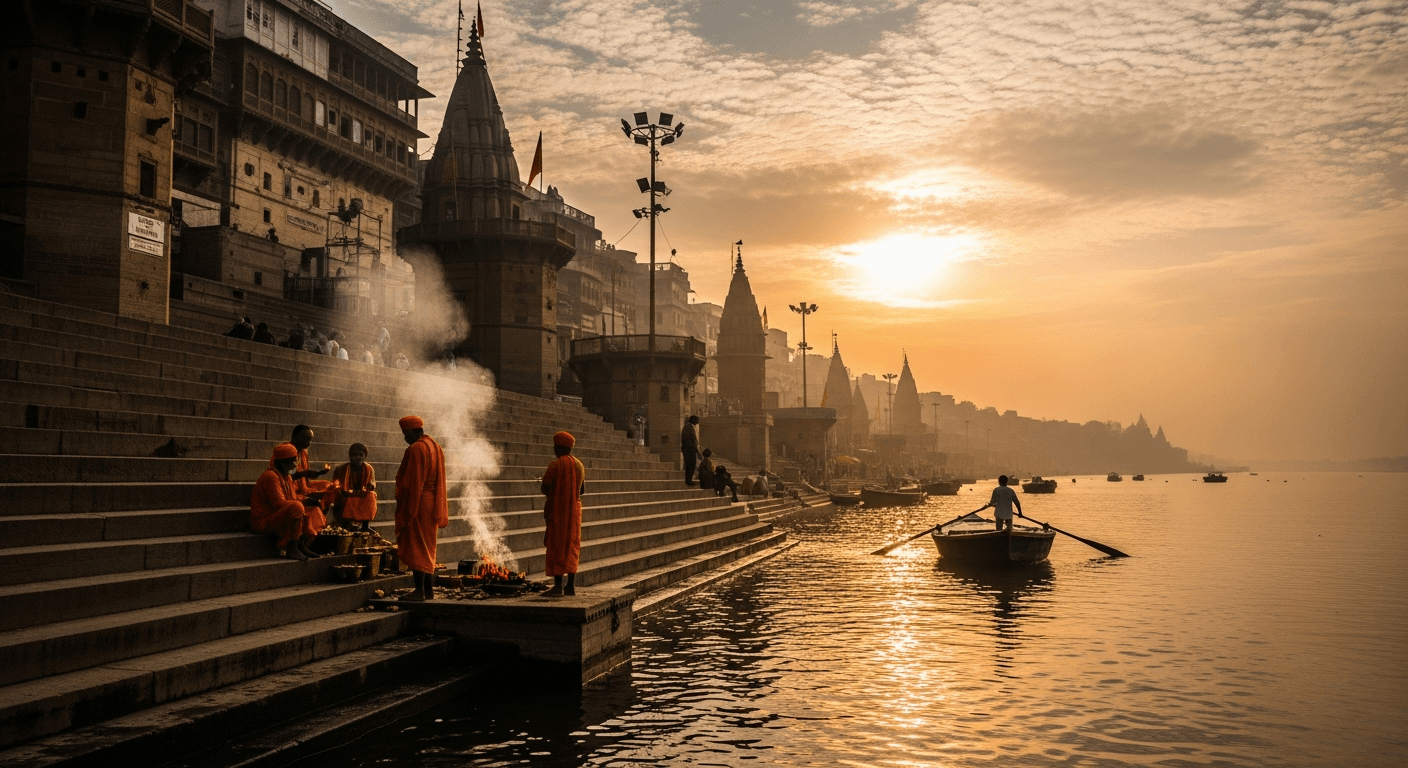
This isn't primarily about photography, though the visual composition is extraordinary. It's about presence. Hundreds of candles, oil lamps arranged on metal floats, priests in saffron moving through a choreography that's been refined across centuries. The Ganga reflects everything—the flames, the devotion, the chaos and order existing simultaneously.
The aarti happens twice daily, but evening is where the real visual story unfolds. Position yourself slightly upstream if you can, at ground level, where the flames become the foreground and the Ganga the narrative thread. The faces of worshippers matter more than the ceremony itself—that's where the actual content lives.
Best experienced between October and March when the evening air is cool and the river is lower, creating more intimate gatherings. Arrive early enough to secure a spot but late enough that the initial crowds have sorted themselves. Respect the ritual—this isn't performance, though it photographs like one. Wear long layers if you're female; bring a light shawl. The riverside at night carries a particular kind of cold.
4. Rumi Gate's Geometric Shadows, Lucknow
The Rumi Gate (Roomi Darwaza) is a relatively quiet monument—not famous enough to be mobbed, but architecturally significant enough to justify the diversion. It's an imposing structure of pale stone with proportions that verge on the austere. What makes it remarkable for photography is how light behaves around its geometric planes.
Early morning, when the sun is low and just catching the eastern face, creates shadows that look almost digital in their precision. The gate's dual arches create a frame within your frame. You could spend an hour here and not exhaust the compositional possibilities. There's a particular hush to this location—it feels like everyone is appreciating something slightly overlooked and therefore slightly precious.
Visit in the cooler months (November through February). Morning light is optimal. The surrounding area of Lucknow's old city is worth exploring, but the gate itself functions as a quiet meditation on proportion and time. Bring a tripod if you're planning to shoot; the light plays are precise enough to deserve careful framing.
5. Chikhalwali Haveli's Inner Courtyard, Varanasi
This isn't a famous monument. It's a working haveli—a merchant's mansion—that functions partly as a guesthouse and partly as a living archive of a particular way of life. The inner courtyard is where light does something architectural—it filters through carved stone screens (jali work) in patterns that change minute by minute.
The wooden balconies, the worn stone, the peacocks wandering through courtyards, the sound of the Ganga somewhere beyond the walls—these elements combine to create an atmosphere that feels less like a photograph opportunity and more like stepping inside a watercolor painting. The colors are muted: pale yellows, warm grays, the deep rust of aged wood.
You need permission to visit, but if you're staying at a haveli guesthouse (many exist in Varanasi's old city), you'll have access to these spaces. The best light occurs mid-morning when the sun reaches the courtyard without the harshness of direct overhead light. Respect resident privacy. Bring a book and stay for an hour—these spaces reward stillness.
6. Kashi Vishwanath Temple at Pre-Dawn Hours
The Golden Temple of Varanasi is perhaps overrun with visitors, but there's a threshold moment—roughly between 4:30 and 5:30 AM—when the atmosphere transforms. The pilgrims are meditative rather than touristic. The temple staff are preparing for the day. Lamplight still dominates over natural light.
The gold of the spire glows with an internal quality at this hour. The stone courtyard is damp and cool. You can hear the Ganga lapping below. This is the closest you'll get to understanding what this space meant before it became an Instagram destination.
Entry requires respect for the religious nature of the space. No shoes, modest dress, quiet movement. The crowds are genuinely smaller at dawn, but the spiritual atmosphere is markedly different—it's present rather than performed. This isn't a spot for aggressive photography; it's a place where observation matters more than collection.
7. Lucknow's Bara Imambara—The Labyrinth
The architecture is magnificent, but what matters here is the labyrinth. The Bhool Bhulaiyaa—literally "the maze"—is a warren of narrow passages on the upper floor, designed ostensibly as a cooling system but actually as an architectural puzzle. It's genuinely disorienting in a way that modern spaces rarely are.
The narrow corridors, the filtered light through stone screens, the way sound behaves in confined spaces—it becomes a physical metaphor for navigating complexity. Tourists do visit, but the labyrinth itself enforces slowness. You can't rush these passages. Your phone won't help you navigate. It's refreshingly analog.
Best visited mid-morning when it's not too hot but the light is good. The main courtyard is impressive but crowded; the real discovery is in the labyrinth itself. Allow yourself to get slightly lost. Bring water and a light layer—the passages stay cool. The architectural intelligence on display here—the way form and function interweave—deserves your attention.
8. Benares Hindu University—The Bharat Kala Bhavan
This museum exists in a university setting, and it feels like a secret that's remained undiscovered by most tourists. The collection is extraordinary: Indian miniature paintings, sculptures, manuscripts. The building itself is an example of early twentieth-century institutional architecture.
What strikes visitors isn't the crowding (there rarely is any) but the scale of what's preserved here. You're looking at centuries of artistic output in a quiet, well-lit space. The bhavan has a contemplative quality—it's a museum that rewards slow looking rather than checkbox visiting.
Visit on a weekday if possible. The university grounds themselves are pleasant for walking. Bring your student ID if you have one (discounts usually apply). The staff here are genuinely knowledgeable and helpful. This is a place where you can spend three hours and feel like you've learned something about Indian aesthetics across time.
9. Sarnath's Dhamek Stupa at Afternoon Light
Where Buddha taught his first sermon. The stupa is made of red brick and sandstone—materials that age beautifully. The archaeological park surrounding it has a particular peace; the Buddhist pilgrims who visit move with intention rather than haste.
The stupa is a study in geometric perfection and the way materials weather over time. The brick shows variations in color—russets, burnt oranges, pale yellows—that photographs beautifully in afternoon light. The carved stone panels are worth examining closely; they contain narratives in visual form.
Visit between 2 and 4 PM when the light becomes more textured and the heat begins to ease. The museum at Sarnath is also worth visiting, but the stupa itself is the photograph that will stay with you. The spiritual atmosphere here differs from Varanasi proper—it's quieter, more studious, less performative.
10. The Rathyatra (Chariot Festival) at Mathura—When It Happens
This requires timing, but every year (dates vary according to lunar calendar), the town of Mathura essentially transforms into a visual spectacle. Decorated wooden chariots, thousands of pilgrims, flower arrangements, the chaotic devotion that Indian festivals specialize in. It's not subtle, and it's not quiet, but it's visually extraordinary.
The best photographs come from elevated positions—find a rooftop or upper-floor vantage point beforehand. The color saturation, the movement, the devotional intensity—it's something you witness rather than stage. You're not the observer here; you're briefly part of something larger.
Timing is essential. Check the lunar calendar for the exact date. Hotels book up quickly, so plan ahead. The atmosphere is joyfully chaotic—pack patience, water, and realistic expectations about comfort. This is where tourism and genuine religious fervor blur into something that can't be cleanly categorized.
How to Move Through Uttar Pradesh Thoughtfully
The practicalities matter less than the philosophy of slowing down. Most travelers rush between the major monuments, hitting them like checkpoints. Instead, consider basing yourself in Varanasi or Lucknow for five or six days, visiting sites with repetition and different light conditions. Each visit to the Taj Mahal at different times reveals different architectural truths. The city reveals itself to visitors who stay rather than sprint.
Local transport is straightforward if you're patient with it. Auto-rickshaws for short distances, trains for longer routes. The Indian Railways network is extensive and genuinely interesting—watching the landscape shift from the window of a train is its own kind of documentation. Hiring a car and driver for half-day explorations is inexpensive and allows flexibility.
Respect for religious sites isn't negotiable. Photography etiquette matters. Ask before photographing people. Understand that temples and ghats and stupas are functional spaces, not museums. Your presence is tolerated, not always welcomed. Move with awareness of this dynamic.
Mapping Your Visual Route
On Touratu's interactive map, you'll find traveler routes through Uttar Pradesh that connect these locations with commentary from others who've photographed them. The visual discoveries—the reels and stills—show you not just what to photograph but how light, season, and timing shift the entire meaning of a frame. Browse other travelers' routes to see which timing worked best for them, which seasons brought the clearest light, which lesser-known angles yielded unexpected compositions.
The Photograph You'll Keep
In the end, the images that matter most from Uttar Pradesh aren't necessarily the ones that photograph well or that perform well on feeds. They're the ones that contained a moment of genuine attention—when you stopped documenting and started understanding. That's what this state offers, if you let it slow you down enough to notice.
Loading activities…
