
Morocco: 20 Places That Keep Travelers Coming Back
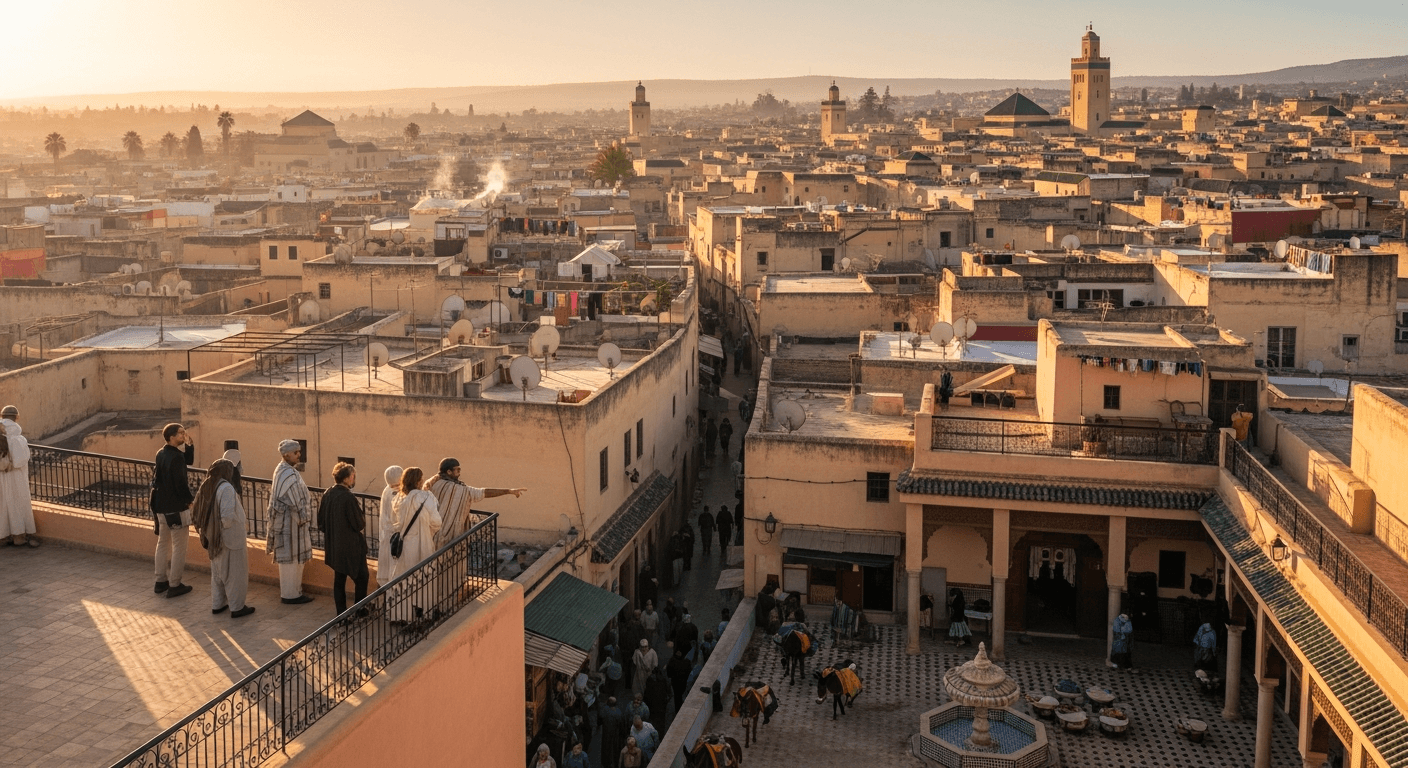
Morocco: Why Travelers Keep Coming Back to These 20 Places
The call to prayer drifts across Marrakech's rooftops as the sky shifts from burnt orange to deep violet. Somewhere below, a vendor arranges pyramids of spices that have been traded along these routes for centuries. A cat stretches on a sun-warmed doorstep painted that particular shade of blue found only in the mountain villages of the Rif. This is Morocco — a country that resists simple description because it insists on being felt.
There's a reason travelers return here, often multiple times, often unexpectedly. Morocco doesn't offer a single experience to be checked off and filed away. It's a place of contradictions that somehow coexist: ancient and contemporary, intimate and vast, gentle and overwhelming. The medinas that first seem like labyrinths become familiar neighborhoods. The chaos that initially exhausts eventually energizes. The hospitality that might feel performative reveals itself as genuine.
What follows isn't a checklist. It's a collection of places that have earned their reputations — not through marketing but through the accumulated weight of traveler stories, the ones shared over mint tea or whispered between friends planning their own journeys south.
Jemaa el-Fnaa, Marrakech
The square breathes differently depending on when you arrive. Morning belongs to orange juice vendors and the shuffle of locals crossing toward the souks. By afternoon, henna artists and snake charmers have claimed their territories. But evening — that's when Jemaa el-Fnaa becomes something else entirely.
Smoke rises from dozens of food stalls assembled like clockwork each sunset. Storytellers gather crowds who understand the Darija they don't speak. Musicians compete for attention without ever seeming to compete at all. This isn't a performance staged for tourists; it's a living tradition that predates tourism itself and will outlast whatever trend defines the current decade.
Best Time to Visit: Arrive around 5 PM to watch the transformation. Stay through dinner. The energy peaks between 8 and 10 PM, then mellows into something more contemplative.
What Most Miss: The rooftop cafés surrounding the square offer perspective, but the real experience happens at ground level, moving through the chaos rather than observing it from above. Let yourself get slightly lost. It's the only way to understand the geometry.
The Photograph: From Café de France's terrace, just as the food stall lights flicker on and the last daylight clings to the Koutoubia Mosque's minaret in the distance.
The Blue Streets of Chefchaouen
Every shade of blue imaginable — cerulean, cobalt, powder, periwinkle, a turquoise so saturated it looks painted by someone who'd never seen the color in nature. Chefchaouen has been photographed relentlessly, and yet walking these streets still catches breath in a way images can't prepare you for.
The blue began, depending on who tells the story, with Jewish refugees in the 1930s or with locals wanting to deter mosquitoes or with a simple desire to reflect the sky. The reason matters less than the effect: a town that feels like it exists slightly outside ordinary reality.
Beyond the famous blue alleys, Chefchaouen offers hiking trails into the Rif Mountains, a local goat cheese called jben that pairs perfectly with fresh bread, and a pace of life that forces rushed travelers to slow down or leave frustrated.
Best Time to Visit: Early morning, before day-trippers arrive from Fez or Tangier. The light between 7 and 9 AM turns the blue walls almost luminous. Alternatively, late afternoon when shadows deepen the color saturation.
What Most Miss: The waterfall at Ras el-Maa, a fifteen-minute walk from the medina, where local women do laundry and children swim in the pools below. It's not spectacular, but it's real.
Practical Note: Two nights minimum. One day feels like skimming a surface that rewards depth.
Fez el-Bali Medina
The world's largest car-free urban zone doesn't announce itself gently. Fez's ancient medina absorbs visitors into its nine thousand alleyways, where donkeys remain the primary delivery system and GPS becomes a suggestion rather than a guide.
This isn't Marrakech's medina, which has largely adapted to tourism. Fez el-Bali functions as it has for a thousand years — a working neighborhood where craftsmen operate from workshops their great-grandfathers established, where the tanneries still use pigeon droppings to soften leather, where the rhythm of daily life pays little attention to visiting strangers.
Getting lost isn't a risk here; it's inevitable. The question is whether you resist or surrender. Those who surrender discover unexpected courtyards, stumble into Sufi shrines, share tea with shopkeepers who've perfected the art of conversation across language barriers.
Best Time to Visit: Weekday mornings, when commerce flows but crowds remain manageable. Friday brings partial closures for prayer.
What Most Miss: The leather tanneries get attention for obvious visual reasons, but the brass workshops near Place Seffarine offer equally ancient craft without the crowds. Listen for the sound of hammers shaping metal.
The Photograph: From a tannery terrace, yes, but also in the narrow passages where light filters down in theatrical shafts, illuminating faces and walls in alternating sequence.
The Dunes of Erg Chebbi
Not all deserts look like the Sahara of imagination — endless, rolling, honey-colored dunes reaching toward an unbroken horizon. Erg Chebbi does.
Rising to heights of 150 meters near Merzouga, these dunes reward both the single-night camel trek and the longer expeditions into surrounding terrain. But something happens in the Sahara beyond visual spectacle: silence so complete it becomes a presence, stars so numerous the Milky Way looks dense enough to touch, a sense of scale that quietly rearranges priorities.
The camps vary from basic to luxurious, but the desert itself doesn't care about thread counts. What matters is waking before dawn to climb the nearest dune and watch light transform sand from purple to gold in a span of minutes.
Best Time to Visit: Autumn through spring avoids the summer extremes that make the Sahara genuinely dangerous. March and October often provide the most comfortable temperatures combined with clear skies.
What Most Miss: The Gnawa musicians who gather around evening fires, playing rhythms that trace back to Sub-Saharan Africa. This isn't performance for tips — it's tradition continuing because it has always continued.
Practical Note: Book directly with desert operators in Merzouga rather than through Marrakech agencies, who add markups without adding value.
Essaouira's Windswept Ramparts
If Morocco's imperial cities sometimes overwhelm with sensory density, Essaouira offers counterbalance: Atlantic breezes, whitewashed walls, a medina scaled for wandering rather than conquering.
The Portuguese fortifications give Essaouira its distinctive character — ramparts facing the sea, cannons still positioned as though expecting ships that stopped threatening centuries ago. The beach stretches for miles in either direction, kite surfers taking advantage of the trade winds that earned this town its reputation among water sports enthusiasts.
But Essaouira's greatest gift might be its rhythm. The medina closes early by Moroccan standards. Restaurants serve fresh-caught fish without pretense. Cats outnumber hustlers by a comfortable margin. After the intensity of inland cities, Essaouira feels like exhaling.
Best Time to Visit: June brings the Gnaoua World Music Festival, transforming the town into an impromptu celebration of rhythm and culture. Otherwise, April and October avoid summer crowds while maintaining pleasant temperatures.
What Most Miss: The working port in the morning, when fishermen auction their catch and boat builders repair vessels using techniques unchanged for generations.
The Photograph: The rampart walkway at sunset, cannons silhouetted against an orange sky, waves crashing below.
Aït Benhaddou
UNESCO protection came late to this fortified village, but not too late. The earthen kasbahs rising from the Ounila Valley have appeared in more films than any location scout could count — Gladiator, Game of Thrones, Lawrence of Arabia — yet Aït Benhaddou predates cinema by nearly a millennium.
A handful of families still live within the original walls, though most residents have moved to the modern village across the river. What remains is architecture as art: intricate geometric patterns carved into clay, watch towers that once defended trans-Saharan caravans, a sense of human settlement in dialogue with landscape.
The climb to the summit requires effort in afternoon heat, but the view across the valley — date palms, desert, distant mountains — explains why traders built here in the first place.
Best Time to Visit: Early morning or late afternoon for photography and temperature. The golden hour paints the earthen walls in colors that feel impossibly warm.
What Most Miss: The workshops across the river where artisans still produce traditional crafts. Not staged displays, but actual work in progress.
Practical Note: Most visitors make this a day trip from Ouarzazate or a stop en route to the desert. Consider staying overnight in the modern village to experience the site at dawn, before the buses arrive.
The Atlas Mountains
The Djebel Toubkal massif, North Africa's highest point, anchors a mountain range that offers everything from day hikes to multi-week treks. But you don't need to summit anything to understand why the Atlas matters.
A two-hour drive from Marrakech delivers you to Imlil, the primary gateway village, where Berber hospitality reveals itself in roadside tagines and offers of mint tea. The terraced villages clinging to valley walls represent a way of life largely vanished from lowland Morocco — communal granaries, traditional dress worn without self-consciousness, an agriculture that works with the mountains rather than against them.
The trekking possibilities scale to any ambition. Day hikers find waterfalls and panoramas. Multi-day expeditions access high passes and remote villages accessible only on foot. The mountains ask for physicality, but they reward with perspective — both literal and existential.
Best Time to Visit: April through June and September through November. Summer brings harsh afternoon heat at lower elevations, while winter blankets higher routes in snow.
What Most Miss: The Berber villages between Imlil and the Toubkal summit, particularly Aroumd, offer authentic homestay experiences that reveal mountain culture beyond the surface-level village tours.
Practical Note: Hire local guides for anything beyond well-marked day hikes. They provide employment for mountain communities and knowledge that transforms a walk into an education.
Volubilis
Roman ruins scattered across Moroccan farmland — the juxtaposition alone justifies the visit. Volubilis was never Rome's most important outpost, but perhaps that's why it survived: not significant enough to dismantle, too distant to salvage, simply left to slowly merge with the surrounding wheat fields.
The mosaics remain remarkably intact, depicting scenes from myth and daily life with a craftsmanship that crosses millennia. You can walk through a Roman bath, stand in a forum, trace the outlines of olive presses that once supplied oil across the empire. But Volubilis's power comes from its setting — storks nesting on fallen columns, wildflowers pushing through stone floors, the Rif Mountains hazy in the distance.
Best Time to Visit: Late afternoon, when tour groups have departed and the slanting light ignites the stone. Spring brings wildflowers that soften the ruins into something painterly.
What Most Miss: The basilica at the site's southern end, often overlooked in favor of the more photogenic triumphal arch and capitol.
The Photograph: The Labours of Hercules mosaic, found in the House of the Ephebe, remains one of the most intact and striking compositions on site.
The Todra Gorge
Three hundred meters of vertical limestone rising from a narrow canyon floor — Todra Gorge delivers geological drama without requiring mountaineering skills. The road passes through easily, but stopping to absorb the scale takes longer than most visitors anticipate.
In the narrowest section, where the walls close to just ten meters apart, the midday sun illuminates the rock face in bands of pink and orange. Small cafés cluster near the entrance, offering tagine and fresh juice to travelers who arrived planning to photograph and leave but found themselves lingering instead.
Beyond the famous narrows, hiking trails follow the gorge deeper into the mountains, passing oases and crumbling kasbahs that suggest this passage has served travelers far longer than the paved road implies.
Best Time to Visit: Midday, despite conventional photography wisdom, is when the sun reaches the canyon floor in the narrow sections. Late afternoon shadows consume the gorge early.
What Most Miss: The villages upstream from the tourist zone, where life continues without attention to visiting cameras.
Tangier's Transformation
For decades, Tangier traded on its reputation — Burroughs and Bowles, Cold War intrigue, a seediness that attracted certain travelers precisely because it repelled others. That city still exists in memory and literature, but the Tangier of now is something different.
The kasbah has been restored without losing character. The medina's European-influenced architecture blends Andalusian, French colonial, and traditional Moroccan elements in ways that read as uniquely Tangerine. New galleries and restaurants have opened in buildings that once crumbled beneath their own weight.
And yet the city hasn't become a sanitized theme park. The writers' cafés still serve the same mint tea. The views across to Spain still inspire the same wanderlust. The energy that drew decades of expatriates and exiles hasn't disappeared — it's simply evolved.
Best Time to Visit: Spring and autumn avoid the summer crowds that arrive via ferry from Spain. The weather remains pleasant year-round thanks to Atlantic influence.
What Most Miss: The Café Hafa, terraced down the cliff face toward the sea, where Paul Bowles and the Rolling Stones once sat where you're sitting now.
The Photograph: From the rooftop of one of the medina's boutique hotels, the port and Spanish coastline spread across the horizon.
Ouarzazate and the Studio Road
They call it "the Hollywood of Morocco," though the label understates both the cinematic history and the landscape that enabled it. The studios here have hosted productions from every major international film industry, drawn by a landscape that convincingly doubles for Tibet, ancient Egypt, or apocalyptic wastelands depending on the budget.
But Ouarzazate exists beyond its film sets. The Taourirt Kasbah predates cinema by centuries, a crumbling fortress that once controlled trade routes and still commands attention. The road to the desert passes landscapes that would feel excessive as CGI — ochre valleys, sudden oases, geological formations that seem designed rather than eroded.
Best Time to Visit: Spring and autumn offer comfortable temperatures without the summer extremes. Studio tours operate year-round but become ghostly quiet during filming breaks.
What Most Miss: The Fint Oasis, a palm grove that appears without warning in the barren surroundings, where a short hike delivers you to complete silence.
Rabat's Understated Capital
The royal capital announces itself more quietly than Marrakech or Fez, which is precisely its appeal. Rabat functions as a city rather than a spectacle — ministries and universities, public gardens and neighborhood cafés, a pace of life that accommodates residents rather than entertaining visitors.
The Kasbah of the Udayas, overlooking the Atlantic, offers the postcard-worthy whites and blues that draw initial attention. But Rabat rewards exploration beyond the obvious: the unfinished Hassan Tower and its forest of columns, the Chellah necropolis where Roman ruins underlie Islamic tombs, the contemporary art museum that insists Morocco's creative energy didn't end with the ancient craftsmen.
Best Time to Visit: Year-round, benefiting from Atlantic climate moderation. The city's relative calm means seasonal crowd variations matter less here than elsewhere.
What Most Miss: The Andalusian gardens within the Kasbah of the Udayas, a manicured escape from medina energy.
The Drâa Valley
The longest river in Morocco supports a ribbon of green that cuts through some of the country's most dramatic terrain. The Drâa Valley represents oasis life at its most extended — palm groves, fortified villages, kasbahs crumbling picturesquely against backdrop mountains.
The road from Ouarzazate to Zagora follows this lifeline, passing through landscapes that shift from harsh to pastoral in the span of kilometers. Each bend reveals another oasis, another cluster of earthen buildings, another scene that seems arranged for photography but exists because water dictates where life gathers in the desert.
Best Time to Visit: February to April, when palms are bearing dates and temperatures haven't yet climbed to summer extremes. Autumn harvest offers its own appeal.
What Most Miss: The smaller villages between major stops, where the hospitality offered to strangers hasn't yet been complicated by tourism's transactional pressures.
Meknes and Its Imperial Past
Moulay Ismail wanted Meknes to rival Versailles. He didn't quite achieve that ambition, but he left behind walls that stretch for forty kilometers, stables that once housed twelve thousand horses, granaries that fed an army, and gates whose scale suggests a city that could swallow invaders whole.
Today Meknes operates at a lower intensity than its imperial ambitions suggested. The medina serves primarily residents rather than tourists. The sprawling ruins invite exploration without time pressure. The pace of discovery suits travelers who've grown weary of monument-hopping and want simply to wander.
Best Time to Visit: Comfortable year-round, with spring offering pleasant temperatures and blooming gardens.
What Most Miss: The Heri es-Souani granaries and royal stables, less photogenic than the famous Bab Mansour gate but more revealing of imperial scale and ambition.
Dades Valley's Kasbah Road
Between the Atlas and the desert, the Dades Valley threads through a landscape where every kilometer offers another crumbling fortress, another terraced oasis, another reason to stop the car.
The "Road of a Thousand Kasbahs" delivers on its promise, though many have deteriorated beyond recognition. What remains are scattered jewels — some restored as guesthouses, others abandoned to time, all speaking to a period when defensive architecture and aesthetic ambition coexisted without contradiction.
The valley also delivers geological surprises: the Monkey Fingers rock formations, named for obvious reasons; the winding road to the gorge itself, a series of hairpin turns that reward nerve with views; and the intimate scale of valley floor life, where agriculture continues much as it has for centuries.
Best Time to Visit: Spring paints the valley green; autumn offers harvest energy without summer heat.
What Most Miss: The villages accessible only by foot, where traditional architecture hasn't been modified for tourist comfort.
Casablanca's Modernity
Travelers seeking ancient Morocco often skip Casablanca entirely, which misses half the story. This is where contemporary Morocco reveals itself — Art Deco architecture from the French colonial period, a creative class driving design and cuisine, and the Hassan II Mosque, whose minaret reaches higher than any in the world.
The mosque alone justifies a visit. Its scale defies reasonable expectation — the prayer hall accommodates twenty-five thousand worshippers under a retractable roof, the marble floors heat in winter, the Atlantic crashes against the platform upon which the whole structure stands. It's modern construction invoking ancient tradition, built by six thousand craftsmen over thirteen years.
Beyond the mosque, Casablanca offers urban Morocco: the Central Market's morning chaos, the Habous Quarter's neo-Moorish architecture, restaurants where French and Moroccan techniques blur without pretension.
Best Time to Visit: Year-round, though the mosque tour schedule varies by season. The city functions regardless of tourist timing.
What Most Miss: The Art Deco heritage beyond the obvious Corniche, particularly in the city center where Parisian influence met Moroccan craft.
The Paradise Valley
Between Agadir and the mountains, the Paradise Valley offers respite from coastal heat and tourist density alike. Natural pools collect in the riverbed, surrounded by palm groves and shaded by cliffs that provide natural air conditioning.
This isn't a secret — Moroccan families have picnicked here for generations, and guidebooks mention it reliably. But the valley remains surprisingly peaceful, perhaps because reaching the best pools requires a modest hike, perhaps because it offers no monuments or museums to justify a stop on rushed itineraries.
Best Time to Visit: Late morning through early afternoon, when the sun reaches the water but crowds remain manageable. Swimming is best spring through autumn.
What Most Miss: The upper pools, beyond where most visitors turn back, where solitude becomes possible even in peak season.
Azrou and the Cedar Forests
Barbary macaques — Morocco's only wild primates — live in the cedar forests surrounding Azrou, a Berber town in the Middle Atlas that offers cool relief from lowland intensity.
The forests themselves reward exploration beyond the famous monkey encounters. The Cèdre Gouraud, a massive cedar estimated at eight hundred years old, provides a destination for gentle hikes. The surrounding landscape alternates between alpine meadow and dense woodland in ways that feel European rather than African.
Best Time to Visit: Spring and summer, when the macaques are most active and the high-elevation climate offers genuine coolness.
What Most Miss: The Sunday souk in Azrou itself, where Berber traders gather in numbers that dwarf the tourist trickle.
Legzira Beach
The red sandstone arches that once defined Legzira largely collapsed in 2016, but one remains — and the beach itself never depended solely on its famous formations. The cliffs here glow copper and rust at sunset, the waves arrive with Atlantic force, and the fishing village behind offers a pace of life that coastal development hasn't yet disrupted.
This stretch of coast, between Agadir and the disputed Western Sahara, remains relatively untraveled by international visitors. The wind blows reliably, the seafood arrives fresh, and the sunsets deliver colors that would seem manipulated in photographs.
Best Time to Visit: Spring and autumn balance pleasant temperatures with accessible swimming conditions.
What Most Miss: The caves carved into the cliff face at the beach's northern end, accessible at low tide.
Moulay Idriss Zerhoun
Morocco's holiest town — the birthplace of the country's foundational dynasty — only recently opened to non-Muslim overnight visitors. The whitewashed buildings cascade down a hillside toward Volubilis below, creating a composition that hasn't changed appreciably in centuries.
The sanctity here is real, not performed. Pilgrims arrive throughout the year to pay respects at the tomb of Moulay Idriss I. The pace is contemplative. The tourism infrastructure remains minimal, which is both a limitation and an appeal.
Best Time to Visit: Any season works, though spring wildflowers beautify the surrounding countryside.
What Most Miss: The view from the terraces above town, where the full scope of the sacred site and its relationship to the Roman ruins below becomes clear.
Local Intelligence
Moving Through Morocco: Trains connect the major cities with reliability and reasonable comfort. CTM buses fill the gaps, though the mountain and desert routes require patience and flexibility. Grand taxis — shared vehicles running fixed routes — offer an intermediate option between buses and private hire. Rental cars provide freedom outside the medinas but become liabilities within them.
Choosing Your Base: Marrakech's riads offer the quintessential Moroccan accommodation experience, but consider distributing your nights. A single base misses the country's regional diversity. Two or three nights in each location allows depth without requiring constant movement.
Timing Your Days: Mornings belong to markets and medinas, before heat and crowds compound. Midday suits museums and cafés. Late afternoon through evening opens the best light and energy for exploration. Many attractions close early by Western standards — plan accordingly.
Cultural Navigation: Hospitality is genuine, but so is commerce. Learn to distinguish between helpful guidance and sales approaches, both of which present similarly. Bargaining is expected in souks but not in establishments with fixed prices. Photograph people only with permission, buildings without concern.
Seasons: October through May delivers the most comfortable travel conditions for most of the country. Summer overwhelms the interior but suits coastal and mountain destinations. Ramadan changes rhythms without closing doors — traveling during the holy month requires flexibility but rewards with insight.
Finding Your Morocco
For travelers ready to plot their own route through Morocco's varied terrain, Touratu's interactive map offers a different kind of guidance. Explore the paths other travelers have traced, discover reels and visual moments from each destination, and find the places that haven't made it into any listicle — the personal discoveries that become the stories you'll tell years from now.
Morocco doesn't reveal itself according to a schedule. You can arrive with an itinerary polished by research and still find yourself redirected by a chance conversation, a weather shift, an intuition that says to stay another night somewhere you planned to leave. This is how the country works. It doesn't demand attention; it invites relationship. And when you finally leave — for a flight that feels too soon, because they always do — something persists. Not just memory, though that too. Something more like recognition. The sense that these places knew you before you arrived, and will remember you after you've gone.
Loading activities…
