
Morocco: 20 Places That Keep Travelers Coming Back Again
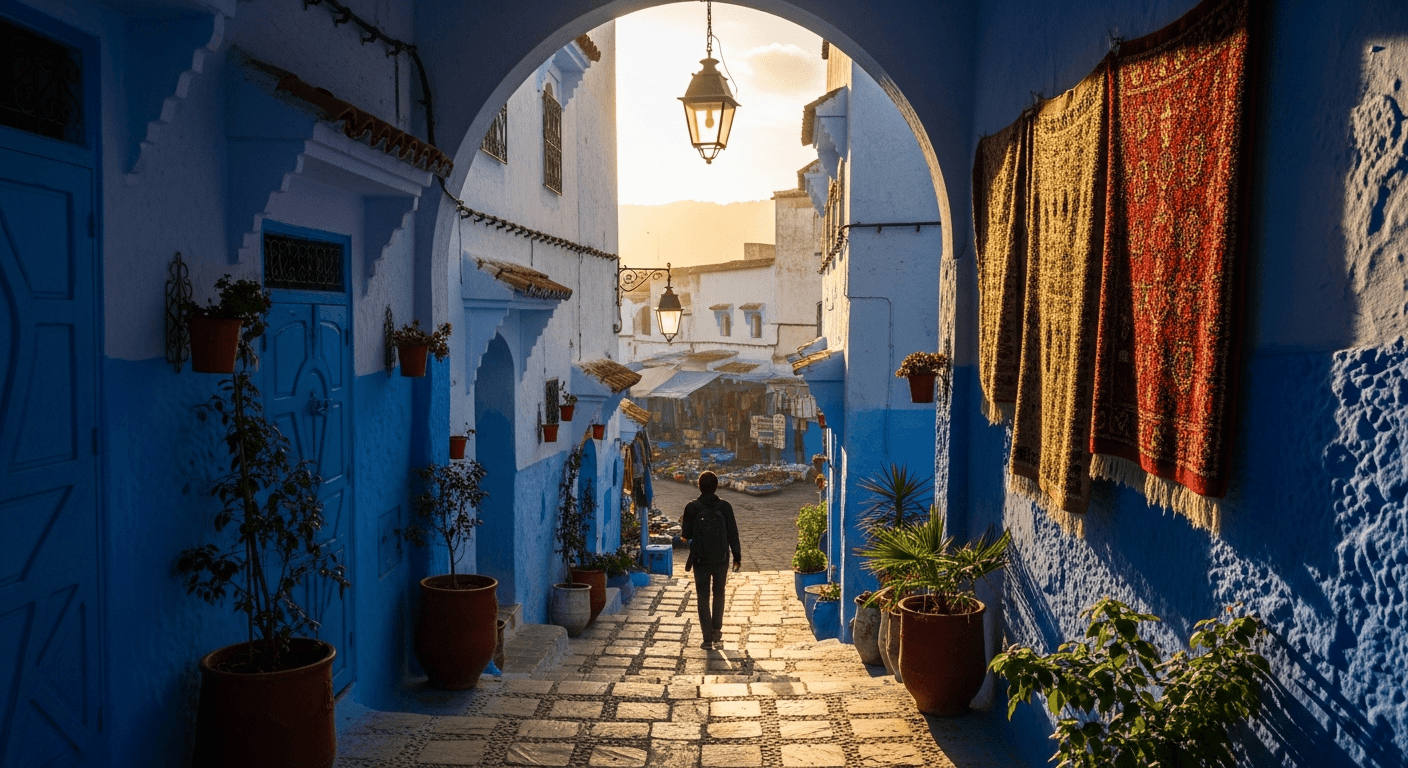
Morocco: Why Travelers Keep Coming Back to These 20 Places
The first time Morocco finds you, it arrives all at once — the call to prayer drifting over rose-gold rooftops, the shock of spice pyramids in colors that don't exist elsewhere, the way a medina alley can deliver you from chaos to perfect stillness in twelve steps. You think you understand it. You photograph the blue doors and the tagine steam and the camels silhouetted against dunes. You leave satisfied, story complete.
Then something shifts. A scent catches you months later — cumin and cedar and something you can't name — and suddenly Morocco isn't a memory but an ache. The country has this effect on people. It isn't just visited; it's contracted, like a beautiful illness that flares up in grey afternoons and crowded commutes. There's a reason travelers return here more than almost anywhere else in Africa. Morocco doesn't just show you things. It rearranges something in you.
What follows isn't a checklist. It's an atlas of obsessions — twenty places that explain why suitcases get packed again, why frequent flyer miles get burned, why people who swore they'd seen enough suddenly find themselves booking another riad, another desert night, another morning watching light climb over the Atlas. These are the places that haunt.
Jemaa el-Fnaa, Marrakech
By day, it's a sun-bleached plaza where snake charmers compete with orange juice vendors and henna artists stake their territory. But Jemaa el-Fnaa doesn't truly wake until dusk, when smoke from a hundred food stalls rises like collective prayer and the square transforms into the world's most chaotic dinner party.
This isn't a tourist attraction that happens to have locals — it's a living organism that has pulsed for a thousand years, UNESCO-protected not as a monument but as an "intangible cultural space." The storytellers who once drew crowds have mostly faded, but the square's essential genius remains: controlled mayhem, theatrical commerce, the feeling that anything could happen and probably will.
The experience unfolds in layers. First visit, you're overwhelmed, defensive, clutching your bag. By the third evening, you've learned the rhythms — which stall has the best lamb mechoui, which drummer actually knows what he's doing, where to stand for the best view of the Koutoubia minaret going pink in the dying light.
Come at 6 PM in shoulder season, when the light softens and the crowds haven't yet reached their crushing peak. For photographs, the Café de France terrace offers the establishing shot, but the real images hide at ground level: steam rising through shafts of lamplight, a grandmother's hands working dough, the sudden eye contact with a performer who's decided you're his mark.
Skip the fresh-squeezed orange juice closest to the main entrances — walk deeper in where prices halve and quality doubles.
Fès el-Bali
If Marrakech is Morocco performing for visitors, Fès is Morocco when it thinks no one's watching. The medina here — the largest car-free urban zone on Earth — operates on medieval logic, and entering it feels less like sightseeing than time travel that requires comfortable shoes.
The tanneries get the photographs, those famous honeycomb pits of dye where leather has been processed the same way since the 12th century. But the tanneries are almost too famous now, too performed, too surrounded by salesmen offering mint sprigs to mask the ammonia and pigeon-dung smell. The real Fès hides elsewhere: in the Nejjarine fountain where woodworkers still gather, in the Attarine Medersa where 14th-century stucco work makes you question what civilization means, in the moments when a donkey-traffic-jam forces you into an alcove and you realize you're standing in someone's 600-year-old workshop.
Best entered early, around 8 AM, when shopkeepers are still sweeping and the labyrinth belongs to residents doing actual errands. Hire a guide for the first morning — not for safety but for context. Then lose the guide and get lost. Getting lost in Fès is not a failure; it's the point.
The blue gate, Bab Boujloud, photographs beautifully from outside but reveals its best tile work from inside, looking back out. Most tourists miss this.
Chefchaouen
A town painted blue shouldn't work this well. The premise sounds gimmicky, Instagram-bait, the kind of place that's better in photos than in person. And yet Chefchaouen earns its reputation through accumulation — alley after alley of that particular blue, from powder to cobalt to something approaching purple, until the color stops being a novelty and starts feeling like a philosophy.
The blue has explanations: Jewish refugees who arrived in the 1930s brought the tradition, believing it symbolized sky and heaven; others say it keeps mosquitoes away; locals now maintain it because the tourists expect it. The reason matters less than the effect. Walking here, especially in early morning before the day-trippers arrive from Tangier, induces a specific calm. The blue is cool even when the sun isn't.
The experience shifts with time of day. Dawn light turns the walls almost lavender. Noon creates harsh shadows that emphasize every cracked door and rusty hinge. But the magic hour here isn't golden hour — it's the deep blue twilight after sunset, when the painted walls merge with the actual sky and the boundary between architecture and atmosphere dissolves.
Climb to the Spanish Mosque on the hill opposite town for the postcard shot, but make the climb around 5 PM when the light is soft and the tour groups have descended for dinner. The town glows below like a blue ember.
The vegetable sellers along the main square offer produce from the Rif Mountains that rarely reaches other markets. The olives in particular are exceptional.
Erg Chebbi, Merzouga
There's a specific silence in the Sahara that doesn't exist anywhere else — not absence of sound but presence of something older than sound. At Erg Chebbi, where dunes rise 150 meters and curve like frozen waves, you understand why deserts have always produced prophets and poets.
The tourist infrastructure here has grown slick: luxury camps with hot showers and actual beds, camel treks with mint tea ceremonies, sandboarding options for those who need action. None of this diminishes the essential experience, which is elemental and cannot be packaged: watching light move across sand that shifts from gold to orange to deep rose to violet, watching stars emerge so thick they look like spilled salt, waking before dawn to a cold you didn't expect and a silence that recalibrates your nervous system.
Avoid the crowds by avoiding the obvious. Most sunrise tours head to the same dune because it's closest to camp. Ask your guide about walking twenty minutes further. The extra effort buys solitude, and solitude in the Sahara is the actual luxury.
The camel ride in is traditional but honestly uncomfortable after the first hour. If you're staying overnight, ask about 4x4 transfer to camp and save the camel experience for a shorter, more romantic sunset ride.
Photography note: bring a lens cloth and prepare for sand in everything. But also — consider putting the camera down for one sunrise. Some moments shouldn't be mediated.
Essaouira
The wind here isn't a feature; it's a character. Essaouira exists in constant negotiation with the Atlantic trades that scour its ramparts and fill its air with salt and make it feel cleansed of Morocco's interior intensity. Where Marrakech is fire, Essaouira is water.
The town has attracted artists and musicians since Orson Welles filmed Othello here in the 1950s, and that creative residue persists in the galleries along Rue de la Skala and the musicians who practice gnawa rhythms in workshops you can hear but not always find. The fishing port operates on its own schedule — arrive around 2 PM when the blue boats return and the afternoon auction turns the harbor into theater.
The medina here stays manageable even when it's full, contained within 18th-century walls that create order from what could be chaos. You can learn its layout in a day, then spend several more days finding the places the layout doesn't explain: the riad café with the rooftop where cats outnumber humans, the spice shop where the owner actually knows what he's selling, the section of rampart where you can watch sunset without sharing the view.
Best months are April through June and September through October, when the wind is fresh rather than relentless and the summer crowds haven't yet arrived or have already departed.
The thuya wood workshops near the port produce genuinely skilled marquetry that exists nowhere else. Watching the craftsmen work is more interesting than most of what's called "cultural experience" elsewhere.
Todra Gorge
The canyon walls rise 300 meters and close to just 10 meters apart at their narrowest point, creating a natural cathedral that makes human voices echo and sunlight arrive in dramatic shafts. This is the Atlas Mountains at their most theatrical — pure geology drama that requires no cultural context to appreciate.
Most visitors arrive midday when tour buses do, spend an hour photographing the narrow section, and leave. This is reasonable but incomplete. Todra reveals itself differently in morning, when the west wall catches early light and the river water runs clearest, and in late afternoon, when the east wall glows and the crowds thin and the valley restaurants start their tagine fires.
Consider staying overnight in Tinghir, the nearby town, which has its own mellah (Jewish quarter) worth exploring and which positions you to enter the gorge before the tour buses. The drive into the canyon in early morning, with the walls growing taller around you, builds anticipation in a way that arriving at noon cannot.
Serious hikers use Todra as a base for multi-day treks into the Atlas, but the gorge rewards even modest exploration. Walk past the tourist concentration at the narrowest point and continue upstream where the canyon opens slightly and palmeries appear and the landscape shifts from postcard to something more subtle and more yours.
Aït Benhaddou
This ksar — a fortified village of earthen clay architecture — has appeared in so many films (Gladiator, Game of Thrones, Lawrence of Arabia) that it risks feeling like a set rather than a place. The risk is real but resistible. Arrive early or late, skip the guided movie-location tour, and what remains is genuinely extraordinary: a UNESCO site that looks almost exactly as it did centuries ago, terracotta walls rising in organic geometry against snow-capped Atlas peaks.
The old village is mostly empty now — residents have moved to the modern town across the river — but a handful of families remain, their homes serving as shops and tea houses that break up the climb to the top. The ascent is worth making. From the summit, the view extends across the high desert plateau, and the silence has a quality the lower village — with its tour groups and souvenir calls — cannot match.
The river crossing is part of the experience. In wet season, you wade through or hire a donkey; in dry season, you walk across the riverbed where the water would be. Either way, the approach across the floodplain, with the ksar rising ahead, makes the arrival feel earned.
Best photographed from across the river in late afternoon light, when the walls glow and the Atlas catches the same warmth. But also photograph from inside, looking down: the rooftop geometry and the palm grove below make images that feel less familiar and more discovered.
Tangier
The city that guards the Strait of Gibraltar has always been a threshold — between Europe and Africa, between Atlantic and Mediterranean, between respectability and beautiful disrepute. Writers from Paul Bowles to William Burroughs came here because Tangier felt like the edge of things, a place where normal rules softened and reinvention was possible.
That louche literary Tangier has largely gentrified — the Interzone of cheap hotels and dangerous freedoms has become a city of restored riads and international money — but echoes remain. The Petit Socco café scene still attracts characters who seem to be waiting for something. The medina retains corners where time moves differently. And the Kasbah Museum, in a former sultan's palace, holds both Roman antiquities and killer views of Spain across the water.
The experience here is about edges and intersections. Have mint tea in the Café Hafa, clinging to the cliff where Burroughs and Kerouac once sat, and watch container ships heading into the Atlantic. Walk the Grand Socco at twilight when the vegetable sellers are packing up and the cafés are filling. Understand that Tangier's genius has always been its in-betweenness, its refusal to be entirely one thing.
Avoid the official guides who descend at the port — they're often more aggressive than helpful — and simply walk with purpose. The medina here is smaller and more manageable than Fès or Marrakech; getting lost takes actual effort.
Volubilis
Roman ruins shouldn't surprise this far south, but they do. Volubilis rises from wheat fields near Meknes, a city that once housed 20,000 people at the edge of empire, and its mosaics — depicting Orpheus, Hercules, Diana bathing — survive with colors so vivid they seem recently laid rather than 2,000 years old.
The site sprawls across a hillside, its triumphal arch and basilica and olive presses and private homes arranged in legible city planning that makes the ancient inhabitants feel strangely present. Unlike crowded Roman sites elsewhere in the Mediterranean, Volubilis often offers solitude — you can have a mosaic to yourself for minutes at a time, can sit on a fallen column and watch storks nest in the ruins and understand that even empire ends.
Morning visits avoid both midday heat and bus tours from Fès and Meknes. The light is also better — the mosaics read most clearly when the sun is low and the colors haven't been washed out by noon glare.
Combine with nearby Moulay Idriss, Morocco's holiest town, where the founder of the first Moroccan dynasty is buried. Non-Muslims can't enter the shrine but can explore the surrounding town, which stacks white houses up a hillside and offers rooftop cafés with views back toward the Roman ruins.
Dades Valley
The road between Ouarzazate and the gorges cuts through landscape that shifts constantly — terracotta kasbahs give way to green palmeries give way to red rock formations that look too dramatic to be natural. This is the Route des Kasbahs, Morocco's scenic drive, and while individual stops have names and parking lots, the experience is really continuous: the Atlas on your right, the valley unfolding ahead, the light changing everything every thirty minutes.
The famous formations near Tamellalt — sometimes called "monkey fingers" — draw photographers for good reason, but don't neglect the smaller stops. The villages built into cliff faces along the upper Dades offer glimpses of Berber life that tourism hasn't yet distorted. The riverside camps where the road ends invite overnight stays that turn a drive-through into something more lived.
Drive slowly and stop often. The temptation is to push toward the Todra or Merzouga, but the valley rewards dawdling. Ask at any café about nearby waterfalls or kasbahs that aren't on maps. The best discoveries here have always been accidental.
Spring is ideal, when almond blossoms whiten the valley floor and snowmelt keeps the river running. Summer heat makes the drive uncomfortable; winter can bring snow that closes high passes.
Jardin Majorelle, Marrakech
Yves Saint Laurent and Pierre Bergé bought this garden from Jacques Majorelle's estate in 1980, saving it from development and preserving the particular blue — cobalt intense enough to have its own name — that the French painter applied to every surface. The garden feels artificial in the best sense: a curated fantasy of Moroccan and global botanicals arranged around pools and paths that induce immediate calm.
The experience here is about color saturation and contrast — Majorelle Blue against bougainvillea pink, against cactus green, against the terracotta pots and yellow pathways. The Berber Museum inside the original studio adds cultural context, but the garden itself is the point, a manufactured paradise that works anyway.
Visit at opening (8 AM) or late afternoon. The midday crowds — and this is one of Marrakech's most visited sites — make contemplation difficult. Morning light enters the garden from the east, illuminating the blue walls and creating shadows in the bamboo grove that photograph beautifully.
The small café inside offers expensive mint tea in a setting that justifies the price. Drink slowly. This is a garden for slowing down, for noticing how thoughtfully every sight line has been considered.
Tafraoute and the Anti-Atlas
South of the tourist trail, the Anti-Atlas offers Morocco at its most stark and strange. Tafraoute sits in a valley of pink granite boulders that look placed by giants, and the Belgian artist Jean Vérame once painted them in blues and purples and reds that have faded but not disappeared. The effect is surreal — land art in a landscape already too dramatic to seem entirely real.
The valley's Berber villages specialize in almonds and argan and sending their sons to grocery shops in European capitals, creating a diaspora wealth that returns as surprisingly large houses in villages with surprisingly few residents. The atmosphere is quieter than tourist Morocco, less performative, more focused on the rhythms of agriculture and family that have always defined life here.
February brings the almond blossom festival, when the valley turns pink and white and the community gathers in celebrations that tourists can observe but not dominate. Other months offer solitude and hiking through landscapes that feel planetary rather than earthly.
Accommodation is limited but includes a few guesthouses with rooftop terraces facing the boulders. Watch sunset from the terrace, watch the rocks change color as the light dies, and understand why some travelers skip the famous places entirely.
Meknes
The least-visited of Morocco's imperial cities is also the most relaxed, its medina human-scaled, its monuments impressive without being overwhelming. Sultan Moulay Ismail built here with ambition — the granary stables alone could house 12,000 horses — but modern Meknes wears its history lightly, more interested in daily life than in tourist performance.
Bab el-Mansour is the country's largest gate, and it delivers exactly what gates should: dramatic entry into a world that feels distinctly contained. Beyond it, the medina unfolds in markets that feel genuinely local — vegetable sellers and hardware shops and fabric merchants serving residents who outnumber tourists substantially.
The experience here is about ease. Prices are lower than Fès or Marrakech; hassle is lighter; you can walk through the medina without deflecting constant sales pitches. Use Meknes as an imperial city introduction before tackling the larger complexities of Fès, or use it as a decompression afterward.
The afternoon mellah (Jewish quarter) has atmosphere that quieter visits can appreciate — doorways marked with Hands of Fatima, synagogues that still occasionally function, an absence of explanation that makes exploration feel more like discovery.
Ouarzazate
This administrative center at the crossroads of southern routes isn't beautiful in itself, but its location — gateway to the desert, to the Draa Valley, to the Route des Kasbahs — makes it a necessary stop that rewards attention. The Atlas Corporation Studios have hosted major Hollywood productions, and while the tour feels cheesy, the sets themselves (Egyptian temples, Tibetan monasteries, Jerusalem streets) are genuinely impressive.
Nearby Taourirt Kasbah, rising at the city's edge, offers a more authentic experience — a former glaoui stronghold that's partially restored and partially crumbling, accessible without guides or fees and revealing the ingenuity of earth architecture in ways that more manicured sites cannot.
Use Ouarzazate as a base for exploring the Skoura palm grove, 45 minutes east, where scattered kasbahs stand amid the palms and boutique hotels offer peace that the city itself lacks. The drive through the palmery at sunset, with the Atlas pink behind you, makes the detour worthwhile even without stopping.
Legzira Beach
The red stone arches that once made this beach famous have partially collapsed — one arch fell in 2016 — but what remains is still extraordinary: a vast sweep of sand backed by red cliffs that glow impossibly in afternoon light. The access scramble down the cliff keeps casual tourists away; those who make it find a beach that feels end-of-the-world remote despite being just south of Sidi Ifni.
The experience here is about raw coastline, about Atlantic power meeting African rock in forms that feel sculptural. Swimming is possible but currents are serious; most visitors come for the walking, the photography, the sunset viewing that turns the remaining arch into silhouette.
Stay in Sidi Ifni, a former Spanish enclave where art deco architecture crumbles photogenically and the fishing port operates on rhythms unchanged for generations. The town is evolving — surfers have discovered the nearby breaks, bringing cafés and yoga studios — but the essential character remains: a beautiful nowhere that visitors either understand immediately or find boring.
Ouzoud Falls
The highest waterfalls in North Africa drop 110 meters through olive groves where Barbary macaques swing between branches and the mist creates permanent rainbows on sunny afternoons. The access has become touristy — stalls and guides and boat operators crowd the viewing areas — but the falls themselves remain genuinely impressive, a reminder that Morocco contains more than medinas and deserts.
Arrive early or stay late to avoid the midday tour groups from Marrakech. The path down to the base is steep but manageable, and the boats that approach the falls offer an angle — water crashing around you, cliff walls rising on both sides — that the overlooks cannot match.
The olive groves surrounding the falls produce oil that's sold locally and is genuinely excellent. The terraces where it's served, with tagines and mint tea and views of the cascade, offer an afternoon that's both spectacular and simple.
Moulay Idriss Zerhoun
Morocco's holiest town clings to two hills above the plain where Volubilis slowly crumbles. Until recently, non-Muslims couldn't stay overnight; the restriction has lifted, and the handful of guesthouses that have opened offer immersion in a town where tourism remains secondary to pilgrimage and daily life.
The experience here is about watching faith in action — white-robed pilgrims climbing to the zaouia, the rhythm of prayer calls from multiple mosques, the particular quiet of a town whose central purpose is spiritual. The streets stack steeply, creating viewpoints that emerge suddenly: the green-tiled shrine roof from one angle, Roman columns from another, the surrounding farmland stretching toward mountains.
Consider the day trip from Fès but stay overnight if time allows. Evening and morning light transform the whitewashed houses, and the after-dark quiet, when day-trippers have left and pilgrims have retired, offers a stillness rare in Moroccan towns.
Skoura Palm Grove
This oasis east of Ouarzazate contains over 700,000 palm trees and uncounted kasbahs, most privately owned, some crumbling, a few converted to hotels that rank among Morocco's most atmospheric stays. The grove operates on agricultural time — dates in autumn, roses in spring, almonds in winter — and walking or biking its dirt tracks reveals a Morocco that functions entirely outside tourist frameworks.
The Amridil Kasbah is the famous one, featured on currency, but the smaller kasbahs scattered through the palmery offer more intimate encounters. Ask at any hotel about walking routes; guides know which families will show their homes, which paths lead to hidden gardens, which groves offer the best light.
Dawn in the palmery, when smoke from morning fires rises through the palms and donkeys begin their rounds, is worth any early alarm. This is working landscape, lived-in oasis, the kind of place that reveals Morocco's depth beyond its monuments.
Draa Valley
The longest river in Morocco cuts through stone desert, creating a green corridor of date palms and mud villages that extends for 200 kilometers south of Ouarzazate. The drive along this valley is Morocco's other great road journey, and where the Route des Kasbahs impresses through dramatic geology, the Draa moves through something subtler: the persistence of life in hard places, the ingenuity of irrigation, the architecture that emerged from building with what the land provides.
Agdz makes a good overnight stop, small enough to walk entirely, positioned where the palmery begins and the canyon scenery starts intensifying. Further south, Zagora offers a base for desert excursions and has a famous sign: "Timbuktu — 52 days by camel." The desert beyond is the M'Hamid hammada, less photogenic than Erg Chebbi but more stark, more real, more challenging.
Stop often. Drink tea in the oasis villages. Watch how farmers channel water through ancient khettara systems. The Draa Valley rewards attention to process, not just scenery.
Bin el-Ouidane
Morocco's largest reservoir fills a valley in the Middle Atlas, creating an improbable blue against surrounding brown — lake landscape in a country associated with coast and desert. The lake draws Moroccan weekenders more than international tourists, which gives it a different atmosphere: families picnicking, fishermen in small boats, an absence of hawkers and hustlers that makes relaxation actually possible.
The experience here is about contrast and escape. From the heat and complexity of Marrakech, the lake appears in a few hours' drive as something almost unreal — cool water, mountain air, the pace of a resort town that hasn't yet learned how to perform for foreigners.
The dam itself is imposing, an engineering project that remade this valley in the 1950s. The surrounding hills offer hiking with views across the water. But mostly Bin el-Ouidane is for unwinding, for floating in the improbable blue and understanding that Morocco contains worlds its tourist trails don't touch.
Local Wisdom for Moving Through Morocco
Morocco moves at its own tempo, and the travelers who enjoy it most are those who adjust their expectations rather than fighting the rhythm. Trains connect the major northern cities efficiently — the Marrakech-to-Tangier line particularly so — but the south requires either rented car, organized tour, or the grand taxi system that delivers you from city to city in shared Mercedes sedans of uncertain vintage. These taxis leave when full, not on schedule, and the wait is part of the experience.
Basing yourself well matters enormously. In Marrakech, stay in the medina for immersion or in the Hivernage district for peace — the Ville Nouvelle offers neither character nor convenience. In Fès, a medina riad puts you inside the labyrinth but can feel overwhelming after multiple days; consider alternating with a night in the Ville Nouvelle for contrast. In smaller towns, accommodation options narrow but often include genuine gems: kasbahs converted with taste, family guesthouses where the host's dinner is the day's highlight.
Moroccan hospitality is legendary and usually genuine, but navigating the line between hospitality and commerce requires social intelligence. Accept the mint tea offered in a shop; understand it doesn't obligate purchase but does obligate politeness. Learn a few Arabic and Berber phrases; the effort registers even when the pronunciation fails. Dress modestly in medinas and villages not from fear but from respect — this is a conservative country that has adapted to tourism without abandoning its values.
Ramadan transforms the rhythm entirely. Days slow as fasting residents conserve energy; evenings explode with life as families feast and promenade. Traveling during Ramadan requires flexibility — restaurants close, hours shift, nothing operates quite normally — but offers access to a different Morocco, one where faith shapes everything in ways the tourist infrastructure usually obscures.
Plan Your Moroccan Journey
Morocco's geography invites planning but rewards spontaneity. Routes that look efficient on maps often miss the discoveries that make travel memorable — the kasbah glimpsed from the road that turns out to have a terrace café with no other visitors, the village market that wasn't supposed to happen today but did, the local who insists you join his family for dinner and genuinely means it.
Explore Touratu's interactive map to discover authentic travel routes from real visitors, visual reels of specific moments and places, and the kind of ground-level insight that guidebooks can't capture. The map reveals how travelers actually move through the country — which stops connect naturally, which detours reward the extra time, which experiences spark the return trips that Morocco inevitably inspires.
The Return Begins Now
Morocco is the rare place that becomes more interesting the better you know it. First visits capture the surfaces: the blue medinas, the dune sunrises, the tagine lunches that all taste slightly different from each other. Return visits find the depth: the specific riad where the host remembers how you take your coffee, the village where the craftsman finally shows you his workshop's second room, the understanding that arrives slowly — this country contains more than any itinerary can exhaust.
The twenty places here aren't a checklist but a starting point. Each one opens onto others that only become visible once you've arrived, once you've started paying the particular attention that Morocco both demands and rewards. The country gives back what you bring to it. Bring curiosity. Bring patience. Bring the expectation that something will happen that you couldn't have planned.
Bring the understanding that you'll be back.
Loading activities…
