
Morocco: Why Travelers Keep Coming Back to These 20 Places
Morocco: Why Travelers Keep Coming Back to These 20 Places
The call to prayer drifts across the rooftops as the sky shifts from pale rose to deep saffron. Somewhere below, a cart laden with mint and orange blossoms rattles through a lane too narrow for anything wider. A shopkeeper adjusts hanging brass lanterns that have been catching this same light for centuries, while the scent of fresh bread and wood smoke mingles in the cool morning air.
This is Morocco — a country that doesn't reveal itself all at once but rather in layers, each visit peeling back something new. It's a place where the medieval and the modern exist in comfortable proximity, where Berber traditions weave through Arab influences and French colonial echoes, where the Sahara meets the Atlantic and the Atlas Mountains stand as ancient sentinels between worlds.
What keeps travelers returning isn't a single monument or a famous view. It's the accumulation of moments: the particular quality of light in a blue-washed alley, the unexpected kindness of a stranger offering tea, the way an entire city seems to exhale as evening settles. These twenty places represent Morocco's full spectrum — from imperial cities to forgotten kasbahs, from coastal escapes to desert silence. Each one offers a different conversation with this endlessly fascinating country.
Marrakech's Medina
The medina of Marrakech operates on its own logic — a labyrinth that seems designed to disorient, then delight. Main arteries pulse with motorcycles and donkeys, tour groups and local women in djellabas carrying groceries. But step through any random archway, and suddenly you're in a quiet residential derb where children play and cats doze on warm stone.
What makes Marrakech's old city singular is its theatre. This isn't a preserved museum quarter; it's a working, breathing organism where commerce, craft, and daily life collide continuously. The souks unfold in organized chaos — leatherworkers clustered together, metalworkers creating their own symphony of hammering, spice merchants presiding over pyramids of turmeric and cumin.
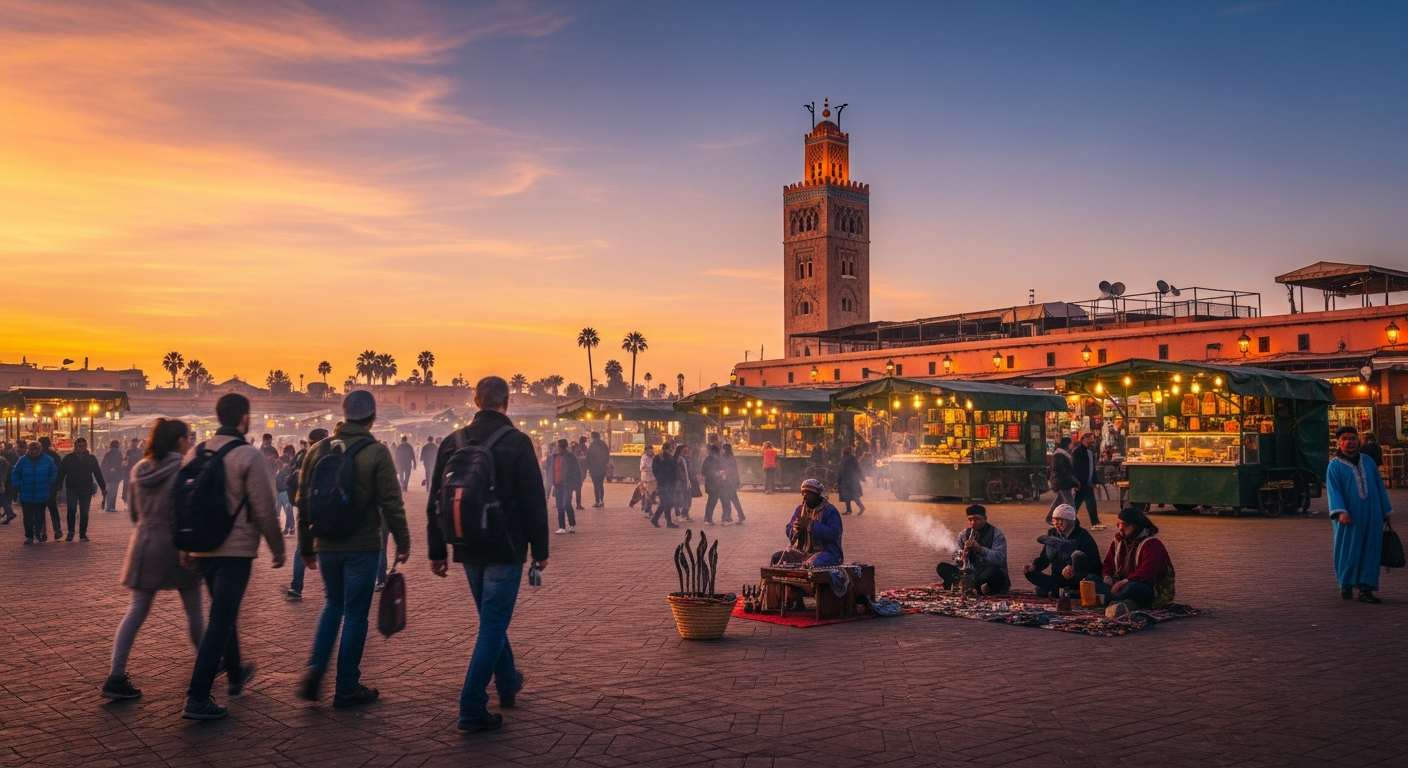
The transformation between day and night feels almost staged. Jemaa el-Fnaa, the main square, shifts from daytime fruit vendors and henna artists to an evening carnival of food stalls, musicians, and storytellers. The smoke rises, the lanterns glow, and for a moment the 21st century feels very far away.
Best time to visit: Early morning for empty lanes and genuine local atmosphere, or late afternoon when the light turns gold and the square begins its nightly metamorphosis.
What most visitors miss: The mellah (old Jewish quarter) near the Bahia Palace, where quieter streets and crumbling balconies tell a different story of Moroccan history.
The photograph: From a rooftop café at sunset, with the Koutoubia Mosque's minaret silhouetted against the Atlas Mountains.
Chefchaouen
The blue city sits in the Rif Mountains like something half-remembered from a dream. Every surface — walls, steps, doorways, flower pots — washed in variations of blue that range from powder soft to electric cobalt. The effect is disorienting and deeply calming simultaneously, as if you've wandered into a meditation on a single colour.
Chefchaouen was founded in 1471 as a fortress against Portuguese invasion, but its famous blue came later — possibly from Jewish refugees in the 1930s who associated the colour with divinity, or perhaps simply as a practical mosquito repellent. The origin matters less than the result: a town that photographs beautifully from every angle but feels best experienced slowly, without agenda.
The pace here is deliberately unhurried. Locals sit in doorways. Cats — so many cats — arrange themselves on blue steps like living decorations. The air smells of kif and cedar and cooking tagines. Beyond the medina walls, hiking trails lead into the surrounding mountains, offering perspective on how improbably this blue cluster clings to its hillside.
Best time to visit: Weekday mornings before the day-trip crowds arrive from Fes, or late afternoons when the shadows deepen the blue.
The insider view: Climb to the Spanish Mosque on the hill opposite town for the definitive panorama — especially powerful at golden hour.
Practical note: Chefchaouen is small enough to explore completely on foot. Stay at least one night; the town feels entirely different after the buses leave.
Fes el-Bali
If Marrakech is theatre, Fes is archaeology — layer upon layer of history compressed into the world's largest car-free urban zone. Fes el-Bali, the old medina, contains over 9,000 alleys, many barely shoulder-width, all curving and climbing in ways that defeat maps and GPS alike.
This is Morocco's spiritual and intellectual heart. The University of Al-Qarawiyyin, founded in 859 CE, claims to be the world's oldest continuously operating educational institution. Scholars still study in the attached mosque. Craftspeople work in shops that have belonged to their families for generations. The tanneries — those famous stone vats of coloured dye — continue using medieval methods, the smell of pigeon droppings (used in the leather-softening process) announcing their presence blocks away.
Getting lost isn't a risk in Fes; it's inevitable and ultimately rewarding. Each wrong turn reveals something: a fountain covered in intricate zellige tilework, a brass workshop where flames dance, a sudden glimpse of a minaret framed perfectly between leaning walls. The disorientation becomes its own kind of discovery.
Best time to visit: Fes rewards slow exploration over multiple days. Mornings are best for the tanneries (viewing terraces fill quickly), while late afternoon brings softer light into the narrow lanes.
What to notice: The carved wooden doors, many centuries old, each telling stories through their patterns and hardware.
Essential experience: Tea on a rooftop overlooking the medina as the evening call to prayer ripples across the city from dozens of mosques, slightly out of sync.
The Sahara at Merzouga
The Sahara Desert near Merzouga isn't Morocco's only sand dune experience, but it's the most theatrical. The Erg Chebbi dunes rise to 150 meters — enormous ochre waves that shift colour throughout the day, from pale coral at noon to deep amber at sunset to silver under moonlight.
The journey here becomes part of the experience. From Marrakech or Fes, the road crosses the High Atlas via dramatic passes, descends through oasis valleys lined with kasbahs, and finally reaches the desert's edge where the paved world simply ends. Camels wait at guesthouses built from the same clay as the surrounding landscape.
Spending a night in the desert remains transformative in ways that resist description. The silence is physical — a presence rather than an absence. The stars, without light pollution, seem impossibly dense. And the sunrise, watching shadows race across the dunes as the first warmth touches your face, belongs to that category of experience that photographs capture only partially.
Best time to visit: October through April for bearable temperatures. Full moon nights offer magical visibility; new moon nights offer overwhelming stars.
Beyond the expected: Ask about Gnawa music sessions at desert camps — the rhythms and melodies feel entirely appropriate to the landscape.
Practical reality: The camel ride to desert camps takes 1-2 hours. It's uncomfortable but memorable. The alternative — a 4x4 transfer — sacrifices atmosphere for convenience.
Essaouira
The wind defines Essaouira. It sweeps off the Atlantic with reliable intensity, making this port city a pilgrimage site for windsurfers and kitesurfers while keeping the atmosphere ten degrees cooler than inland Marrakech. Portuguese ramparts face the sea, their cannons still pointed at waves that have been crashing against the same rocks for five centuries.
Unlike the intensity of the imperial cities, Essaouira moves slowly. The medina, a UNESCO World Heritage site, was designed in the 18th century with unusually wide streets and a rational grid — practically suburban by Moroccan standards. Galleries occupy former merchant houses. The smell of grilling sardines drifts from the port, where blue fishing boats cluster and seagulls wheel endlessly.
The town carries ghosts of its bohemian past. Jimi Hendrix may or may not have stayed here in the 1960s (local legend insists he did), but the creative energy persists. Musicians play gnawa in small squares. Woodworkers craft thuya wood boxes using techniques unchanged for generations. The light, filtered through sea mist and reflected off whitewashed walls, has drawn artists for decades.
Best time to visit: June for the Gnaoua World Music Festival, or shoulder seasons for quieter exploration. Avoid peak wind months (April-May) unless you're here for watersports.
The moment to find: Late afternoon on the ramparts, watching the sun drop toward the Atlantic as fishermen bring in the day's catch.
Where to eat: The port's grill stalls serve the freshest, simplest seafood — choose your fish, specify your preparation, and eat overlooking the boats.
Aït Benhaddou
Rising from the desert plain like a sculpture of mud and straw, Aït Benhaddou is the kasbah that launched a thousand film credits. Gladiator, Game of Thrones, Lawrence of Arabia — this fortified village has stood in for ancient cities across the world while remaining utterly itself.
The UNESCO-protected site represents the apogee of traditional Moroccan defensive architecture. Earthen towers climb the hillside in tiers, connected by walkways and courtyards, the entire structure seeming to grow organically from the red earth beneath. A few families still live within the walls, though most residents have moved to the modern village across the river.
Visiting early morning or late afternoon reveals the kasbah's true character. The crowds thin, the light softens, and the ancient stones seem to breathe. Climbing to the fortified granary at the summit offers views that extend to the snow-capped High Atlas, a reminder of how strategically this location was chosen.
Best time to visit: Early morning for empty lanes and dramatic shadows, or late afternoon when the western light turns the walls to gold.
The photograph to seek: From across the river at sunset, with the entire kasbah reflected in whatever water remains.
Practical note: The river crossing involves stepping stones — manageable but potentially challenging after rain. Most visitors combine Aït Benhaddou with a day trip from Marrakech or as part of a Sahara journey.
The Draa Valley
South of Ouarzazate, the road follows the Draa River through what feels like biblical landscape. Date palms crowd the valley floor in impossible green, while red kasbahs rise at intervals along the 200-kilometer stretch — each one formerly a stop on the trans-Saharan caravan route.
This is Morocco slowed to its essence. Small towns appear and recede: Agdz, Tamnougalt, Zagora — the last famously signed "52 Days to Timbuktu," a reminder of the ancient trade connections. Between them, palm groves create their own microclimate, sheltering gardens and villages from the surrounding desert.
The Draa Valley rewards those who stop often. Kasbahs that appear small from the road reveal intricate interiors. Date harvests in October bring particular activity. And the people here — fewer tourists mean more genuine interactions — often invite strangers for tea with a hospitality that feels distinctly southern.
Best time to visit: Spring for green landscapes and comfortable temperatures, or autumn during date harvest.
The experience to prioritize: Stay overnight in a village guesthouse rather than rushing through. The evening rhythm of palm groves and night skies over the desert creates its own kind of luxury.
What to bring: Cash, as ATMs become rare. And patience — the valley reveals itself slowly.
Tangier
For decades, Tangier traded on its reputation as a city of mystery, spies, and literary excess. William Burroughs wrote Naked Lunch here. Paul Bowles made it his permanent home. Everyone from the Rolling Stones to Tennessee Williams passed through, drawn by the particular freedom that international-zone status once offered.
That Tangier is largely gone, replaced by something more complex. The old medina has been restored rather than preserved in amber. The Kasbah museum tells Morocco's story with sophistication. The new port and high-speed rail connection to Casablanca signal modernity, while the Petit Socco — that famous café-lined square — still fills with characters who seem to belong to no particular era.
What remains constant is the position: gateway between Africa and Europe, Atlantic and Mediterranean. From the terrace of the Café Hafa, where Burroughs used to drink mint tea, Spain floats on the horizon close enough to seem touchable. The light here differs from the rest of Morocco — filtered through sea mist, softer, somehow more European even as everything around remains distinctly North African.
Best time to visit: Late spring or early autumn for mild weather and manageable crowds. Summer brings European vacationers and high humidity.
The pilgrimage: Café Hafa for its layered terraces overlooking the Strait of Gibraltar, unchanged since 1921.
Contemporary Tangier: The new galleries and boutique hotels in the Kasbah area show a city actively reinventing itself while nodding to its past.
The Dadès Gorge
The road through the Dadès Gorge climbs and switchbacks through geology that seems designed to intimidate. Red and orange rock formations tower overhead, carved by the Dadès River into shapes that suggest ruined castles or melted candles — pick your metaphor; the reality exceeds both.
This is the Road of a Thousand Kasbahs, though the count seems conservative. Fortified houses and villages dot the valley, many crumbling, some restored as guesthouses, all blending with the surrounding rock so completely they appear geological themselves. The famous "monkey fingers" rock formations near the village of Tamellalt draw photographers, but the entire drive rewards attention.
Beyond the most dramatic switchbacks (where a small café offers tea and vertiginous views), the paved road ends and the valley narrows further. This upper section, accessible by 4x4 or on foot, leads to Berber villages that feel genuinely remote, where hospitality comes with fresh almonds and honey from local hives.
Best time to visit: Spring when the fruit trees blossom, or autumn when the harvest brings activity to the valley. Summer midday is brutally hot; winter can bring snow at higher elevations.
The stop to make: Any of the guesthouses perched above the river for lunch with a view that earns the word "spectacular."
Photography tip: Early morning light picks out the rock formations in high relief; midday flattens everything to uniform ochre.
Moulay Idriss Zerhoun
Morocco's holiest town clusters on two hills above a valley of olive groves and Roman ruins. Until 2005, non-Muslims couldn't stay overnight here; even now, it sees few international visitors compared to nearby Volubilis. The atmosphere remains distinctly local — a pilgrimage site first, a tourist destination barely at all.
Moulay Idriss I, great-grandson of the Prophet Muhammad and founder of Morocco's first Arab dynasty, is buried here in a zawiya (shrine) at the town's heart. Non-Muslims can't enter, but the green-tiled roof and surrounding neighborhood pulse with spiritual energy that transcends religious boundaries. Locals discuss theology in cafés. Pilgrims arrive throughout the year.
The town itself rewards wandering. White houses with green trim climb steep lanes. Viewpoints reveal the mausoleum's distinctive circular minaret — the only round one in Morocco — against a backdrop of agricultural land that seems unchanged for centuries. The Saturday souk brings particular animation, with regional produce and crafts rarely seen in tourist markets.
Best time to visit: Saturday for the weekly market, or during moussems (religious festivals) for an intensity of devotion rarely glimpsed elsewhere.
The view: From the terrace of Dar Zerhoune guesthouse, overlooking the shrine and the valley beyond.
Combine with: Volubilis, the Roman ruins just down the hill — ancient and holy Morocco in easy proximity.
Volubilis
The Roman ruins at Volubilis rise from wheat fields like a fragment of Italy misplaced in North Africa. Triumphal arches, a capitol building, and remarkably preserved mosaic floors testify to 300 years of Roman presence at the empire's southwestern frontier.
What distinguishes Volubilis from Mediterranean Roman sites is its setting and its solitude. The Moroccan countryside stretches to the horizon. Storks nest on the highest columns. In low season, entire hours can pass without another visitor. The sense of discovery — of having happened upon something remarkable — remains available.
The mosaics deserve slow attention. Protected under modern shelters, they depict Orpheus charming animals, Dionysus discovering Ariadne, daily life in a prosperous colonial outpost. Walking the site's main street, imagining chariots and toga-clad administrators, requires no great effort. The stones hold their stories close to the surface.
Best time to visit: Early morning or late afternoon for best light and fewer visitors. Spring wildflowers add colour; summer heat makes midday difficult.
The essential moment: Standing in the House of Orpheus, afternoon light catching the mosaic, birdsong replacing ancient conversations.
Practical note: There's minimal shade and no café within the site. Bring water and sun protection.
Tetouan
The white medina of Tetouan feels distinctly Andalusian — and for good reason. When Muslims and Jews fled Granada after 1492, many settled here, bringing Spanish architecture, crafts, and sensibilities. The result is a UNESCO-listed old city where buildings feature wrought-iron balconies and interior courtyards that would fit comfortably in Seville.
Tetouan remains off most tourist itineraries, overshadowed by Chefchaouen and Tangier nearby. This oversight creates opportunity. The royal palace occupies a central position. The Jewish quarter preserves its particular character. The craft tradition — especially leather and textiles — continues with less tourism influence than elsewhere.
The medina's lanes feel genuinely lived-in rather than performed. Local families shop alongside the occasional visitor. Spanish echoes in the architecture and occasional conversation. And the relationship between Muslim and Jewish heritage — visible in adjacent quarters — tells a story of coexistence that resonates particularly in contemporary times.
Best time to visit: Morning for active market scenes, afternoon for quieter exploration.
What to seek: The tanneries, smaller and less touristic than Fes, where you can watch the process without the hard sell.
Combine with: Day trips to Chefchaouen (1.5 hours) or the beach at Martil (15 minutes).
The Todra Gorge
Where the Todra River cuts through the eastern High Atlas, sheer canyon walls rise 300 meters on either side, separated at their narrowest point by just ten meters. The effect is geological drama concentrated — a natural cathedral with a river running through.
The most dramatic section lies just beyond the village of Tinghir, where the road passes between the canyon walls before emerging into a wider valley. In this narrow passage, climbers scale routes rated among Morocco's most challenging, their colorful ropes contrasting with grey-pink limestone.
Beyond the famous slot canyon, the gorge continues for kilometers into the mountains. A paved road gives way to piste, passing Berber villages where traditional life continues with minimal tourist impact. Hiking here requires no technical skill but rewards with silence, prehistoric rock carvings, and hospitality in villages that see few strangers.
Best time to visit: Morning before tour buses arrive, or overnight to experience the canyon at dawn when light first penetrates the narrow walls.
The experience beyond: Hike beyond the paved road to the village of Tizgui for tea and tagine with families who've lived in these mountains for generations.
Practical note: Swimming in the river is possible in summer, though water levels vary seasonally.
Rabat
Morocco's capital lacks the touristic intensity of Marrakech or the historical weight of Fes, which may explain its appeal. Rabat is where Morocco's contemporary identity lives most comfortably — modern art museums, excellent restaurants, and a medina that feels genuinely local because it primarily is.
The Kasbah des Oudaias, perched above the Atlantic, contains a residential neighborhood painted in the familiar blue and white, but quieter than Chefchaouen, more authentic somehow. Andalusian gardens overlook the river mouth and the sea beyond. The Hassan Tower — an unfinished minaret from an abandoned 12th-century mosque — stands as a monument to ambitions that exceeded their time.
The modern city offers Morocco's best museum experience. The Mohammed VI Museum of Modern and Contemporary Art shows Moroccan artists in sophisticated context. The Rabat Archaeological Museum houses Roman bronzes and prehistoric artifacts. And the medina, UNESCO-listed but not yet gentrified, sells to locals what tourists elsewhere pay premium prices for.
Best time to visit: Year-round — Rabat's Atlantic climate remains mild when interior cities swelter or freeze.
The neighbourhood: Kasbah des Oudaias at sunset, when the light turns golden and residents gather on their doorsteps.
Contemporary Rabat: The tramway, spotless and efficient, offers a way to see the city as residents do.
Meknes
The smallest of Morocco's four imperial cities, Meknes was briefly the center of Moroccan power under the 17th-century sultan Moulay Ismail. His ambitions — he aimed to rival Versailles — left massive walls, ornate gates, and granaries capable of feeding 12,000 horses.
Today, Meknes lives comfortably outside the tourist mainstream. The medina lacks Fes's overwhelming complexity, making it manageable for independent exploration. The Bab Mansour gate, completed in 1732, ranks among Morocco's most impressive monuments. And the Jewish quarter, the mellah, preserves a character largely lost in more visited cities.
The pleasure of Meknes lies partly in what it isn't: not overcrowded, not overly restored, not performing for visitors. The Place el-Hedim, Meknes's main square, fills with locals rather than tourists as evening approaches. Restaurants serve food priced for residents. The imperial legacy remains, but as backdrop rather than main attraction.
Best time to visit: Spring or autumn for comfortable exploration; the city's inland position makes summers hot.
The monument: Moulay Ismail's mausoleum, one of Morocco's few shrines open to non-Muslims, its courtyards a masterpiece of zellige tilework.
Day trip: The Roman ruins of Volubilis and the holy town of Moulay Idriss lie within thirty minutes.
The Paradise Valley
South of Agadir, a hidden valley earned its name through palm groves, natural pools, and an atmosphere that feels more Eden than Atlas. The drive from the coast climbs through argan forests (watch for goats in trees, a genuine phenomenon rather than tourist setup), then descends into a green gorge where time operates differently.
Natural swimming pools formed by the river attract locals and visitors seeking relief from summer heat. The water runs cool and clear, shaded by palms and wild figs. Small cafés perched on rocks serve tagines and fresh juices while the river sounds below.
Paradise Valley functions as Agadir's countryside escape, but midweek and off-season, it regains its peaceful character. The hiking extends beyond the main pools into higher valleys where Berber villages dot the landscape. The sense of discovery — of having found something not in every guidebook — remains available for those who venture past the first café.
Best time to visit: Spring for full pools and green landscapes, or early autumn when crowds thin but water remains.
The experience: Pack a picnic and hike upstream from the main pools to find your own swimming spot.
Getting there: The road from Agadir takes about an hour; signage is minimal, so detailed directions or GPS prove helpful.
Tafraoute
The Anti-Atlas mountains around Tafraoute produce a landscape that seems designed by a surrealist. Massive pink granite boulders balance improbably. Almond trees blanket the valleys in February blossoms. And the Painted Rocks — boulders decorated in bright colors by a Belgian artist in 1984 — add a final note of cheerful absurdity.
Tafraoute itself is a small town that serves as base for exploration. The surrounding valleys shelter Berber villages where traditional adobe architecture blends with pink stone. Hiking here requires no guide but rewards with constantly surprising geology and encounters with rural life unchanged for generations.
The light in Tafraoute deserves particular attention. At sunset, the pink granite glows as if internally lit, the entire landscape shifting through coral and rose to deep purple. The effect draws photographers, but even without camera, the daily performance justifies the journey from more accessible destinations.
Best time to visit: February for almond blossoms, or any month avoiding July-August heat.
The palette: Sunset from Lion's Head rock formation for the full colour transformation.
Cultural note: The region is Amazigh (Berber) heartland; Friday markets in Tafraoute and surrounding villages offer authentic local commerce.
Casablanca
"Of all the gin joints in all the towns in all the world..." Humphrey Bogart never actually came to Casablanca — the famous film was shot entirely in Hollywood — but the city has learned to leverage its cinematic associations. Rick's Café, a replica of the movie's bar, serves nostalgic meals to visitors who know they're participating in fiction.
Beyond the movie mythology, Casablanca functions as Morocco's economic engine — a modern, functional city that few tourists linger in. This is a mistake. The Hassan II Mosque, completed in 1993, ranks among the world's largest and most beautiful, its minaret rising 210 meters above the Atlantic, its interior open to non-Muslims during guided tours.
The architecture of Casablanca tells Morocco's 20th-century story. French colonial art deco buildings line the downtown boulevards. The 1930s Quartier Habous shows a French interpretation of Moroccan urban design. And the contemporary arts scene, galleries and restaurants concentrated in the Maarif district, reveals a Morocco actively creating rather than merely preserving.
Best time to visit: The mosque tours run throughout the day; aim for morning light. Spring and autumn offer the most comfortable weather.
The architecture walk: Downtown between Place Mohammed V and the port, where art deco details reward upward glances.
Contemporary Casablanca: The Maarif district for galleries, boutiques, and restaurants that show Morocco's modern creative energy.
The Ouzoud Falls
The highest waterfalls in North Africa drop 110 meters through red cliffs into pools where Barbary macaques play and swimmers cool off. The cascade appears suddenly, after a drive through olive groves and small villages that give no indication of what lies ahead.
The falls create their own microclimate — cooler, greener, the air thick with mist. Rainbow fragments appear and vanish in the spray. Terraced cafés cling to the cliffside, offering the peculiar pleasure of eating tagine while watching water thunder into the gorge below.
Beyond the main viewpoints, trails descend to the base of the falls, where the power becomes visceral. Swimming is possible in calmer pools slightly downstream. The macaques, while entertaining, have grown accustomed to tourists — guard your food and keep appropriate distance.
Best time to visit: Spring for maximum water volume, or early morning any season to avoid crowds and catch the light.
The perspective: Descent to the falls' base takes 15-20 minutes and rewards with the full sensory experience — sound, spray, and scale.
Practical note: The falls are a popular day trip from Marrakech (2.5 hours); overnight in the village of Ouzoud allows for quieter morning access.
Skoura
The oasis of Skoura spreads beneath a scatter of kasbahs, a palm grove where traditional agriculture continues much as it has for centuries. This is the Morocco that existed before tourism, accessible now through boutique hotels converted from fortified houses and walks through gardens that feel genuinely timeless.
The Amridil Kasbah, still privately owned and partially inhabited, stands as the palm grove's most photogenic monument — a multi-towered fortress that appears on Morocco's 50-dirham note. But equally rewarding are the nameless smaller kasbahs glimpsed through palm fronds, the irrigation channels that distribute water with ancient precision, the villages where afternoon tea comes with fresh dates.
Skoura functions as counterpoint to Morocco's more dramatic landscapes. No massive dunes or plunging gorges here — just the patient beauty of oasis agriculture, the particular green of date palms against red earth, the unhurried rhythm of rural life.
Best time to visit: Morning or late afternoon for walking the palm grove in comfortable temperatures; October-November during date harvest for particular activity.
The stay: Any of the converted kasbahs offer the essential experience — sunset from the rooftop, dinner by lantern light, birdsong at dawn.
The detail: Watch for the roses grown between palm trees, used for rose water and beauty products throughout Morocco.
Local Wisdom for Traveling Morocco
Understanding Morocco requires adjusting certain expectations while embracing others. Transportation between cities operates on multiple levels: CTM buses run punctually and comfortably on major routes, while smaller town connections may involve waiting for enough passengers to fill a grand taxi. Both approaches have their merits — the bus offers predictability, the shared taxi offers encounter.
The question of where to base yourself depends entirely on what you're seeking. Marrakech and Fes provide urban immersion and extensive day trip options. Smaller towns — Chefchaouen, Essaouira, Skoura — offer calmer rhythms and easier relationship building with locals. The desert camps near Merzouga offer something else entirely: silence, stars, and temporary detachment from everything familiar.
Timing transforms the Moroccan experience. Visit Jemaa el-Fnaa at noon and wonder what the fuss is about; return at dusk and understand immediately. Explore Fes's medina during Friday afternoon prayers and find uncharacteristic quiet. Travel during Ramadan and encounter both practical challenges (daytime restaurant closures) and spiritual opportunities (iftar meals with local families). Morocco rewards those who pay attention to when, not just where.
The mint tea ritual deserves respect and patience. Three glasses represent hospitality's arc — "the first glass is as gentle as life, the second is as strong as love, the third is as bitter as death," goes the saying. Declining tea rarely offends, but accepting creates connection. The same applies more broadly: Morocco responds to genuine curiosity with genuine welcome. Bargaining belongs in souks, but relationship precedes transaction. Take time to talk before buying, and the entire interaction shifts.
Navigation improves with surrender. GPS fails in medinas; getting lost leads somewhere. Guides — official or otherwise — offer real value in the most complex sites, provided expectations are set clearly at the beginning. A good guide in Fes saves hours of frustration and reveals layers otherwise invisible.
Discover Your Morocco Through Traveler Routes
These twenty places represent entry points rather than checkboxes — each one opens into further discovery, further conversation with this infinitely layered country. The traveler who returns to Morocco repeatedly isn't checking off a list but deepening a relationship, finding that the country offers different gifts at different times.
For those beginning to plan their own journey, Touratu's interactive map offers a way to see how other travelers have connected these destinations, which routes reveal the most, and which hidden corners don't appear in standard itineraries. The reels and visual discoveries from travelers already on the ground show Morocco not as monument but as experience — the quality of light in a particular alley, the moment a market comes alive, the view that makes the long drive worthwhile.
Morocco stays with you. Not as a collection of photographs or a list of sites visited, but as a sensory presence — the taste of fresh mint, the feel of old stone under your hand, the particular blue of a Chefchaouen doorway, the silence of the Sahara at midnight. It's a country that asks something of its visitors: attention, patience, willingness to be surprised. And it gives back in proportion to what you bring.
The twenty places here will change. Some will become more touristic; others may find their way back toward authenticity. The medinas will continue their slow evolution. The desert will keep its silence. And travelers will keep returning, drawn by whatever quality it is that makes Morocco feel not like a destination but like a recurring dream — familiar enough to navigate, strange enough to wonder.
FAQ_JSON_START [ {"question": "What is the best time of year to visit Morocco?", "answer": "Spring (March-May) and autumn (September-November) offer the most comfortable temperatures across the country. Summer brings intense heat to inland cities and the Sahara, while coastal towns like Essaouira remain pleasant. Winter is ideal for desert trips but can bring snow to mountain passes.", "sortOrder": 1}, {"question": "How many days do you need to explore Morocco properly?", "answer": "A minimum of 10-14 days allows for experiencing Morocco's diversity — combining an imperial city like Fes or Marrakech with coastal Essaouira, the Sahara Desert, and mountain scenery. Two to three weeks permits deeper exploration and the slower pace that reveals Morocco's true character.", "sortOrder": 2}, {"question": "Is Morocco safe for solo travelers and women?", "answer": "Morocco is generally safe for solo travelers including women, though unwanted attention can occur in tourist areas. Dressing modestly, avoiding isolated areas at night, and trusting your instincts are sensible precautions. Many solo travelers report positive experiences, particularly when staying in reputable accommodations and joining small group excursions.", "sortOrder": 3}, {"question": "What should I know about bargaining in Moroccan souks?", "answer": "Bargaining is expected in souks and can reduce prices by 50-70% from initial asking prices. Start low, remain friendly throughout, and be willing to walk away. In fixed-price shops and for food, bargaining is not customary. Building rapport before discussing price often leads to better outcomes and more enjoyable interactions.", "sortOrder": 4}, {"question": "Can
