
Nag Nathaiya Festival Varanasi: Complete Guide to Krishna's Water Drama
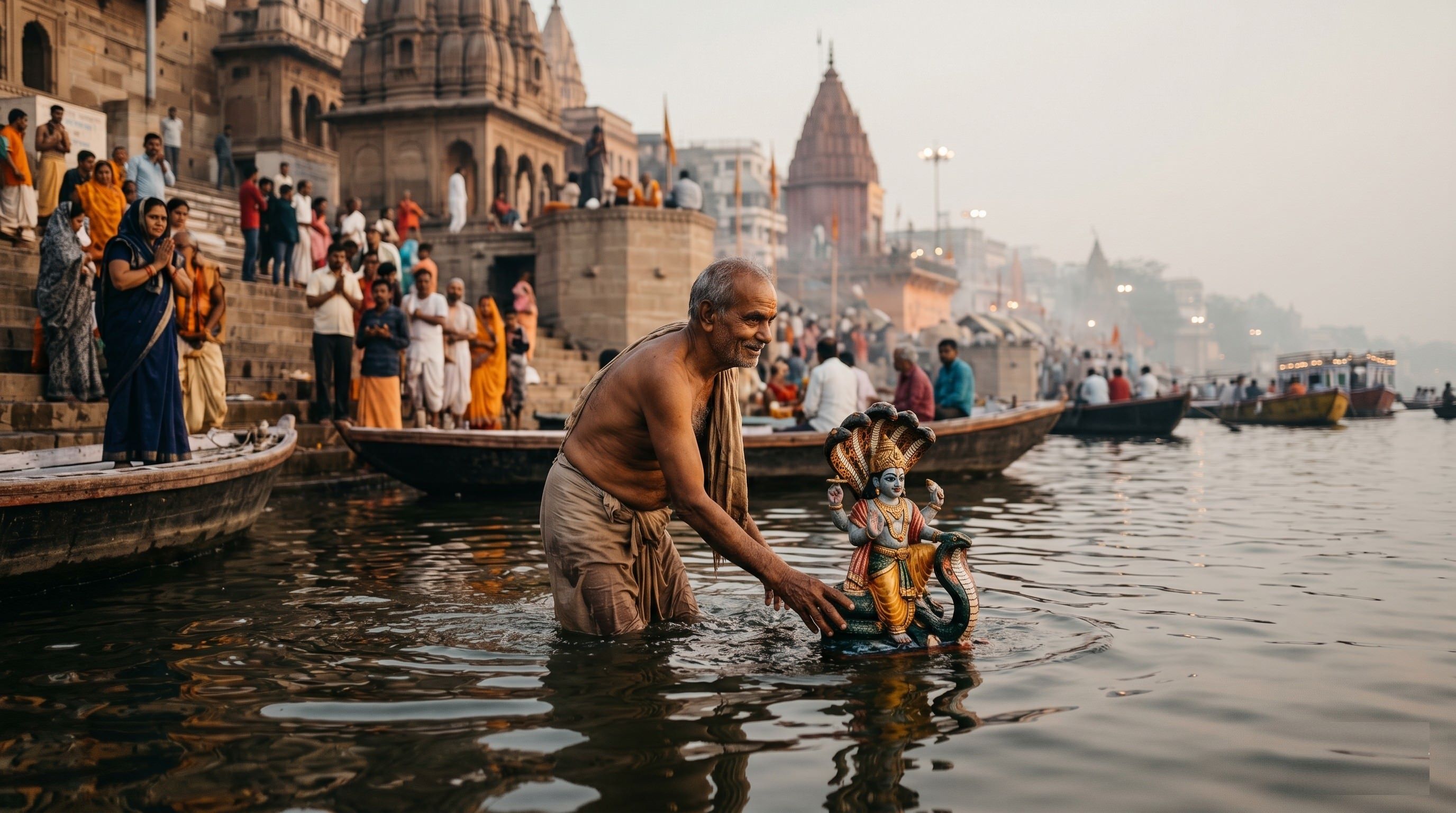
Nag Nathaiya: Varanasi's Most Mystical Festival That'll Leave You Completely Spellbound
The boat rocks gently as the oarsman stops rowing, and for a moment, the only sound is water lapping against wood. Then it begins — a low, rhythmic chanting that seems to rise from the river itself, swelling across the Ganga until it reaches the thousands of us crowded onto boats, ghats, and rooftops. Somewhere ahead, through the morning mist that clings to Tulsi Ghat, a brass serpent hood catches the first light of day, and the crowd exhales as one. The god has arrived.
I've witnessed Varanasi in many of its moods — the predawn silence of Assi Ghat, the chaos of evening aarti at Dashashwamedh, the quiet grief of funeral processions. But nothing prepared me for Nag Nathaiya, this annual theatrical retelling of Krishna's victory over the serpent king Kaliya, performed not on a stage but on the sacred waters themselves. It's part devotion, part folk opera, part collective dream — and standing in a wooden boat at 6 AM on a cold November morning, I understood why people travel from across India to witness ninety minutes that feel suspended outside of time.
Where River Becomes Stage
Tulsi Ghat transforms overnight. The ancient steps — usually quiet, favored by those seeking respite from the city's more famous ghats — become an amphitheater. Temporary platforms rise from the water. Boats string with marigolds and lights cluster at the edges like expectant witnesses. The ghat takes its name from the poet-saint Tulsidas, who lived here while writing his Hindi Ramayana, and there's something fitting about poetry returning to these stones in the form of water-borne drama.
The morning I arrived, families were already claiming spots on the steps before 5 AM, spreading blankets and unpacking thermoses of chai. Children sat on fathers' shoulders. Elderly women in white saris found positions near the water's edge, their lips moving in quiet prayer. A group of young men had climbed to a rooftop terrace, their phones ready to capture what their grandparents once watched as children.
What struck me immediately was the intimacy. Unlike the overwhelming spectacle of the main aarti, Nag Nathaiya maintains a strange closeness despite the crowds. Perhaps it's the water — everyone oriented toward the same patch of river, watching the same floating platform where gods and demons will dance. Perhaps it's the morning hour, when Varanasi hasn't yet woken into its full commercial energy. Or perhaps it's simply that this festival belongs to the city itself, not to tourists, and you feel like a welcomed guest at something private.
The Drama on Water
The performance itself defies easy description. It's Ramlila's cousin — folk theater rooted in centuries of tradition, passed down through families of performers who treat their roles as sacred duty, not mere acting. The story is simple: Krishna, the divine child, dances on the hood of the serpent king Kaliya, subduing the creature that had poisoned the Yamuna River. Good conquers evil. The waters are purified. Life continues.
But simplicity contains multitudes.
When the boy playing Krishna emerged — perhaps twelve years old, his face painted blue, his crown catching morning light — the crowd fell silent with an intensity I've rarely felt. This wasn't applause-worthy entertainment. This was darshan, the sacred act of seeing and being seen by the divine. Women around me pressed palms together. An old man beside me whispered "Jai Shri Krishna" with tears on his cheeks.
The choreography unfolds on a floating platform that dips and sways with each movement. Krishna dances, and the river dances with him. The serpent hoods rise — elaborate papier-mâché constructions that somehow look both theatrical and ancient — and their movements mirror the water's rhythm. Musicians on nearby boats play shehnai and drums, the sound bouncing off ghat walls until it seems to come from everywhere and nowhere.
For ninety minutes, modern Varanasi disappears. No honking, no construction noise, no amplified advertising. Just the river, the music, the bodies moving through myth, and thousands of people collectively holding their breath.
The Devotees and Their River
I spent the days before the festival walking the ghats, asking people about Nag Nathaiya. Their answers taught me more than any guidebook could.
A flower seller at Dashashwamedh, threading marigold garlands with fingers that moved faster than my eyes could follow, told me her family has watched the festival for five generations. "My great-grandmother used to say that when Krishna dances, the Ganga herself becomes young again," she said. "I don't know if it's true. But I feel something change in the water that day. Everyone does."
A boatman named Rajesh, who would later row me to my viewing spot, explained that securing a boat position for Nag Nathaiya is a matter of serious negotiation. "Families book the same spots every year. My father rowed for the same Marwari family for thirty years. Now I row for their sons." He paused, adjusting his oars. "It's not about money. Well, not only about money. It's about being part of something."
At a chai stall near Tulsi Ghat, I met a group of engineering students from Banaras Hindu University who had woken at 4 AM to claim their spots. "My roommate is from Bangalore," one of them said. "He asked why we bother with old religious dramas. I told him — come watch, then ask again." His roommate, standing beside him, smiled sheepishly. "I'm not asking again. I understand now."
The Texture of the Morning
What I remember most vividly is not the central performance but the edges — the details that fill the frame around the main event.
The smell of burning dung fires from nearby homes, mixing with incense and river water and the particular mustiness of old wool blankets. The fog that refused to lift completely, keeping the sun diffused and golden throughout the morning. A baby sleeping through the entire performance in her mother's arms, oblivious to gods and demons battling above her dreaming head.
The way silence works differently on water — how the crowd's hush has a texture, an almost physical presence, broken only by the slap of waves against hulls and the distant call of birds.
I watched an elderly man in a wooden boat, sitting absolutely still, his eyes fixed on the young Krishna with an expression I couldn't read — devotion, certainly, but also something like grief, or perhaps memory. When the performance ended, he didn't move for several minutes while others around him began packing up, calling to boatmen, resuming their ordinary lives. He just sat there, looking at the water where the serpent had been defeated, where the god had danced.
The Landscape of Devotion
Tulsi Ghat occupies a particular geography in Varanasi's sacred map. It sits south of the main tourist corridor, between Assi Ghat and the Hanuman temple at Sankat Mochan. The neighborhood behind it — narrow lanes lined with old havelis, small temples tucked into corners, chai stalls that seem to have existed since time began — maintains a quieter energy than the areas around Dashashwamedh.
This matters for Nag Nathaiya. The festival draws crowds, but crowds of a different composition than Varanasi's usual tourist gatherings. Here, the ratio shifts toward local families, students, priests from nearby temples, shopkeepers who have closed their businesses for the morning. You hear more Hindi, more Bhojpuri, fewer European languages.
The ghat itself has a particular quality of light — the buildings behind it are lower than at some other locations, allowing morning sun to reach the water earlier, painting everything in shades of amber and rose. Photographers know this. So did whoever chose this spot for water-based performance centuries ago.
Beyond the Festival Day
Varanasi reveals different faces to those who linger. If Nag Nathaiya brings you here, consider staying to discover the city's other rhythms.
Sarnath sits just ten kilometers away — the deer park where Buddha preached his first sermon after enlightenment. The contrast is striking: where Varanasi overwhelms with sensory density, Sarnath offers space and silence. The Dhamek Stupa rises from green lawns, and monks from across Asia circumambulate in the morning quiet. After the intensity of Nag Nathaiya, Sarnath's stillness feels like a necessary counterpoint, a place to process what you've witnessed.
Ramnagar Fort, across the river, houses the Maharaja's collection and plays host to the city's famous month-long Ramlila performances. If you're interested in the theatrical traditions that birth festivals like Nag Nathaiya, an afternoon wandering Ramnagar's dusty halls and crumbling courtyards offers context. The fort looks particularly beautiful at sunset, when the light turns its sandstone walls the color of old gold.
For those drawn to the textile arts, the weaving neighborhoods of the Muslim quarter — particularly around Madanpura — reveal another Varanasi entirely. Families have woven Banarasi silk for generations, and watching a master craftsman work his loom offers a different kind of devotion, equally patient, equally passed down through time.
Finding Your Way
Nag Nathaiya falls on Kartik Purnima, the full moon day of the Hindu month of Kartik — typically in November. The exact date shifts with the lunar calendar, so check before planning. Arrive in Varanasi at least a day early; the city takes time to decode, and rushing from train station to ghat will leave you disoriented rather than immersed.
Securing a good viewing position requires predawn dedication. Most serious viewers arrive by 5 AM; the performance typically begins around 6:30 and ends by 8. Boat viewing is the most atmospheric option — negotiate the previous afternoon, and expect to pay a premium. Ghat steps fill quickly but offer excellent vantage points if you're willing to sit for several hours.
November mornings in Varanasi are cold — genuinely cold, especially on the water. Bring layers, including something to cover your head. The sun warms things eventually, but the wait can be uncomfortable if you've underestimated the chill.
Photography is permitted, but consider the etiquette of the moment. This is active worship for many attendees, not performance art. I saw several travelers put their cameras away after the first few minutes, choosing presence over documentation. They seemed, somehow, to see more.
The Discovery Continues
For travelers seeking to understand the deeper currents of Varanasi — the festivals, ghats, and traditions that most visitors never encounter — Touratu's interactive maps offer a way into the city's layered geography. Explore curated travel reels from local guides and visual journeys that illuminate the spaces between the famous sites.
What Remains
Late that afternoon, I returned to Tulsi Ghat alone. The platforms had been dismantled, the boats scattered back to their regular duties. A few children played in the shallows. An old woman sat on the steps, feeding pigeons from a paper bag.
The ghat had returned to its ordinary self — quiet, unremarkable, one of dozens along the city's riverfront. Nothing visible suggested that gods and serpents had danced there that morning, that thousands of people had collectively witnessed a myth made flesh and water.
And yet.
The stones remembered, I was certain of it. The river carried something different in her current, some trace of that communal dreaming. The old woman feeding pigeons had probably watched the same performance for fifty years. The children would watch for fifty more.
This is what Varanasi teaches, slowly, if you let it: that time moves differently along sacred rivers. That old stories matter because they keep being told. That watching a twelve-year-old boy dance on a serpent's hood isn't performance — it's participation in something larger than any single life, any single morning, any single boat rocking gently on cold water as the mist finally lifts.
Loading activities…
