
Sarnath Buddhist Temple: History, Visiting Guide
Sarnath
The Quiet Power of Sarnath: Where Buddha Found His Voice
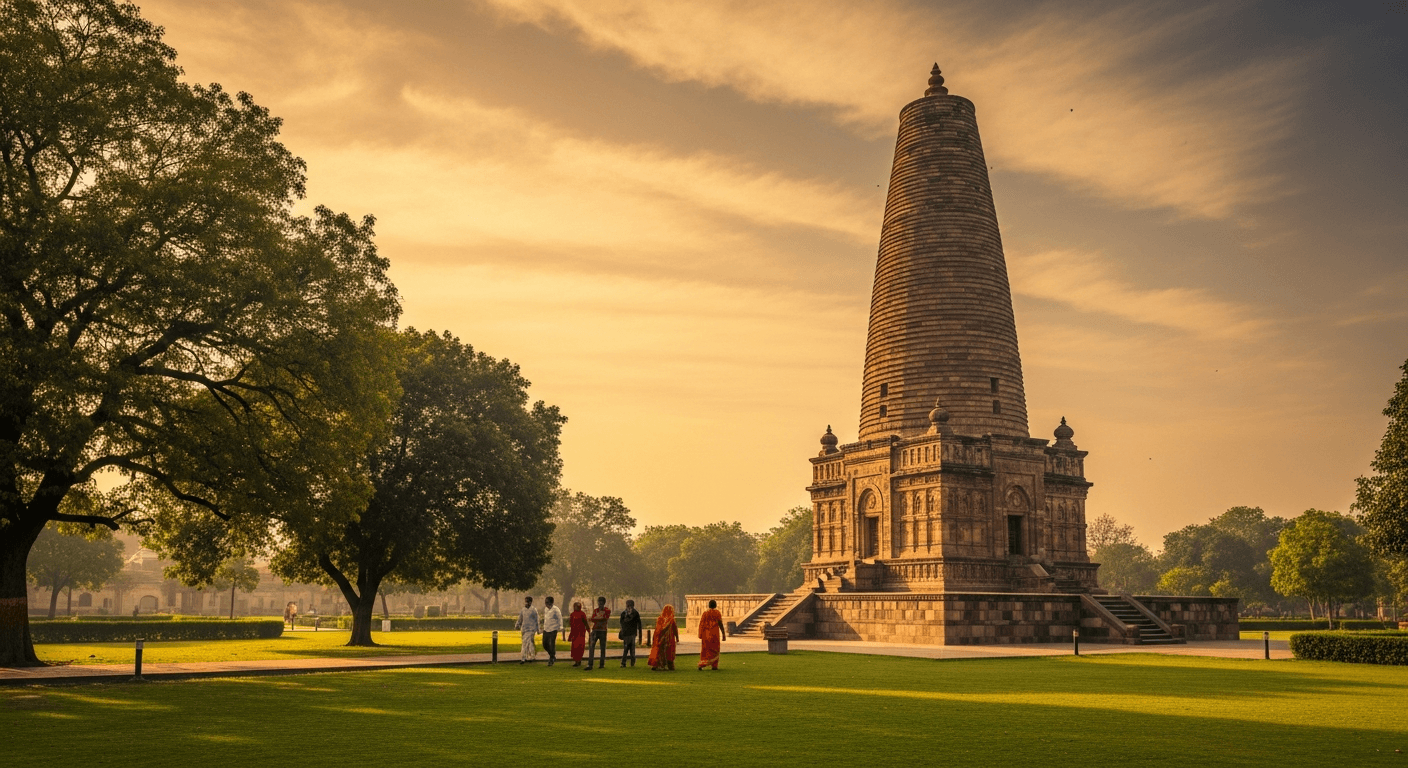
The morning light hits the Dhamek Stupa at an angle that makes you understand why people have stood in this exact spot for 2,500 years. There's no drama to it—no soaring cliffs or turquoise water to gaslight your senses. Just red brick, weathered stone, silence, and the sudden awareness that something genuinely important happened here.
Sarnath, a short drive from Varanasi's chaos, is where Siddhartha Gautama delivered his first sermon after reaching enlightenment. The Deer Park, the temple grounds, the museum—they're all physical proof of a moment that changed the course of human thought. But here's the thing most visitors don't realize until they arrive: understanding the place's significance and actually feeling it are two different things.
Why This Place Matters More Than The Photos Suggest
Sarnath isn't photogenic in the way that sells postcards. The main stupa is largely ruins—beautiful, important ruins, but ruins nonetheless. There are no monks chanting at convenient times. The grounds can be surprisingly quiet, even crowded. You won't leave with your chest heaving from spiritual transcendence unless you're already predisposed to that experience.
What you will get is context. Walking through Sarnath is like reading a paragraph explaining why a sentence matters so much. Buddhism, as it spread across Asia, carried this moment with it—the moment when Buddha sat beneath the Bodhi tree, understood suffering, and then walked to a deer park to tell five ascetics what he'd learned. The intellectual scaffolding of an entire religion builds from this place.
The temples themselves—particularly the main temple with its 19th-century reconstruction efforts—are functional rather than ornate. The Buddha statue inside sits in a posture of teaching rather than meditation. The four deer sculptures outside commemorate the legend of a deer king who offered himself to a hunter to save his herd. These aren't devices meant to impress; they're visual grammar in a language you're learning as you walk.
The archaeological museum is where the place crystallizes for most visitors. The Ashokan capital—a lion head with four lions roaring outward—sits behind glass. This isn't just a sculpture. It's a physical bridge between Emperor Ashoka's decision to convert to Buddhism and the religion's subsequent dominance across Asia. The museum contains fragments, pillars, seals, and coins that document the fact that Sarnath was once a massive university town, a place of serious intellectual work, not just pilgrimage.
Walking Through Sarnath: What the Experience Actually Feels Like
You'll likely arrive by tuk-tuk from Varanasi, a 10-kilometer journey that takes 20-30 minutes depending on traffic. The approach to the temple grounds is peaceful—tree-lined pathways, relatively few people hawking things, and a clear delineation between the loud city and this pocket of deliberate quiet.
The entrance fee (around 250 rupees for Indians, 600 for foreigners) gives you access to the main temple grounds. Your first real encounter is usually the Dhamek Stupa—that cylindrical brick structure I mentioned. Walking around it, you start to grasp its scale: nearly 44 meters tall, built in the 5th century CE, and somehow both solid and delicate. The stone carvings around its base are worn nearly smooth by time and hands, but you can still make out decorative patterns and what were once intricate details.
The main temple is a working space. You remove your shoes, step inside, and encounter that Buddha statue in teaching pose. The light is dim inside, warm. There's often incense, and sometimes a few people sitting quietly in front of the statue. It's an active place of worship, not a museum frozen in time.
The Chaukhandi Stupa, a smaller structure to the northeast, marks the spot where Buddha met his first students. It's less impressive visually but important contextually—this is where the sermon actually happened, in this deer park, with five monks who would become his first followers.
The ground level is mostly open air and walkable. The whole complex can be explored in 1-2 hours, though the museums warrant additional time if you're genuinely interested. Many visitors spend 45 minutes and move on, which is fine. Some sit for two hours absorbing the layers of history. Both are valid.
When To Come, How Long To Stay, And What To Actually Plan
Best time: October to March, when the temperature is manageable. April-June is punishing heat. July-September brings monsoon and few visitors, which has its own appeal if solitude matters to you.
Duration: 2-3 hours is realistic. The temple itself takes 45 minutes. The museum takes 30-60 minutes depending on your reading speed and genuine interest. If you arrive in late afternoon, the light improves and crowds thin slightly.
Transport: You're coming from Varanasi, which is the only practical base. A tuk-tuk from the city center costs 250-400 rupees (3-5 USD). Hiring a tuk-tuk for the round trip with waiting time costs around 800-1,200 rupees. Alternatively, local buses run from Varanasi but require patience and Hindi.
What to bring: Water. Definitely water. The grounds are partially exposed, and there's limited shade. Comfortable shoes matter because you'll walk on brick and stone. The shoe-removal thing happens at the main temple, so easy-on-easy-off footwear saves frustration. Sunscreen. A small notebook if you're the type who processes places better by writing.
Crowds: Sarnath never feels overwhelming like major Indian temples can. You might encounter school groups (Indian children visiting cultural sites are a constant), a few tourist groups, and individual pilgrims. Weekday mornings are quieter than weekend afternoons. The site doesn't have the infrastructure for massive crowds, so even when "busy," it remains contemplative.
The Archaeological Museum: The Part That Changes Your Understanding
Most visitors underestimate how much time the museum deserves. The Ashokan lion capital is the centerpiece, but the real value is in understanding how Sarnath was literally a city—not just a temple site. Pottery, coins, seals, and pillar fragments show administrative complexity, trade connections, and the fact that people lived here intensely for centuries.
The museum's English explanations are generally clear. You'll learn that Sarnath thrived from roughly the 2nd century BCE through the 13th century CE, when Islamic invasions scattered the Buddhist establishment and the site was abandoned until 19th-century British archaeologists rediscovered it.
Spending 45-60 minutes here instead of rushing through completely reframes the site from "ancient temple" to "ancient seat of intellectual authority." This matters if you want to understand why Sarnath appears in Buddhist pilgrimage itineraries worldwide.
Nearby Places Worth Considering
Varanasi itself (12 km away) is the obvious pairing. The Ganges ghats, Kashi Vishwanath Temple, and the intensity of the city create deliberate contrast with Sarnath's quietness. You can visit both in a day, though it's rushed.
Ramnagar Fort (across the Ganges from Varanasi's main ghats) offers a different historical texture—a 19th-century royal residence with palace rooms and gardens. It's less crowded than Varanasi's central attractions and gives you the river without the cremation ghats' intensity.
Jivaji Ghat and the Manikarnika Ghat rituals are Varanasi experiences, not Sarnath experiences, but worth mentioning because they're close and represent a completely different Hindu spiritual tradition from the Buddhist history at Sarnath.
Is It Actually Worth The Trip?
Yes, with caveats.
If you're in Varanasi anyway, Sarnath is an easy half-day excursion. It won't disappoint unless you expect grand temples and spiritual fireworks. What it will do is ground your understanding of Buddhism in an actual location with physical depth. You'll see original artifacts, walk on earth that has witnessed centuries of pilgrimage, and understand that religion doesn't require spectacle to matter.
If you're not in Varanasi and considering a trip specifically to Sarnath: you need to pair it with Varanasi exploration. Sarnath alone doesn't justify the logistics. But Varanasi + Sarnath as a two-day experience makes excellent sense—one city for complexity and Hindu tradition, one site for Buddhist history and contemplation.
The experience is introspective rather than exhilarating. It suits travelers who enjoy context, history, and quiet spaces. It's less suitable for people who process places primarily through photos and Instagram moments.
Quick Reference Facts
- Established: The stupa was built in the 5th century CE, on the site of Buddha's first sermon
- Main Buddha sermon: Happened approximately 2,500 years ago
- Dhamek Stupa height: 43.6 meters
- Museum highlights: Ashokan lion capital, pottery, coins, seals from the monastic university
- Language of explanations: English available at the museum and some signage
- Entry fee: 250 rupees (Indian citizens), 600 rupees (foreigners)
- Hours: Generally 9 AM - 5 PM; check locally as schedules can shift
- Best photo light: Early morning or late afternoon, particularly around 4-5 PM
The Real Value of Standing Here
Walking the grounds of Sarnath, you're standing in a place that matters not because it looks impressive but because it changed the intellectual trajectory of billions of humans across centuries. The Dhamek Stupa remains because someone decided to mark the spot. The museum exists because archaeologists recognized the evidence of something important. The temples stand because people continue to believe.
That kind of weight—historical, intellectual, spiritual—doesn't always announce itself loudly. Sometimes it whispers. You have to be paying attention to hear it.
Sarnath rewards that attention. It's a place for travelers who understand that the most important moments in human history aren't necessarily the most photogenic.
Ready to map your journey to Sarnath and explore the routes connecting it to nearby Buddhist sites across India? Check out Touratu's interactive map to plan your visit, watch travel videos of the temple grounds, and discover how Sarnath connects to the broader Buddhist pilgrimage circuit across the subcontinent.
Loading activities…
