
Western Australia's Best Places & Hidden Gems
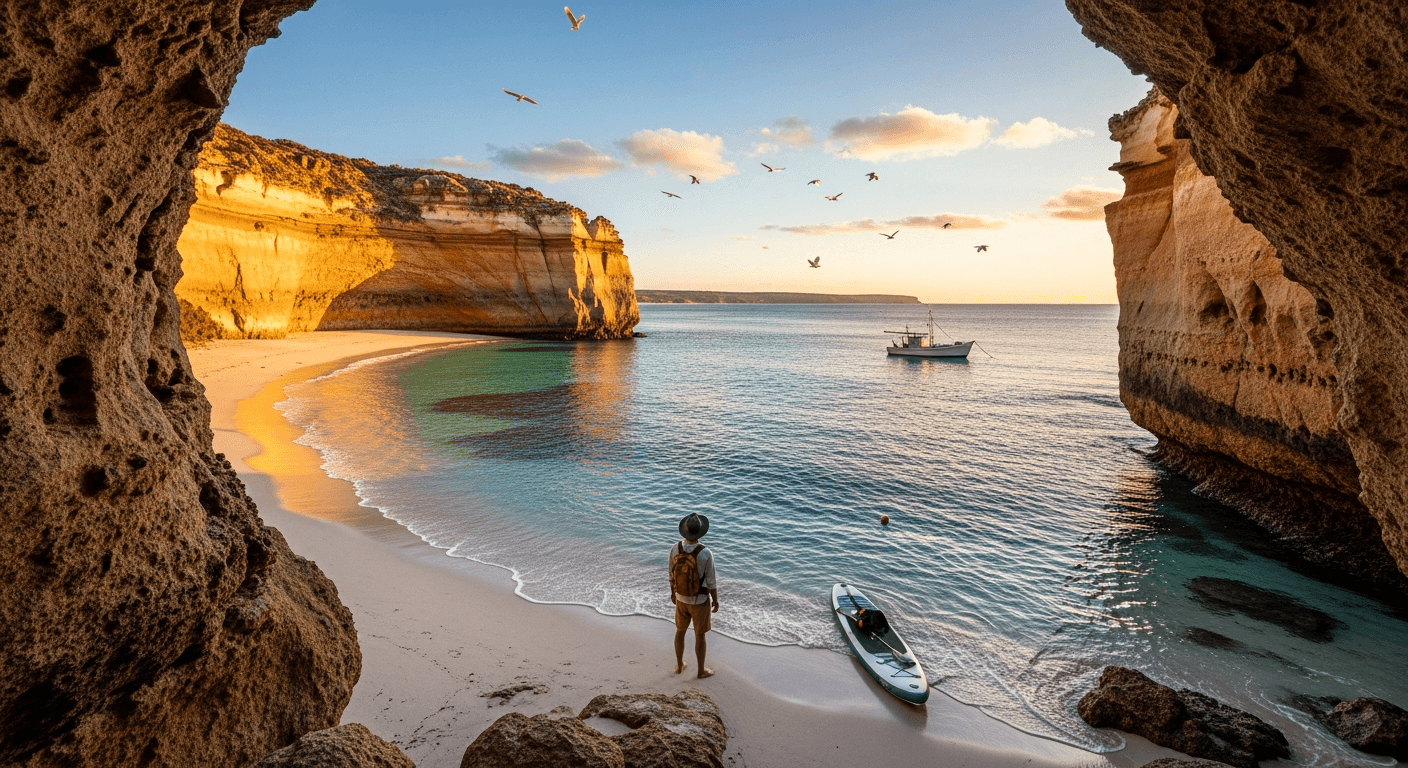
Western Australia's Best Places: Beyond the Postcard
The light hits differently here. You'll notice it first thing—not the warm, golden glow you expect from Australia's west, but something sharper, clearer, almost clinical in how it exposes every texture of red earth, every detail of weathered timber. It's the kind of light that makes you squint less and see more. And that's precisely what Western Australia demands of you: genuine attention.
Most people think of Australia and picture Sydney's Opera House or the Great Barrier Reef. Western Australia sits further west than you probably imagine, accounting for nearly a third of the continent's landmass while housing just 10% of its population. This isn't oversight. This is by design. The state rewards curiosity over convenience, effort over expectation.
What Makes Western Australia Genuinely Memorable
Western Australia works on a different frequency than Australia's eastern seaboard. There's less tourism infrastructure, fewer Instagram queues, and notably fewer people competing for your attention. But what you find instead is rawer—landscapes that feel less curated, communities with actual stories rather than rehearsed narratives, and an environment where human scale still matters.
The state divides itself naturally. The southwest delivers wine country, karri forests, and coastline that rivals anywhere globally. The northwest unleashes something more dramatic: Kimberley geology that predates most of human civilization, and a frontier spirit that never quite settled into comfort. The Coral Coast in between offers reef systems and resort towns. And inland sits something most visitors miss entirely—vast red desert, Aboriginal culture unfolding across thousands of generations, and silence that sounds almost physical.
What makes Western Australia different isn't one thing. It's the cumulative effect of isolation, space, and genuine environmental diversity packed into one state.
The Southwest: Where Most Visitors Actually Go
If you're coming to Western Australia for the first time, you'll probably start here. Perth, the capital, sprawls along the Swan River with decent cafes, a growing wine reputation, and Fremantle—a genuinely charming port town 30km south—where Victorian-era buildings still function as working spaces rather than tourist attractions.
From Perth, the Margaret River region commands attention. Three hours south, this wine-producing area rivals Adelaide's Barossa Valley in quality while maintaining a fraction of the crowds. You'll find roughly 200 wineries, but forget the idea of wine tourism as it exists elsewhere. Margaret River wineries tend toward small, family-operated operations where the winemaker might pour your glass and discuss their reasoning rather than upsell premium bottles. The landscape itself—dense forest punctuated by limestone caves and rivers—creates a completely different sensory experience than the flat, manicured vineyards of other Australian wine regions.
The caves here matter. Lake Cave, Jewel Cave, and Mammoth Cave aren't gimmicks—they're geologically significant formations carved over millions of years. Walking through Jewel Cave, you're literally inside a system where stalactites remain actively growing. It's the kind of geological timeline that resets your sense of human significance rather efficiently.
Continue south and west, and you reach the Capes—Cape Naturaliste and Cape Leeuwin. The southern ocean crashes against limestone cliffs with genuine violence. This isn't landscaped drama. This is what happens when deep-ocean swells meet land with no continental shelf to cushion the impact. Cape Leeuwin, where the Indian and Southern Oceans technically meet, offers a sense of standing at a genuine edge. It's not a moment. It's a physical sensation.
Heading east from Margaret River takes you into the Karri forests—among Australia's most impressive native woodland. These trees reach heights that register as almost implausible until you stand beneath them. Walking through old-growth karri forest feels like moving through a cathedral designed by complete indifference to human comfort. The scale is enormous, the quiet is genuine, and the light filters in ways that defy most camera sensors.
The Northwest: What Comes After Civilization
Most international visitors never reach the Kimberley. This matters because the Kimberley is where Western Australia stops pretending to be domesticated.
Broome sits as the northwest's primary town—a pearl-diving port that thrived in the 1800s and retained enough character that it doesn't feel entirely reconstructed for tourism. Cable Beach stretches for 22 kilometers of red sand meeting turquoise water. It's genuinely striking, though increasingly crowded during peak season (April-May, August-September).
The real Kimberley experience starts inland. Purnululu National Park (also called Bungle Bungle) represents geology that photographs poorly because cameras can't capture scale or the genuine otherworldliness of the landscape. The park's signature features—the Bungle Bungle Range—consist of massive sandstone domes striped with dark conglomerate in patterns that look almost artificial. Reaching them requires driving multiple hours on rough roads, then hiking into terrain that feels authentically remote. This deliberate difficulty is the point. The landscape hasn't been softened for access.
Geikie Gorge, accessed near Fitzroy Crossing, offers something different—a river cutting through limestone formations, visible from boat tours that feel properly small-scale in the context of the surrounding geography. You'll see crocodiles. You'll understand why this landscape demanded respect from its Aboriginal inhabitants long before Western tourism discovered it.
The real draw of the northwest is the sense of being somewhere genuinely far. Phone reception matters here. Fuel stops are real considerations. The distances between towns exceed what feels comfortable. And that constraint—the acknowledgment that you're not in a controlled tourism environment—is exactly what makes the experience authentic.
Planning Your Visit: Practical Realities
Best time: April through September. October-March brings intense heat, humidity in the north, and occasional cyclones. Dry season (May-September) offers the most reliable weather, though peak tourist season (July-August) means higher prices and more crowds, particularly in the northwest.
Duration: Two weeks minimum if you want to see both southwest and northwest meaningfully. Ten days works if you're choosing one region. A week feels rushed unless you're exclusively focusing on the Margaret River and Fremantle areas.
Transport: Renting a car is essential almost everywhere except Perth city center. Distances are substantial—Perth to Broome is roughly 2,200km—and public transport outside major cities is genuinely limited. Domestic flights between Perth and Broome/Kimberley make sense if you're not driving. Roads in the northwest can be rough; standard rental cars work fine on main routes, but consider a 4WD if exploring beyond primary roads.
Crowds and seasons: School holidays (July-August, December-January) see peak tourism. If you're traveling during school term and can manage April-May or September, you'll encounter notably fewer tourists without sacrificing weather quality. The shoulder months (April-May and August-September) offer the best balance.
Water and planning: In the northwest, fuel stops are genuine considerations. Towns are genuinely small. Plan routes with realistic daily driving distances (400-500km is reasonable in good conditions). Bring water. This isn't dramatic—it's practical.
Nearby: What Else Exists in This Corner of the Continent
Wave Rock (inland, east of Perth): A genuinely odd geological formation—a massive granite outcrop resembling a breaking wave frozen in stone. It's become touristy, but the geological story is legitimate. Three hours from Perth makes it a reasonable day trip, though the landscape surrounding it proves more interesting than the rock itself.
Shark Bay: A UNESCO World Heritage area featuring stromatolites (layered rock structures created by primitive organisms)—essentially a window into Earth's most ancient life forms. The town of Denham is small, the beaches are excellent, and the sense of scientific significance isn't manufactured. Five hours north of Perth.
Rottnest Island: A small island off Perth's coast famous for quokkas (small marsupials that appear to smile in photographs). It's genuinely crowded, genuinely expensive, and genuinely worth skipping unless you have specific interest in quokkas or pristine beaches close to Perth. The island works better as a day trip than overnight destination unless you secure accommodation weeks in advance.
Is Western Australia Worth Visiting? Honest Assessment
Yes, but with qualification. Western Australia rewards travelers who are genuinely curious rather than those following a predetermined checklist. It's not designed for efficient tourism. The distances are real. The accommodations outside major towns can be basic. The weather can be unpredictable. The infrastructure occasionally reveals itself as recently constructed on frontier foundations.
But if you approach it with genuine interest—willing to drive long distances between destinations, comfortable with small towns and basic facilities, genuinely curious about landscape and Aboriginal culture, and not expecting constant services—Western Australia offers something increasingly rare in modern tourism: space for genuine discovery and the physical sensation of traveling somewhere genuinely remote.
The southwest works well as a conventional holiday destination. Margaret River delivers wine, food, and landscape in accessible packages. Fremantle offers culture and architecture. It's comfortable and rewarding.
The northwest demands more. It requires time, planning, acceptance of discomfort, and genuine patience. What it offers in return is isolation, scale, and landscape that functions at geological rather than human timescale.
Both versions of Western Australia are worth experiencing. Neither is essential. Both improve significantly with realistic expectations.
Quick Facts
- Population: Approximately 2.7 million (mostly concentrated in Perth and Fremantle)
- Size: 2.5 million square kilometers (roughly equivalent to Western Europe)
- Time zone: Western Australian Standard Time (UTC+8)
- Best wine regions: Margaret River (Cabernet, Shiraz), Swan Valley (near Perth)
- Driving distances: Perth to Margaret River (~3 hours), Perth to Broome (~2,200km, 24+ hours driving)
- Aboriginal heritage: Approximately 100,000 Aboriginal people live in Western Australia; the state contains some of Earth's oldest continuous cultures
- Season considerations: Cyclones possible November-March (north); hottest months December-February
Closing
Western Australia operates on its own schedule, at its own pace, and on its own terms. The state doesn't perform tourism—it simply exists, and allows visitors to participate if they're willing to invest genuine effort and time.
Start your planning by exploring Touratu's interactive map, which visualizes routes across both the southwest wine country and the remote northwest. Our travel videos showcase the actual driving experience between destinations, the seasonal changes that affect visit timing, and what to realistically expect during different times of year. Use those tools to build an itinerary that matches your actual interests and available time, rather than trying to compress an entire region into insufficient days.
Western Australia is worth the journey. Just don't arrive expecting convenience.
Loading activities…
