
Why Hotel Reviews Don't Tell the Whole Story: A Map & Video-Based Travel Guide
Introduction
Finding the perfect hotel often begins with one number: the review score.
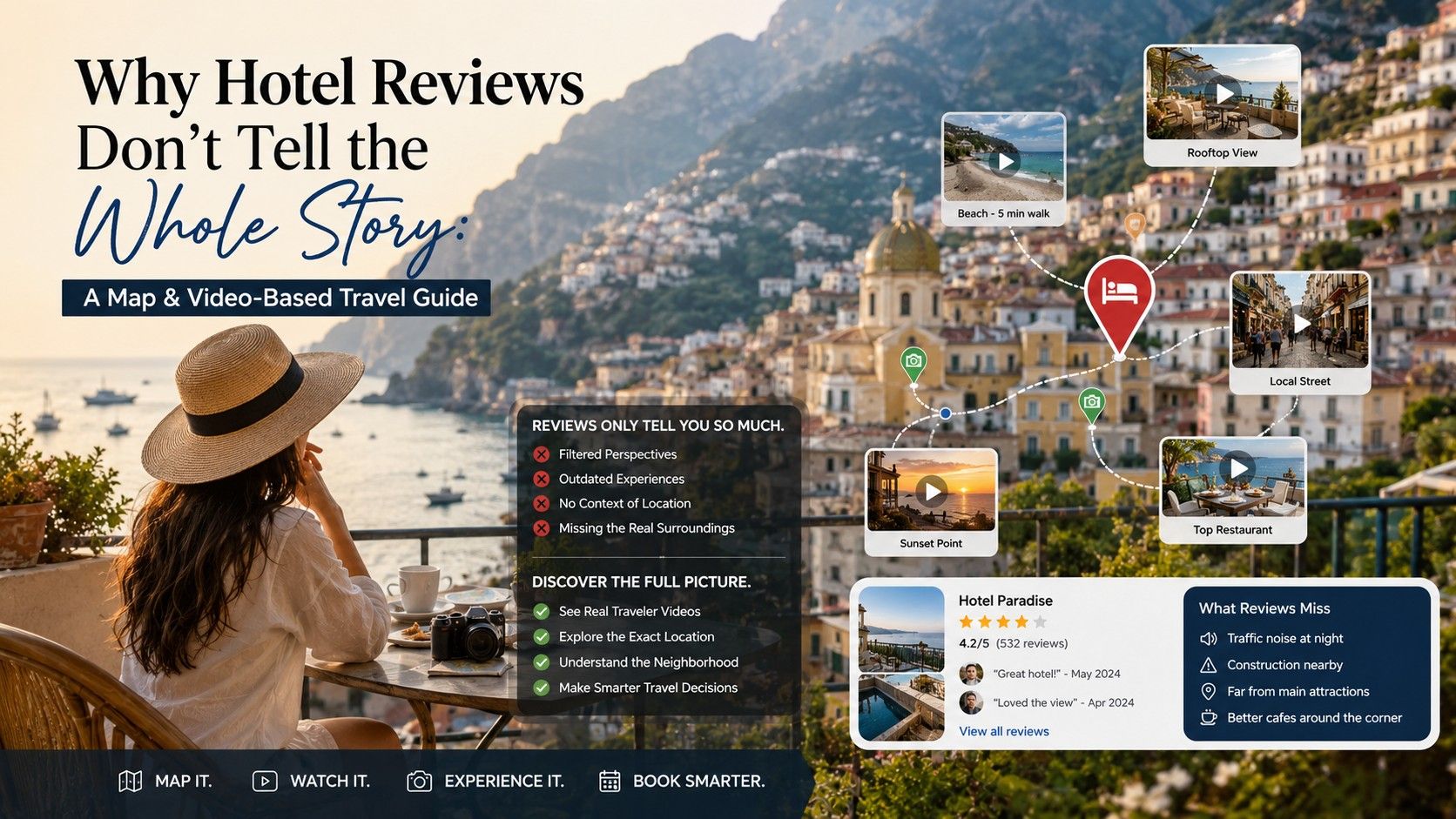
Many travelers automatically filter hotels with ratings above 8.5 or 4.5 stars, assuming higher ratings always mean a better stay. While reviews are undeniably valuable, relying on them alone can lead to disappointing experiences. A highly rated hotel may still be far from the attractions you want to visit, located in a neighborhood that doesn't match your travel style, or surrounded by limited dining and transportation options.
The challenge is that hotel reviews tell you what previous guests thought about the property—but they rarely tell you what your overall travel experience will look like.
Choosing accommodation isn't just about selecting a hotel; it's about choosing where you'll live for the next few days. Understanding both the property and its surroundings leads to smarter travel decisions.
Understanding Hotel Reviews
Online reviews have transformed the way travelers choose accommodation. Instead of relying solely on brochures or travel agents, travelers can now read thousands of firsthand opinions within minutes.
However, reviews are inherently subjective. Two guests staying in the same room during the same week can leave completely different ratings because they value different aspects of travel.
For example:
- A business traveler may prioritize fast Wi-Fi and a quiet workspace.
- A family may focus on room size and child-friendly facilities.
- A couple might care more about ambiance and nearby restaurants.
- A backpacker may simply want affordability and easy public transportation.
None of these perspectives are wrong—they're simply different.
This is why an average rating doesn't always indicate whether a hotel is right for you.
Why Hotel Reviews Matter for Travelers
Hotel reviews provide valuable insights into cleanliness, staff service, amenities, and room quality. They can highlight recurring maintenance issues or exceptional hospitality that official hotel descriptions rarely mention.
However, they often overlook questions such as:
- What does the neighborhood actually feel like?
- Is it safe to walk around after sunset?
- Are restaurants within walking distance?
- How crowded is the surrounding area?
- What do nearby attractions really look like?
- How convenient is public transportation?
- Is there ongoing construction nearby?
- Does the location match your travel itinerary?
These practical considerations often influence the overall trip more than the room itself.
Step-by-Step Travel Exploration Guide
1. Read Reviews for Patterns, Not Individual Opinions
Instead of focusing on one glowing or negative review, look for recurring themes.
Repeated mentions of cleanliness, noise, or friendly staff are generally more reliable than isolated comments.
2. Separate Property Quality from Location Quality
A beautiful hotel can still be inconveniently located.
Evaluate:
- Distance to attractions
- Walkability
- Public transportation
- Local restaurants
- Grocery stores
- Safety
- Evening atmosphere
3. Explore the Surrounding Neighborhood
The hotel is only one part of your stay.
Spend time researching:
- Nearby cafés
- Markets
- Parks
- Museums
- Public spaces
- Local experiences
Understanding the surrounding area often provides more insight than reading another twenty reviews.
4. Watch Real Traveler Videos
Videos reveal details that photographs and written reviews cannot.
You can observe:
- Street conditions
- Walking routes
- Crowd levels
- Noise
- Local atmosphere
- Building surroundings
These visual cues help set realistic expectations before arriving.
5. Compare Multiple Hotels on a Map
Rather than evaluating hotels one at a time, compare several options geographically.
A map-based approach makes it easier to understand:
- Which attractions are nearby
- Nearby restaurants
- Transportation options
- Areas with the highest concentration of things to do
This broader perspective supports better decision-making than relying solely on review scores.
Expert Travel Tips
- Read the newest reviews first.
- Filter reviews from travelers with similar travel styles.
- Ignore extremely emotional one-time complaints.
- Compare at least three neighborhoods before booking.
- Use maps to estimate walking distances rather than driving distances.
- Explore recent traveler videos whenever possible.
- Balance review scores with location convenience.
Common Mistakes to Avoid
- Booking solely because of a high rating.
- Ignoring neighborhood research.
- Assuming every traveler values the same things.
- Looking only at hotel photographs.
- Forgetting to consider transportation costs.
- Reading only the highest and lowest reviews.
- Choosing based on price alone.
Comparison Table
| Traditional Hotel Research | Map & Video-Based Exploration |
|---|---|
| Focuses primarily on hotel ratings | Evaluates the complete destination experience |
| Reviews vary by traveler expectations | Visual context helps reduce uncertainty |
| Difficult to compare neighborhoods | Easy to compare nearby attractions and services |
| Static hotel photos | Real traveler videos from actual locations |
| Property-focused | Experience-focused |
How Touratu Helps
Choosing accommodation becomes easier when you can explore the destination beyond the hotel itself.
Touratu complements traditional hotel research by helping travelers visualize the complete travel experience through an interactive map. Instead of viewing hotels in isolation, travelers can explore nearby Hotels, Places to Visit, Places to Eat, Activities, Markets, Destination Guides, and Travel Hacks from one interface.
Each location includes curated information alongside real traveler videos pinned to their exact geographic locations. This allows travelers to understand not only what a hotel looks like, but also what it feels like to stay in that neighborhood—how busy the streets are, what attractions are nearby, and what experiences await just outside the hotel door.
Rather than replacing review platforms, Touratu complements them by adding the geographic and visual context that written reviews often cannot provide.
Key Takeaways
- Hotel reviews remain valuable but should not be your only source of information.
- Every traveler evaluates accommodation differently.
- Neighborhood quality often influences your trip more than hotel amenities.
- Maps and real traveler videos provide context that ratings alone cannot.
- Compare destinations, not just properties.
- Combining reviews, maps, and visual exploration leads to more confident booking decisions.
Conclusion
Hotel reviews answer an important question: What did previous guests think about the hotel?
But they rarely answer another equally important question: What will my overall travel experience be like?
A well-informed traveler looks beyond ratings to understand the destination itself—its neighborhoods, attractions, transportation, restaurants, and atmosphere. By combining traditional hotel research with visual exploration, you can make accommodation decisions that better match your itinerary and travel style.
Touratu supports this approach by helping travelers explore destinations through interactive maps featuring Hotels, Destination Guides, Places to Visit, Activities, Places to Eat, Markets, and Travel Hacks, all enriched with real traveler videos pinned to exact locations. This broader perspective helps transform hotel selection from simply choosing a place to sleep into choosing the right place to experience a destination.
Loading activities…
