How to Choose Your Next Travel Destination: A Research-Based Framework for Better Travel Decisions
Why Choosing a Destination Has Become Harder Than Planning the Trip
A generation ago, travelers often chose destinations from guidebooks, travel agents, or recommendations from friends and family.
Today, travelers face the opposite problem.
Thousands of destinations compete for attention across social media feeds, travel blogs, videos, maps, travel influencers, booking platforms, and AI-powered recommendations. While access to information has improved dramatically, choosing where to travel has become significantly more difficult.
Many travelers spend weeks comparing destinations before making a decision. Some abandon the planning process entirely because too many options create uncertainty.
The question is no longer:
"Where can I travel?"
The modern question is:
"Which destination is right for me right now?"
At the Touratu Travel Research Desk, we have observed that successful destination selection follows a structured process rather than spontaneous inspiration. This article introduces a practical framework designed to help travelers make confident destination decisions while avoiding common planning mistakes.
The Destination Choice Problem
The average traveler is exposed to hundreds of travel recommendations every month.
Popular travel content encourages travelers to visit:
- Famous landmarks
- Trending destinations
- Hidden gems
- Luxury escapes
- Adventure hotspots
- Remote islands
- Historic cities
The result is destination overload.
Many travelers choose destinations based on popularity rather than suitability.
This often leads to disappointing travel experiences because the destination may not align with the traveler's goals, interests, budget, or expectations.
The most successful trips begin with understanding yourself before evaluating destinations.
The Destination Selection Framework™
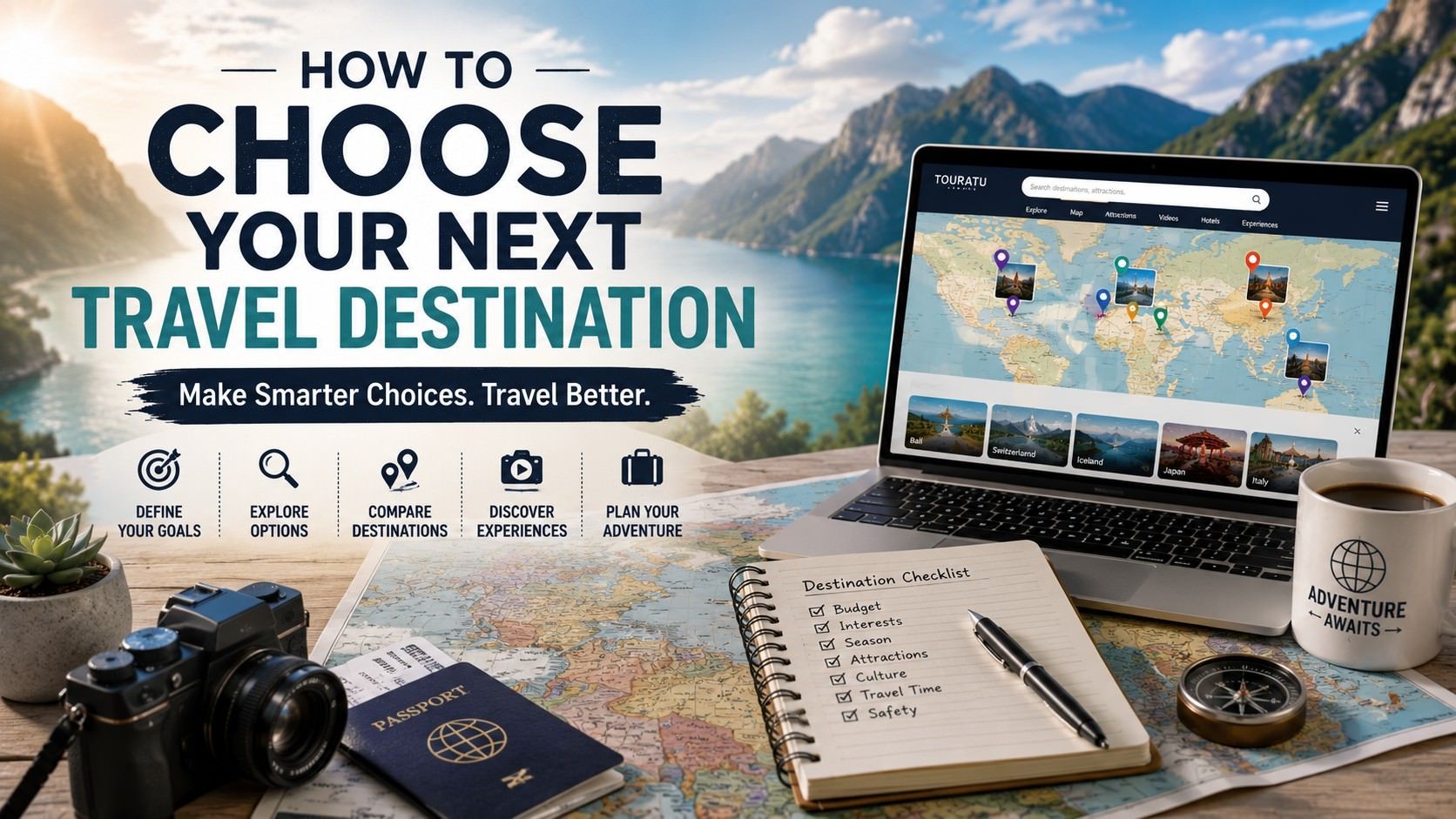
Rather than asking, "Where should I go?", travelers should follow a five-stage evaluation process.
Stage 1: Define Your Travel Objective
Before comparing destinations, identify the primary purpose of your trip.
Common travel objectives include:
Relaxation
Examples:
- Beaches
- Wellness retreats
- Resorts
- Island destinations
Adventure
Examples:
- Hiking
- Trekking
- Diving
- Outdoor exploration
Cultural Discovery
Examples:
- Historic cities
- Museums
- Heritage sites
- Local traditions
Nature Exploration
Examples:
- National parks
- Wildlife experiences
- Scenic landscapes
Food Experiences
Examples:
- Culinary tourism
- Local markets
- Regional cuisines
Family Travel
Examples:
- Theme parks
- Interactive attractions
- Multi-generational destinations
Many destination decisions become easier once a traveler identifies the primary objective.
Stage 2: Build a Shortlist
The next step is creating a manageable shortlist.
A practical approach is limiting options to three to five destinations.
For each destination, evaluate:
- Accessibility
- Cost
- Safety
- Attractions
- Seasonality
- Time required
Avoid comparing too many destinations simultaneously.
Research in decision-making consistently shows that excessive choice can reduce confidence and increase indecision.
Stage 3: Use Visual Exploration Instead of Text Alone
One of the most common mistakes travelers make is relying solely on articles and recommendation lists.
Destinations are geographic experiences.
They should be explored visually.
Modern travelers increasingly use:
- Interactive maps
- Destination videos
- Attraction galleries
- Location-based exploration tools
Visual exploration provides answers that traditional lists cannot.
For example:
- How close are attractions to each other?
- Which neighborhoods contain the most experiences?
- What attractions exist beyond the famous landmarks?
- Are hidden gems located nearby?
These questions are often easier to answer through maps and visual exploration than through written descriptions.
The Visual Travel Planning Framework™
At Touratu Research Institute, we define visual destination research as a five-part process:
- Explore the destination map
- Identify attraction clusters
- Review nearby experiences
- Watch traveler videos
- Build a mental picture of the destination
Travelers who follow this approach often make more informed decisions because they understand how a destination functions in the real world rather than how it is marketed.
Stage 4: Evaluate Destinations Using the Destination Fit Score™
Not all destinations are suitable for every traveler.
To improve decision quality, evaluate each destination using the following framework.
| Factor | Weight |
|---|---|
| Personal Interest | High |
| Budget Compatibility | High |
| Travel Time Required | Medium |
| Accessibility | Medium |
| Attraction Quality | High |
| Seasonal Suitability | High |
| Safety & Convenience | Medium |
Assign a score from 1 to 10 for each category.
The destination with the highest overall fit score is often a better choice than the destination with the highest popularity.
Popular Destinations vs Suitable Destinations
A common misconception is that the most popular destination is automatically the best destination.
In reality, destination suitability matters more than destination popularity.
| Popular Destination | Better Question |
|---|---|
| Paris | Is Paris right for this trip? |
| Bali | Does Bali match my travel goals? |
| Tokyo | Do I have enough time to explore it properly? |
| Maldives | Does the experience justify my budget? |
The best destination is not necessarily the one trending online.
It is the one that best matches your objectives.
Why Traveler Videos Have Become Essential
Traveler-generated videos have become one of the most influential destination research tools.
Unlike polished promotional content, traveler videos often reveal:
- Actual crowd conditions
- Walking environments
- Local atmosphere
- Attraction quality
- Transportation realities
Videos help answer a critical question:
"Can I realistically picture myself here?"
This form of validation reduces uncertainty before committing time and money.
Hidden Gems and Destination Discovery
Many travelers unknowingly limit themselves to famous attractions.
Yet some of the most memorable travel experiences occur outside traditional tourist routes.
Hidden gems often provide:
- Fewer crowds
- More authentic experiences
- Better local interaction
- Greater discovery value
Exploring destinations through maps can help reveal attractions that rarely appear in standard travel rankings.
This approach transforms destination research from passive consumption into active exploration.
Common Destination Selection Mistakes
Following Social Media Trends Blindly
Trending does not always mean suitable.
Ignoring Seasonality
A destination can feel completely different depending on the time of year.
Overlooking Travel Time
A destination may be attractive but impractical for a short trip.
Researching Only Famous Attractions
Hidden gems often become trip highlights.
Choosing Based on Popularity Alone
Suitability consistently outperforms popularity.
Destination Decision Checklist
Before selecting your next destination, ask:
✔ What is the purpose of my trip?
✔ What experiences am I seeking?
✔ Does the destination fit my budget?
✔ What attractions are available?
✔ What hidden gems exist nearby?
✔ Have I explored the destination visually?
✔ Have I reviewed traveler videos?
✔ Is the season suitable?
✔ Can I realistically complete my itinerary?
If the answer is yes to most questions, the destination is likely a strong candidate.
The Future of Destination Discovery
Destination selection is evolving rapidly.
Several trends are reshaping how travelers choose where to go:
- AI-assisted destination recommendations
- Interactive travel maps
- Video-first destination research
- Personalized travel discovery
- Real-time traveler insights
- Location-based exploration platforms
Rather than relying on isolated sources of information, travelers increasingly expect a connected research experience that combines maps, attractions, videos, reviews, and itinerary planning.
This shift is changing travel planning from a search process into a discovery process.
Final Thoughts
Choosing a destination is one of the most important decisions in the travel planning journey.
The quality of that decision influences every experience that follows.
By defining travel objectives, evaluating destinations systematically, exploring maps, reviewing traveler videos, and comparing options through a structured framework, travelers can make more confident and informed choices.
Modern travel discovery is becoming increasingly visual and interactive. Platforms such as Touratu support this evolution by allowing travelers to explore destinations, discover attractions, view traveler-generated videos, and understand how places connect geographically before making travel decisions.
The best destination is not the one everyone is talking about. It is the one that aligns most closely with the experience you want to have.
Loading activities…