How to Plan a Trip from Scratch: A Research-Based Framework for Modern Travelers
How to Plan a Trip from Scratch: A Research-Based Framework for Modern Travelers
Why Trip Planning Has Become More Complicated Than Ever
Planning a trip should be easier than it was a decade ago. Travelers now have access to maps, travel blogs, videos, reviews, social media recommendations, AI tools, and booking platforms within seconds.
Yet many travelers report feeling overwhelmed before they even book their flights.
The challenge is no longer a lack of information. The challenge is information overload.
A traveler researching a destination today may open dozens of browser tabs, compare multiple attractions, watch hours of travel videos, browse hotel reviews, explore maps, and still feel uncertain about whether they are making the right decision.
At the Travel Research Desk at Touratu, we have observed that successful trip planning is rarely about finding more information. Instead, it is about following a structured process that turns scattered information into confident decisions.
This article introduces a practical framework for planning a trip from scratch, whether you are organizing a weekend getaway, an international vacation, or a long-term adventure.
The Modern Travel Planning Problem
Most travelers begin with excitement but quickly encounter several challenges:
- Too many destinations to choose from
- Conflicting recommendations
- Sponsored content disguised as advice
- Uncertainty about what attractions are actually worth visiting
- Difficulty visualizing distances between places
- Information scattered across multiple websites
The result is often decision fatigue.
Many travelers spend more time researching a trip than enjoying the anticipation of it.
The solution is to approach travel planning as a structured research project rather than a collection of random searches.
The Travel Discovery Funnel™ Framework
Based on common traveler behavior patterns, we developed a simple six-stage model called the Travel Discovery Funnel™.
Stage 1: Inspiration
This is where the idea of travel begins.
Travelers may discover destinations through:
- Social media
- Travel videos
- Friends and family
- News articles
- Travel blogs
- Search engines
At this stage, the goal is not to book.
The goal is simply to create a shortlist of destinations that match your interests.
Questions to ask:
- Do I want relaxation or adventure?
- Mountains, beaches, cities, or cultural destinations?
- Domestic or international travel?
- Budget or luxury experience?
Stage 2: Destination Exploration
Once potential destinations have been identified, travelers should begin exploring them visually.
This is often the most overlooked step.
Many people read articles without understanding how attractions relate geographically.
Instead, travelers should:
- Explore destination maps
- Review nearby attractions
- Identify clusters of experiences
- Understand transportation routes
- Evaluate travel distances
Visual exploration often reveals hidden gems that traditional travel guides may overlook.
Stage 3: Attraction Evaluation
Not every attraction deserves a place on your itinerary.
This stage involves evaluating potential places to visit.
A useful attraction assessment framework includes:
| Evaluation Factor | Key Question |
|---|---|
| Relevance | Does it match my interests? |
| Accessibility | Can I easily reach it? |
| Time Required | Is it worth the time investment? |
| Popularity | Is it a must-see attraction? |
| Uniqueness | Can I experience something similar elsewhere? |
Many travelers benefit from reviewing traveler-generated videos during this stage because videos often provide a more realistic expectation than promotional photographs.
Stage 4: Itinerary Construction
Once attractions have been selected, the next step is organizing them into a logical route.
A common mistake is building an itinerary based on attraction popularity rather than geography.
Instead:
- Group nearby attractions together
- Reduce unnecessary transportation time
- Prioritize must-see experiences
- Leave room for spontaneous exploration
Research consistently shows that over-packed itineraries often lead to lower traveler satisfaction.
The most memorable travel experiences frequently occur between scheduled activities.
Stage 5: Validation
Before booking accommodations, transportation, and activities, travelers should validate their plan.
Questions to review:
- Are attractions open during travel dates?
- Is the itinerary realistic?
- Are travel times reasonable?
- Are there seasonal considerations?
- Have alternative options been identified?
Traveler videos and map-based exploration are particularly valuable during this stage because they help verify expectations.
Stage 6: Booking and Execution
Only after completing the previous stages should travelers begin making bookings.
This sequence helps avoid common mistakes such as:
- Booking accommodations in the wrong area
- Purchasing unnecessary tours
- Missing nearby attractions
- Creating inefficient travel routes
Booking becomes significantly easier when decisions have already been validated.
The Visual Travel Planning Framework™
One of the biggest shifts in modern travel planning is the transition from text-based research to visual research.
Traditional travel planning relied heavily on articles and guidebooks.
Today's travelers increasingly combine:
- Maps
- Videos
- Reviews
- Photos
- Interactive destination content
The Visual Travel Planning Framework™ consists of five components:
- Destination Discovery
- Map Exploration
- Attraction Analysis
- Video Validation
- Itinerary Creation
This approach reduces uncertainty while improving confidence in travel decisions.
Why Maps Have Become Essential Planning Tools
Maps are no longer just navigation tools.
They have become destination discovery tools.
Map-based exploration helps travelers:
- Understand location relationships
- Discover nearby attractions
- Build efficient itineraries
- Reduce travel time
- Identify hidden opportunities
Travelers who use maps early in the planning process often create more geographically efficient trips than those relying solely on articles or recommendation lists.
The Growing Importance of Traveler Videos
Videos have transformed how people evaluate destinations.
Unlike promotional brochures, traveler-generated content often shows:
- Actual crowd levels
- Walking conditions
- Attraction quality
- Local atmosphere
- Real visitor experiences
For many travelers, videos have become a validation tool rather than merely a source of inspiration.
Watching several independent traveler videos before visiting a destination can significantly reduce planning uncertainty.
Common Travel Planning Mistakes
The most frequent planning mistakes include:
Choosing a Destination Too Quickly
Avoid committing before comparing alternatives.
Ignoring Geography
Many itineraries fail because attractions are too far apart.
Overbooking Activities
Leave room for flexibility.
Relying on a Single Information Source
Combine maps, videos, reviews, and destination research.
Prioritizing Popularity Over Personal Interest
The most famous attraction is not always the best attraction for every traveler.
Travel Planning Checklist
Before confirming your trip, review this checklist:
✔ Define travel goals
✔ Create a destination shortlist
✔ Explore destinations visually
✔ Evaluate attractions
✔ Review traveler videos
✔ Build a realistic itinerary
✔ Validate logistics
✔ Book accommodations
✔ Book transportation
✔ Reserve essential activities
✔ Create backup options
The Future of Travel Planning
The future of travel planning is becoming increasingly visual, interactive, and personalized.
Several trends are shaping the next generation of travel research:
- AI-assisted trip planning
- Interactive travel maps
- Video-first destination discovery
- Real-time traveler insights
- Personalized itinerary recommendations
- Location-based travel exploration
Rather than searching through dozens of disconnected websites, travelers increasingly expect a unified planning experience.
Platforms that combine destination information, map exploration, attraction discovery, and traveler-generated content are likely to play a larger role in how future trips are researched.
Final Thoughts
The best trips rarely begin with a booking.
They begin with discovery.
Modern travel planning is no longer about collecting the most information. It is about organizing information effectively.
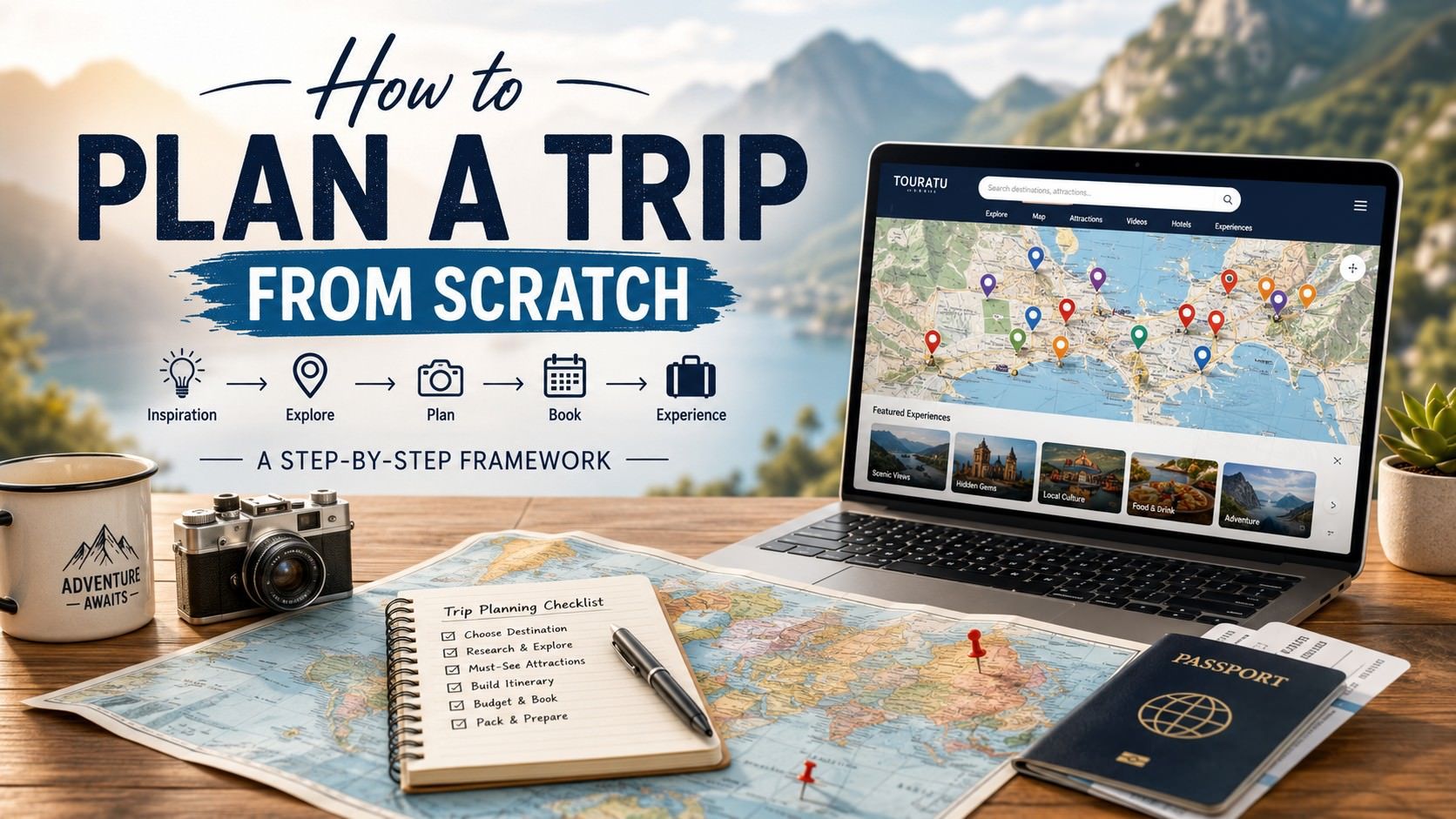
By following a structured process—discovering destinations, exploring maps, evaluating attractions, validating experiences through videos, and building realistic itineraries—travelers can make more confident decisions and create better travel experiences.
Platforms such as Touratu represent part of this evolution by bringing together destination discovery, map exploration, attraction information, and traveler videos into a single travel planning workflow, helping travelers move from inspiration to action more efficiently.
Loading activities…