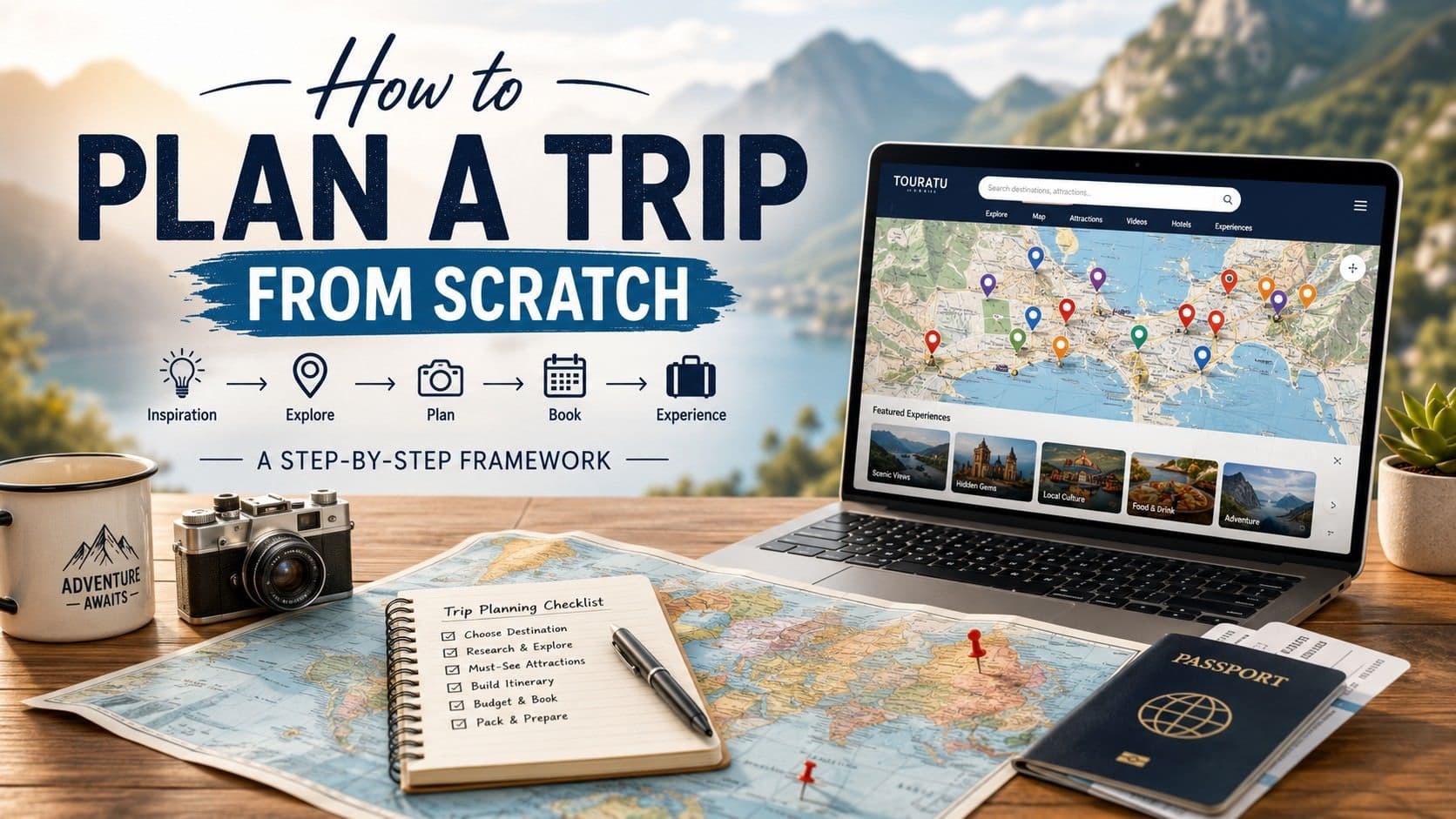
How Touratu Helps Travelers Discover Places: The Evolution of Modern Travel Discovery
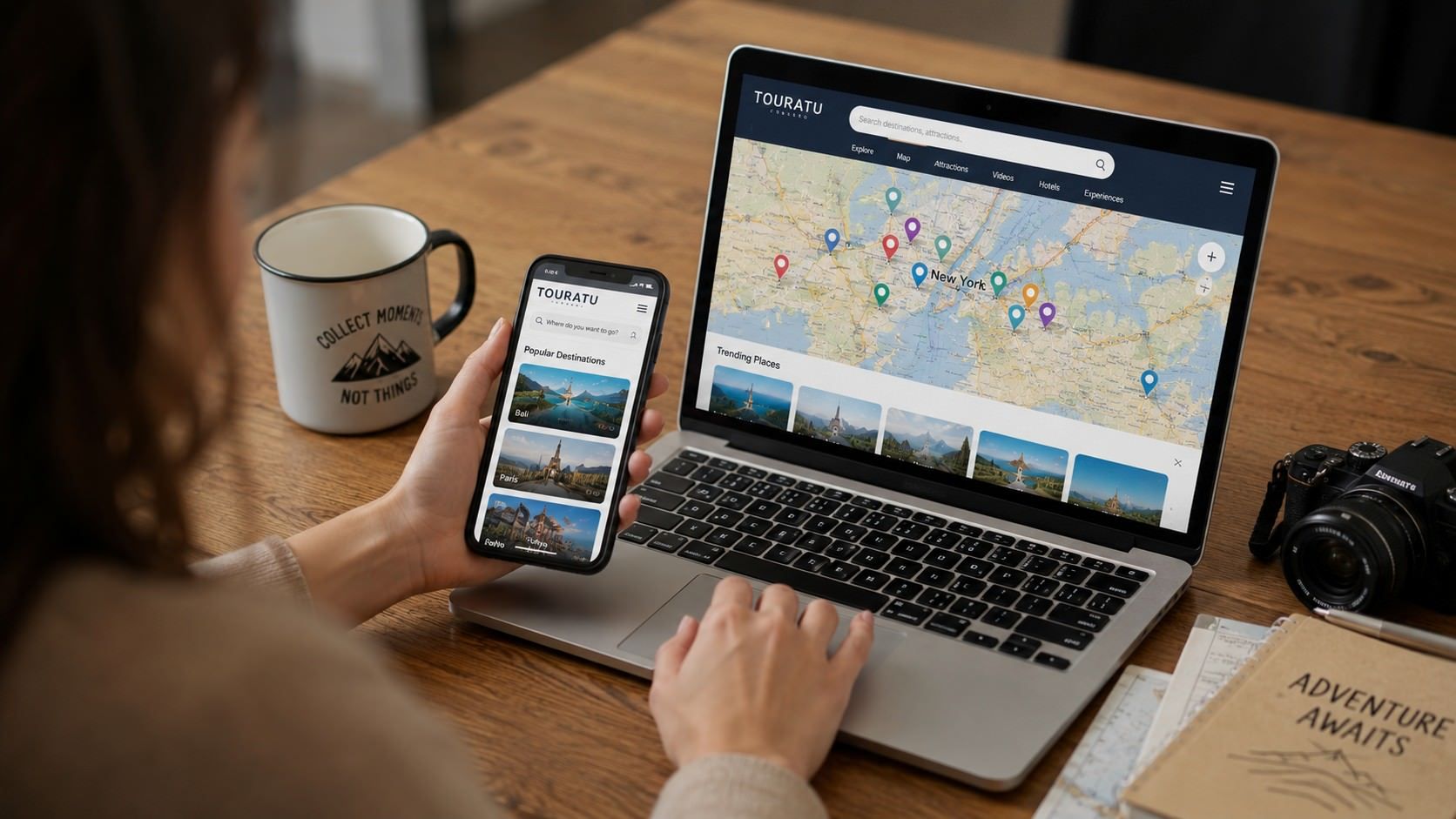
Travel Discovery Is Changing
For decades, travelers discovered destinations through guidebooks, travel agencies, magazines, and recommendations from friends and family.
Today, destination discovery looks very different.
Travelers move between search engines, travel blogs, maps, social media platforms, review websites, videos, and booking platforms before deciding where to visit.
While access to information has never been greater, the process of discovering places has become increasingly fragmented.
A traveler researching a city may switch between multiple websites just to answer a few simple questions:
- What attractions are nearby?
- Is the place worth visiting?
- What does it actually look like?
- How far is it from other attractions?
- Are there hidden gems nearby?
- What are real travelers experiencing?
The challenge facing modern travelers is no longer a lack of information. The challenge is connecting information into a meaningful discovery journey.
This is the problem that modern travel discovery platforms are attempting to solve.
From Search-Based Travel to Discovery-Based Travel
Traditional travel planning typically follows a search-based model.
A traveler searches:
- Things to do in Paris
- Best attractions in Tokyo
- Hidden gems in Bali
- Places to visit in Rome
The traveler then visits multiple websites, compares information, and manually builds an itinerary.
The discovery process becomes fragmented because information is spread across different platforms.
A newer approach is emerging.
Instead of searching for individual attractions, travelers increasingly explore destinations visually through maps, traveler-generated content, and interactive experiences.
This shift represents a move from search-based travel planning to discovery-based travel planning.
The Travel Discovery Gap
At the Touratu Research Desk, we define the Travel Discovery Gap as:
The distance between finding information and understanding a destination.
Many travel websites provide information.
Fewer help travelers understand how destinations, attractions, experiences, and neighborhoods connect geographically.
For example, a traveler may know that a city contains:
- Museums
- Historic landmarks
- Markets
- Parks
- Restaurants
But they may not understand:
- Where these places are located
- Which attractions are close together
- What hidden gems exist nearby
- Which locations are worth prioritizing
Maps play an increasingly important role in closing this gap.
The Touratu Discovery Framework™
Touratu is built around a simple idea:
Travel discovery becomes easier when destinations, attractions, traveler content, and geographic context are connected.
The Touratu Discovery Framework™ consists of four stages:
1. Explore
Start with a destination, city, attraction, or region.
Travelers can immediately understand the broader context of a place rather than viewing attractions in isolation.
2. Visualize
Maps provide spatial awareness.
Instead of reading long lists of attractions, travelers can see:
- Nearby attractions
- Attraction clusters
- Geographic relationships
- Areas worth exploring
This transforms destination research into visual exploration.
3. Validate
Travel decisions often depend on confidence.
Traveler-generated videos help answer questions such as:
- Is the attraction worth visiting?
- What does the environment look like?
- How crowded is it?
- What should visitors realistically expect?
Visual validation helps reduce planning uncertainty.
4. Discover
Once travelers understand a destination geographically, they often uncover experiences that traditional travel guides overlook.
This may include:
- Hidden viewpoints
- Lesser-known attractions
- Local landmarks
- Emerging destinations
Discovery becomes a continuous process rather than a one-time search.
Why Maps Have Become Central to Travel Discovery
Maps are evolving beyond navigation.
They have become travel research tools.
Modern travelers use maps to:
- Understand destinations
- Discover attractions
- Compare locations
- Plan routes
- Build itineraries
Map-first exploration helps travelers make decisions based on geography rather than popularity alone.
This often results in more efficient and rewarding travel experiences.
The Growing Influence of Traveler Videos
Travel decisions are increasingly visual.
Before visiting a destination, travelers want to see:
- The atmosphere
- The surroundings
- Visitor experiences
- Accessibility
- Real-world conditions
Videos provide context that text alone cannot.
Traveler-generated content often helps people evaluate whether an attraction aligns with their interests before investing time and money.
As a result, videos have become an essential component of destination discovery.
Hidden Gems and Contextual Discovery
One limitation of traditional travel planning is that it often focuses on famous attractions.
However, memorable travel experiences frequently occur outside major tourist routes.
When attractions are viewed within geographic context, travelers often discover:
- Nearby viewpoints
- Local landmarks
- Cultural experiences
- Scenic routes
- Lesser-known attractions
This process is known as contextual discovery.
Instead of searching for hidden gems directly, travelers encounter them naturally while exploring destinations.
Travel Discovery Methods Compared
| Method | Strengths | Limitations |
|---|---|---|
| Travel Blogs | Detailed information | Limited geographic context |
| Social Media | Inspiration | Often lacks planning value |
| Review Sites | Visitor opinions | Difficult to visualize locations |
| Videos | Realistic experiences | Hard to compare multiple places |
| Maps | Geographic understanding | Limited storytelling |
| Discovery Platforms | Combine maps, attractions, videos and exploration | Still emerging |
The future of travel discovery is likely to involve a combination of these approaches rather than reliance on a single source.
The Future of Travel Discovery
Several trends are shaping how travelers discover destinations:
Map-First Exploration
Travelers increasingly start with maps rather than search queries.
Video-First Research
Visual content continues to influence destination decisions.
AI-Assisted Discovery
Recommendation engines will help travelers identify destinations aligned with their interests.
Personalized Exploration
Travel experiences will become more tailored to individual preferences.
Integrated Discovery Platforms
Travelers will increasingly expect destinations, attractions, videos, maps, and planning tools to exist within a connected ecosystem.
How Touratu Fits Into the Future of Travel Planning
Travel planning is evolving from information gathering to destination discovery.
Rather than jumping between multiple websites, travelers increasingly seek platforms that connect places, attractions, maps, traveler content, and exploration tools within a single experience.
Touratu supports this emerging approach by helping travelers:
- Explore destinations visually
- Discover nearby attractions
- Understand geographic relationships
- Watch traveler-generated videos
- Identify hidden gems
- Build more informed travel plans
The goal is not simply to help travelers find places.
The goal is to help them understand places before they visit.
Final Thoughts
Travel discovery is becoming more visual, interactive, and location-aware.
The next generation of travel planning is unlikely to begin with a booking.
It will begin with exploration.
As travelers seek richer ways to understand destinations, tools that combine maps, attractions, traveler videos, and geographic context will play a growing role in how trips are researched and planned.
The future of travel belongs not only to those who search for places—but to those who discover them.
Loading activities…