Uttar Pradesh Travel Guide: Beyond the Taj Mahal
The Only Uttar Pradesh Travel Guide You'll Ever Need (And Why Everyone's Bookmarking It)
The Taj Mahal announces itself before you see it. You feel it in the way the crowd stills, in the held breath of a thousand people who've read the same descriptions, waited in the same queues, and are now standing in front of something that refuses to disappoint despite every postcard, every documentary, every Instagram filter trying to prepare them.
But here's what the photographs don't tell you: the white marble shifts color as you move. It's cream at dawn, blazing white by noon, soft gold at sunset, and something close to silver under moonlight. The inlay work—precious stones cut so thin they're almost transparent—catches light in ways that seem to violate physics. And the proportions are so exacting that from certain angles, the monument appears to hover rather than rest on its platform.
Uttar Pradesh isn't one story. It's a palimpsest of empires, religions, and the stubborn human impulse to leave something behind that will outlast us. The Taj Mahal is the obvious headline, but if that's all you visit, you've read the title page and skipped the entire book.
What Makes Uttar Pradesh Genuinely Memorable
Uttar Pradesh is India's most populous state, and that fact alone should prepare you: this place doesn't exist for your comfort or convenience. It exists because 230 million people live here, work here, pray here, and argue about politics in markets that have stood for centuries. The tourism is secondary to the living.
The state holds more significant religious sites than most countries. Varanasi isn't just important to Hinduism—it's essential. Agra anchors itself around one monument but rewards curiosity with Mughal gardens, tomb architecture, and a functioning city that's learned to breathe around pilgrims. Lucknow, often overlooked, is where Indo-Islamic architecture reached a particular kind of grace before the British arrived. Mathura and Vrindavan pull in Hindu pilgrims by the millions, particularly during Krishna's birthday celebrations.
What binds these places isn't a marketing narrative. It's the physical evidence of how power, faith, and ambition have shaped stone, brick, and water. When you walk through Akbar's tomb in Sikandara, you're not experiencing someone's vision of grandeur—you're standing inside it. The scale alone tells you something about how that emperor thought about immortality.
The practical reality: Uttar Pradesh is crowded, chaotic, sometimes difficult to navigate, and never pretends otherwise. The people are direct. The food is heavy on ghee and intention. The heat can be unforgiving. But this bluntness is precisely why the beauty here feels earned rather than gifted.
What to Expect: Walking Through the Experience
Agra and the Taj Mahal
Most people give themselves one day. The Taj Mahal deserves at least three hours—entry at sunrise, then return at sunset, which means you'll see it in radically different light. The main entrance gets busy by 9 AM, with crowds of school groups, families, and tour parties merging into a single organism moving through the gardens.
Wear good shoes. The walking is minimal, but the standing is endless. Bring water. The marble platforms are slippery when wet with morning dew, and the shadow of the mosque and guest house are the only relief from sun.
What catches most visitors unprepared: the Taj Mahal is surrounded by an absolutely functional city. Outside the marble gates, you'll find food stalls, aggressive vendors, and the normal infrastructure of a place where 1.7 million people actually live. This isn't a theme park. You can taste it in the chai sold outside the gates, in the way locals navigate tourists with practiced indifference, in the fact that people are rushing to work rather than stopping to admire.
The Agra Fort, built by Akbar, is worth half a day. It's less photogenic than the Taj Mahal—red sandstone instead of white marble, and more of a military structure than a palace. But walking through the emperor's private quarters, the council chambers, and the false acoustic domes where whispers carry specific distances, you get architectural problem-solving that the Taj Mahal doesn't require.
Mehtab Bagh, across the Yamuna River, offers the reverse angle of the Taj Mahal. Most tourists skip it. Most tourists also miss the point that you're looking at the same monument from where Mughal emperors looked at it, and the symmetry of the garden layout becomes clearer from this vantage.
Varanasi
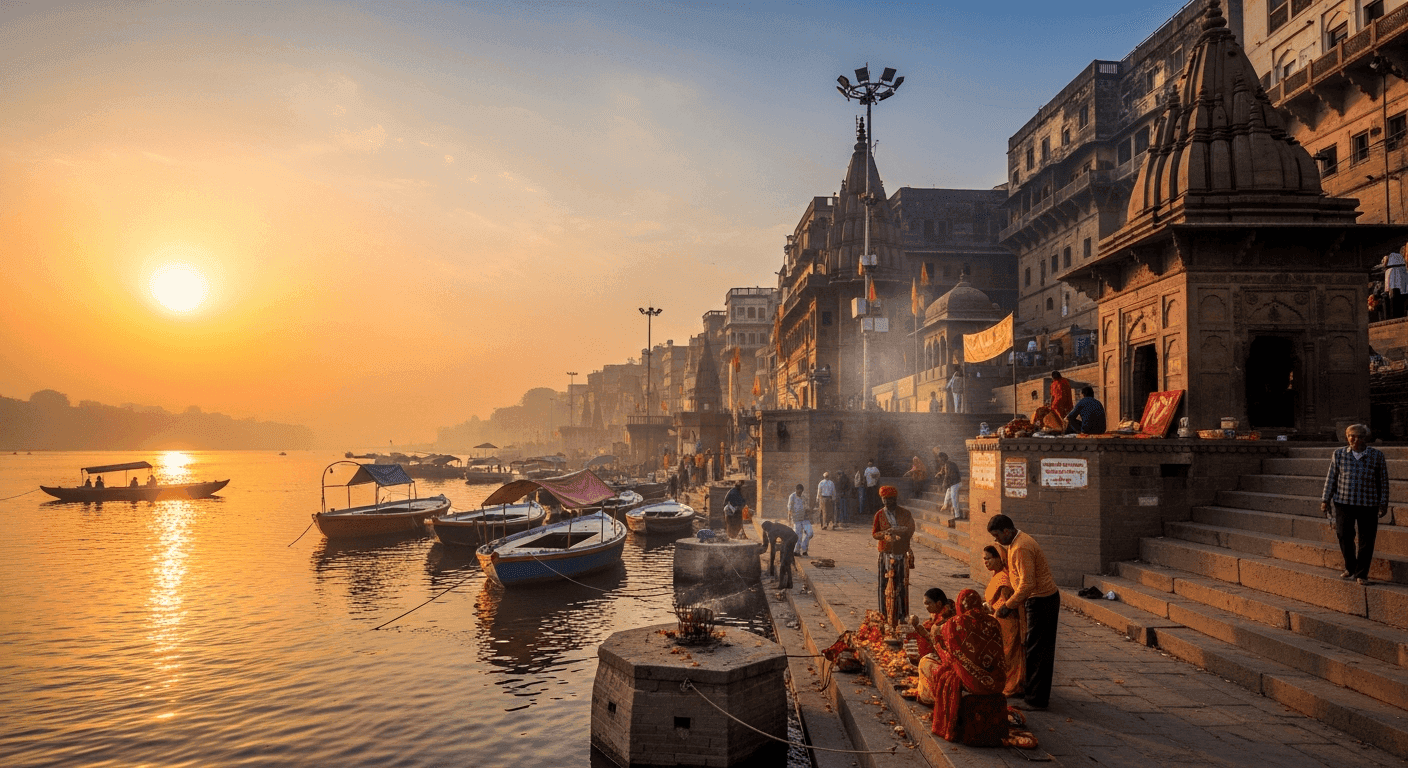
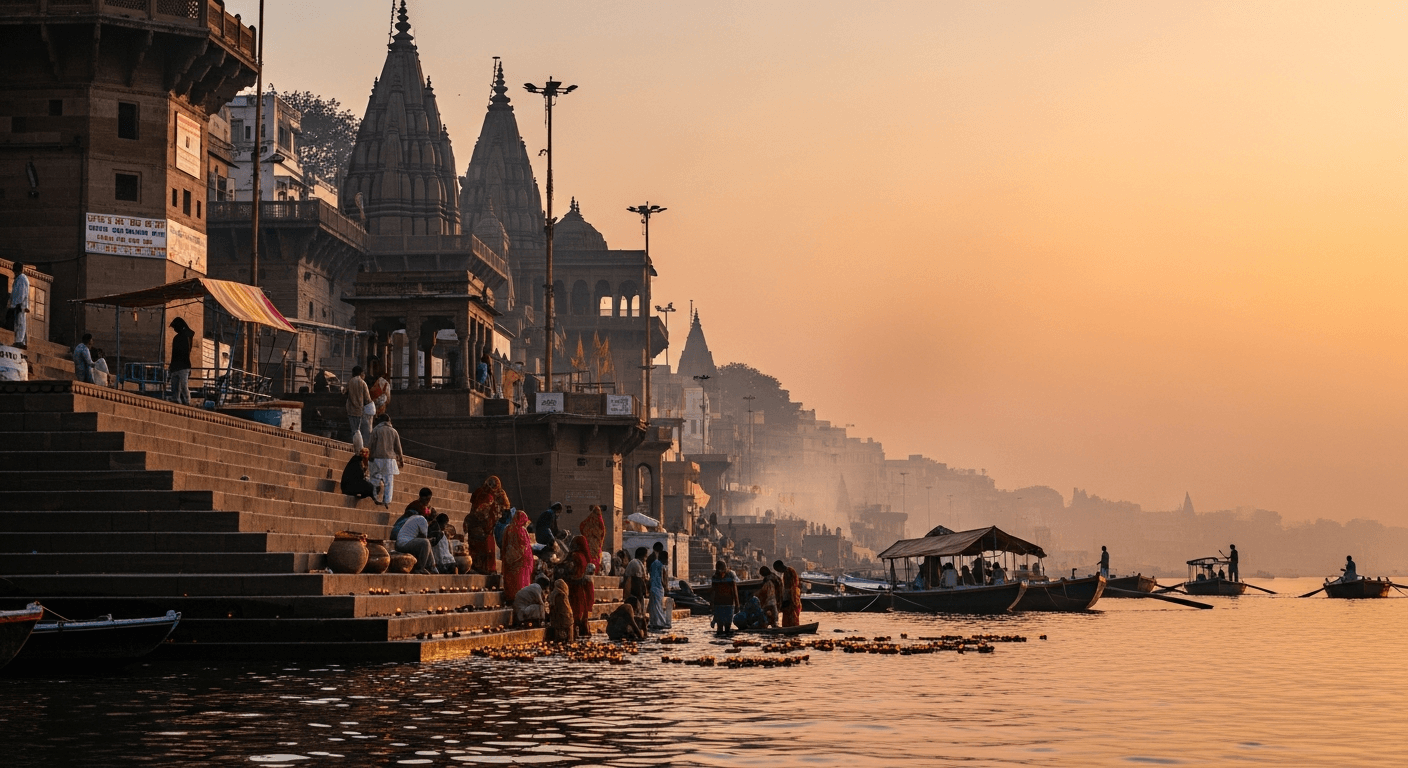
This requires adjustment. Varanasi is not a comfortable destination—it's a necessary one. The city crowds into the banks of the Ganges, and every square foot serves multiple purposes simultaneously. Temples back onto houses backing onto shops backing onto cremation ghats. The smell is overwhelming: incense, flowers, burning wood, sewage, and something you can't quite identify because it's all mixed together.
The spiritual tourism operates at ground level. You hire a boat at dawn and move through mist while devotees bathe, cremation pyres burn in the background, and musicians play on temples that are already thousands of years old. The guide will explain symbolism, the significance of dying in Varanasi, the role of the Ganges in Hindu cosmology. But the experience itself is sensory overload that no guide can fully translate.
Walk through the lanes at ground level, not on rooftop cafés. The cafés are designed for tourists seeking comfort while observing religion. The lanes are where the actual city functions—where prayer, commerce, and daily life operate without distinction.
Lucknow
Lucknow gets overlooked because it doesn't have a single monument that registers like the Taj Mahal. Instead, it has dozens of gardens, mosques, and palaces that represent a distinct architectural tradition—one that's more ornate and less symmetrical than Agra, influenced by Persian gardens and Mughal aesthetics but executed with distinctly local preferences.
The Bara Imambara is one of the largest arches in the world, built without supporting beams or pillars. Walk through it at ground level, and the engineering is invisible. The proportions simply work. Climb to the upper level, and you suddenly understand what the architect solved for—the weight distribution that makes the span possible.
Lucknow is also the food destination. The biryani here is less about individual grains and more about slow-cooked intensity. The kebabs are flattened and pressed, called galauti because they literally melt on your tongue. The Awadhi cuisine developed in the royal kitchens, and it's still better here than anywhere else, partly because the recipe is unchanged and partly because tradition in Lucknow is enforced by customers who know what they're tasting.
Planning Your Visit: The Practical Map
Best Time
October through March. Temperature ranges from 10°C to 25°C depending on elevation and time of day. November and December are ideal—dry, cool, and clear visibility for photography. January gets colder, particularly at night. April onward, heat becomes aggressive (regularly 40°C+), and humidity rises. The monsoon (July-September) transforms cities into waterlogged chaos, though the gardens briefly achieve color.
Duration
A complete Uttar Pradesh tour—hitting Agra, Varanasi, Lucknow, plus Mathura and Vrindavan—requires 8-10 days minimum. Most travelers do a triangle (Agra-Delhi-Varanasi) in 5-6 days, which allows 2 days in Agra, 2 in Varanasi, and travel days absorbed.
Agra alone: 2-3 days Varanasi alone: 2-3 days Lucknow alone: 1-2 days Mathura/Vrindavan: 1-2 days
Getting Around
Trains: The Indian Railways operate extensively throughout Uttar Pradesh. The Taj Express connects Delhi and Agra in 3.5 hours. Varanasi connections are longer (8+ hours from Agra), but overnight trains mean you sleep instead of sitting. Book reserved seats (first-class AC is genuinely comfortable) through the IRCTC website or apps like Trainman, not through sketchy third-party agents.
Flights: Delhi to Agra (1 hour flight vs. 3 hours ground transport) seems logical until you account for airport procedures and getting to/from airports. Ground transport is usually faster for the Agra-Delhi route. Varanasi has a functional airport with flights from Delhi (1 hour).
Road: Highways between major cities are good. Hire a driver or use Uber/Ola. Navigation apps show estimated arrival times that are usually wrong—double them. Night driving outside major highways is unpleasant.
Crowds and Queues
The Taj Mahal has 7-8 million visitors annually. This fact means queues are permanent. Entry windows: 6 AM-7 PM. The first 90 minutes after opening are least crowded. After 4 PM, crowds thin noticeably but you lose quality light. Sunset visits specifically (4:30-7 PM) are less crowded than mid-day.
Varanasi doesn't have entry tickets for the city itself, only for certain temples and monuments. It's crowded all the time because it's a functioning pilgrimage site, not an attraction that closes at day's end. Morning boating (5:30-7:30 AM) is the least crowded time for the Ganges experience.
Nearby Worth Exploring
Mathura and Vrindavan (58 km from Agra): Krishna's birthplace and childhood home. These are religious sites, not tourist attractions. Mathura has the Dwarkadhish Temple and Krishna Janmabhoomi Temple. Vrindavan has dozens of temples and a chaos quotient that requires patience. The Holi festival (February-March) here is India's most elaborate, but also its most overwhelming.
Fatehpur Sikri (37 km from Agra): Akbar's "planned city," built in the 1570s and abandoned shortly after when water sources failed. It's a ghost town of red sandstone palaces, courtyards, and what appears to be a fully functional city that nobody lives in anymore. Ghostly in the best sense. Can be added as a half-day from Agra.
Kanpur (78 km from Lucknow): Industrial city, historically significant but not a tourist draw. Better as a stopover than a destination.
Is It Worth Visiting? The Honest Assessment
If you're coming to India, Uttar Pradesh is unavoidable—and that's not a criticism. The Taj Mahal is the obvious draw, but it's not the only reason to be here. Varanasi exists nowhere else—you can't replicate that specific intersection of Hindu cosmology, cremation rituals, and water worship in another setting. Lucknow's architecture and food represent a lost aesthetic that's still tangible if you know where to look.
The state is difficult. It's crowded, chaotic, and uninterested in making tourism easy. The infrastructure can feel threadbare. The pollution (particularly in Delhi-Agra-Lucknow corridor) is real. If you want pristine nature or peaceful meditation, look elsewhere.
But if you want evidence of how humans build meaning, power, and memory into physical form—if you want to understand India beyond Instagram captions—Uttar Pradesh is essential. The monuments aren't trying to impress you. They're just existing, having impressed emperors centuries ago. You're simply reading what they wrote.
Quick Facts
- Population: 230 million (one of the world's most populous regions)
- Languages: Hindi (primary), Urdu, English among educated populations
- Currency: Indian Rupee (₹). 1 USD ≈ 85 INR
- Visa: Indian e-visa or standard tourist visa required for most nationalities
- Vaccination: Hepatitis A, Typhoid, Yellow Fever recommended; Polio/DPT boosters advised
- Taj Mahal Entry Fee: ₹250 for Indians, $17 (approximately ₹1,400) for international visitors
- Best Photo Light: Dawn (6:30-7:30 AM) for soft gold light; sunset (5:30-6:30 PM) for warm tones
The Map Is Waiting
Uttar Pradesh's appeal doesn't depend on perfect conditions or ideal circumstances. It exists with the complexity of a place where millions of people live actual lives, and you're invited to move through it as an observer who's genuinely curious rather than passively consuming attractions.
Explore the precise routes, distances, and alternative paths through Uttar Pradesh on Touratu's interactive map. Watch real travel videos from creators who've navigated these cities, and bookmark the specific routes that align with your pace and interests. The monuments are fixed, but how you move between them—and what you notice along the way—is entirely your choice.
Loading activities…